These songs epitomise ‘romance’.
Cole Porter wrote ‘Dream Dancing’ and ‘So Near And Yet So Far’ for musical comedy You’ll Never Get Rich (1941), the Fred Astaire/Rita Hayworth vehicle that made Hayworth stratospherically famous. In its film context, ‘Dream Dancing’ is a blink-and-you’d-miss-it instrumental backdrop to a dinner dance attended by the protagonists. ‘So Near And Yet So Far’ is a killer showpiece rhumba danced by the two, with vocals from Astaire, presented as if in dress rehearsal towards the film’s finale extravaganza.
Within both songs, the object of desire is a fantasy: thrilling, distant, unreachable.
‘Dream Dancing’ narrates a person meeting their lover again in the reverie of sleep. Its interpretive possibilities are numerous. In Marlene VerPlanck’s lively and increasingly agitated version, sleep promises agonising separation. By contrast, this witty live performance by Mel Torme and George Shearing serves up unrequited passion, its melancholy becoming transmuted into frolicsome imaginary fun. Tony Bennett and Bill Evans’s stunning interpretation suggests the sadness of loss assuaged by dreams. Its aching optimism sets off the words of the verse: ‘When shades enfold / The sunset’s gold / And stars are bright above again / I smile, sweetheart / For then I know I can start / To live again, to love again.’
‘So Near And Yet So Far’ is more straightforwardly about someone playing hard to get.
Only a handful of artists have recorded it since 1941, largely sticking with the song’s original Latin feel. My favourite is Fred Astaire’s 1952 recording with Oscar Peterson, a more intimate, conversational rendition than his 1941 performance, relocating the verse and its dubious rhyme of ‘going native’ with ‘co-operative’ to mid-way through the song.
‘So Near And Yet So Far’ is an example of a latune, ‘a tune with a Latin beat and an English-language lyric’, a hybrid form keenly pursued by Cole Porter and many other popular songwriters during the twentieth century. In his fascinating history of the genre, Gustavo Perez Firmat contemplates its ambivalence:
Like Fred and Rita’s rhumba in You’ll Never Get Rich, this type of song is “so near” to and yet “so far” from indigenous Cuban music, for while the rhythm may transport us to Havana, the lyric strands us in the United States. […] Whether applied only to Cuba or to Latin America as a whole, atmospheric Latin Americanism is a mode of intimacy, a mechanism for cultural appropriation that, paradoxically, has the effect of keeping the appropriated object at a distance.
Rita Hayworth was herself a ‘Hollywood Latina’ of Spanish and Irish descent whose career was marked by an ‘evolution from dark-haired señorita to all-American strawberry blonde’. Priscilla Peña Ovalle interprets the self-possessed sexuality of Hayworth’s character in You’ll Never Get Rich in terms of this public transformation: ghosted by Hayworth’s perceived origins, the character is pitched to land ‘somewhere between virgin and siren’.
The plot of You’ll Never Get Rich is curious. The mutual admiration felt between choreographer Robert Curtis (Astaire) and dancer Sheila Winthrop (Hayworth) becomes a convoluted love story when Robert’s boss Martin Cortland (Robert Benchley) tries to hit on Sheila with a diamond bracelet – much to the chagrin of his wife Julia (Frieda Inescort), the theatre’s legal owner.


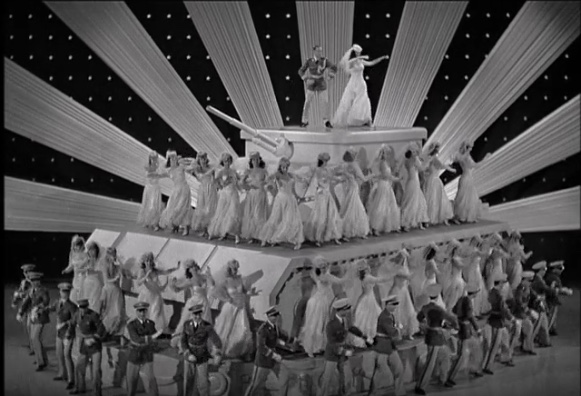
To ward off divorce, Robert agrees to pretend the gift was actually from him. Cue a sequence of misunderstandings consequent upon Martin’s catting around, compounded when Robert is conscripted and assigned to an army base overseen by Sheila’s boyfriend Captain Tom Barton (John Hubbard). Seeking to win her heart, Robert casts Sheila in a big show he is asked to stage for the troops, and egregiously commissions a real justice to marry them amidst a big theatrical wedding. Astonishingly, Robert’s deception ceases to be a problem for Sheila when another misunderstanding is cleared up. In the end he and Sheila are happily united.
Though these beautiful songs describe fantasy, the film in which they appear is an odd combination of escapism and pragmatism. Sheila has money, dances for fun rather than a wage, speaks her mind, expresses her desire, exploits her femininity when the occasion demands it. The war is not immediately threatening. Various characters take wearied jabs at the institution of marriage, yet a marital union is the film’s inevitable end, on the back of this extraordinary spectacle.
And for the most part, the key female characters – a shrewd and capable dancer, a wronged wife, a many-times-married aunt – are strong, economically independent and well able to see through the men’s idiotic ruses towards romantic seduction. With its layers of exoticism, the story is so near and yet so far from idealism and mystery.
 People Think This Is Romantic