13: Violets For Your Furs (1941)

This song is the epitome of shifting sands.

Matt Dennis and Thomas Adair wrote ‘Violets For Your Furs’ together in 1941. Appearing on The Rosemary Clooney Show in 1957, Dennis reminisced about the process:

Well this is probably the corniest songwriting story of all time, but my partner and I were sitting in the pub one snowy night back in New York and he was having a beef with the girl he was dating at the time. Sitting there just listening to a combo play the blues, and well, feeling kind of moody anyway, he came up with this song title. It sounded pretty good to me, so I just started working on the melody right there. Believe it or not he wrote the lyrics right on the tablecloth too, and before the evening was over we’d written ourselves this song.

The wintry context of its creation makes its way into Adair’s lyrics. A kind of theatre of memory, the song sketches out a scene between two lovers, nostalgically recalled by the song’s protagonist. As snow drifts down in the Manhattan streets, a man buys a posy of violets for his beloved’s fur coat, which has the enchanting effect of making the chilly situation seem like spring. The song concludes adorably: “You smiled at me so sweetly, since then one thought occurs / That we fell in love completely, the day that I bought you violets for your furs”.

On one level, it’s a simple story of a simpler time: men were chivalrous, women were graceful, furs were the height of sartorial elegance, and love was new. But even on its own terms, setting aside any questions that may or may not arise concerning ‘men’, ‘women’, courtship, and who can procure fresh flowers and furs in Manhattan at the tail end of the Great Depression, the song contains multitudes.

Tommy Dorsey and Frank Sinatra recorded it first in 1941, in an interpretation that conjures divine dinner dances, and the giddy euphoria of falling in love. The moment on the Manhattan street feels like it happened just last week, but also that it’s yet to come. Meanwhile, Sinatra’s sleigh bell-sprinkled 1956 rendition – whose seasonal phrasing is taken by Barry Manilow’s recording – seems to look back to a happy event many Christmasses ago. Johnny Hartman’s extraordinary performance – a tribute to John Coltrane’s – is heavy with deep disappointment. Shirley Horn’s sublime version aches with remembered longing. Beverly Kenney serves up bright and naive entitlement, with a tiny hint of rage: maybe this character didn’t get what they wanted in the end. Stacey Kent delivers a poignant reverie.

Alec Wilder and James T. Maher delight in the way ‘Violets For Your Furs’ “moves and does lovely inventive things”, comparing singer and composer Matt Dennis’s writings to Johnny Mercer’s, which each “suggest the presence of the performer in their composition”. It’s so rich. Its embrace of then and now, whenever these times are in the universe of a given interpretation and whatever has taken place in-between, is magic. Even still, it’s comparatively neglected as a standard, with recordings only in the double digits. No films seem to have taken it up, although it is fleetingly mentioned in a scene in the ninth episode of cancelled ABC drama Six Degrees (2006-2007).

Is that neglect to do with anti-fur politics, as this piano studio proprietor suggests?

(On that issue, this highly specialised quiz about animals = in the running for my most favourite weird internet thing.)
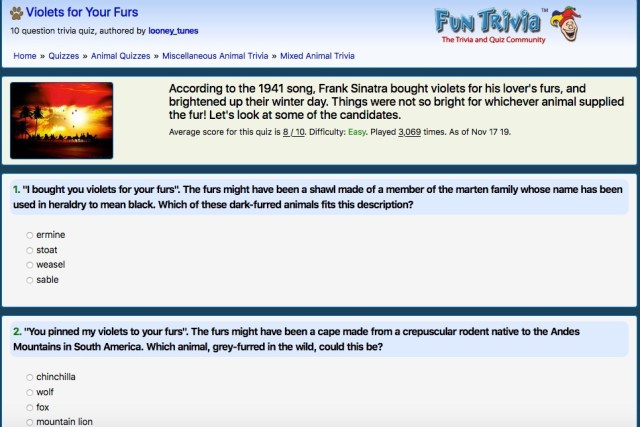
Violets For Your Furs

Or is it to do with the somewhat antiquated ritual it describes?

This 2003 sinatrafamily.com thread is started by a forum member who can’t ‘get’ the song, and thinks it’s ‘asinine’. Her contribution prompts a flurry of rebuttals from fellow posters fantasising trips down all kinds of real and imagined memory lanes, some lamenting the decline of civilisation as manifest in casual dress. A lengthy discourse on hats unfolds. Its kind and friendly online banter is a world away from the cultivated vitriol of the contemporary social industry.
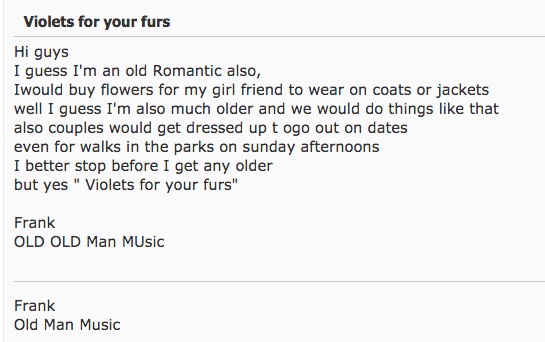
Violets Sinatra forum

These thoughts of animal rights, old school gallantry and polite conversation were front of mind as I wandered around the internet seeking out links to various versions of ‘Violets For Your Furs’. Seeing the cover art for Marty Paich’s I Get A Boot Out Of You (1959) took me aback.

Paich’s magnificently louche arrangement of ‘Violets For Your Furs’ on this album suggests lovers in smoky late night bars. The racy cover art is like a cutesified sexy and highly unsettling anticipation of the shower scene from Hitchcock’s Psycho (1960).

Similarly, Dave Brubeck’s Angel Eyes (1965) features a tremendous hard-swinging version of the song, and a glassy-eyed Terry Reno on its cover. Twenty or so years after ‘Violets For Your Furs’ was composed, second wave feminism was burgeoning, and at the same time beautiful girls stared out from a lot of cover art, in varying states of undress. (I’d call it Playboy-ification, but these album covers are ahead of the Playboy game.) Plus ça change, etc. Romantic love may be protean, and the gentle attentions of ‘Violets For Your Furs’ out of joint with the softcore objectifications of the 1960s. But the patriarchal structures that prop up ‘romance’ are doggedly persistent, for sure.

12: I Only Have Eyes For You (1934)

This song is a fantasy.

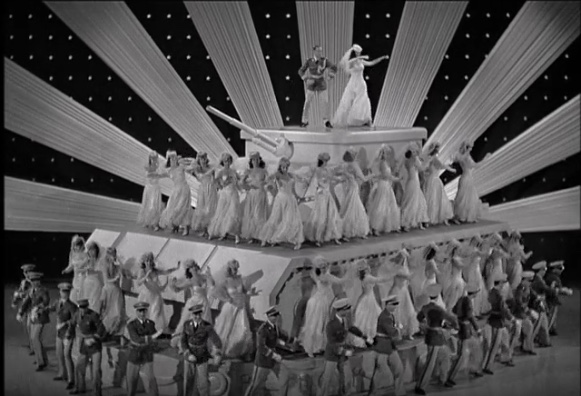
Harry Warren and Al Dubin wrote ‘I Only Have Eyes For You’ for the movie Dames (1934), a satire on theatrical censorship featuring Busby Berkeley’s choreography. In context, the song is a sweet serenade given by budding Broadway composer and impresario Jimmy (Dick Powell) to his dancer girlfriend Barbara (Ruby Keeler). Their love story is a slight vehicle for Dubin’s intense lyrics. But thematically the song suits the film – a comedy of errors about gazing at beautiful actresses.

‘I Only Have Eyes For You’ asks how somebody smitten sees the world. Or rather, what they see. As the (very infrequently performed) verse has it, love is selectively ‘blind’, an ‘optical illusion’. The choruses describe how, to a person in love, all things – stars, gardens, crowded avenues – confusedly ‘disappear from view’. This feat is performed cinematically in Dames, which magically vanishes people from the street and the subway as Jimmy croons to Barbara.

The song’s massive recording history kind of reflects this disappearing act. There are plenty of straight ahead interpretations by jazz greats – Louis Armstrong’s story of gentle flirtation, Frank Sinatra’s confident seducer, Billie Holiday’s effervescent party-goer, coquettish Carmen McRae. Mary Wells gives a big Motown rendition, while Etta Jones swings languidly, weaving in Billie Holiday’s invented lyric ‘big, bulging eyes’ towards the end. But the haunting doo-wop recording made by The Flamingos in 1959, exquisitely arranged by band member Terry Johnson, has influenced so many others that it almost comes to substitute for the original.

‘My love must be a kind of blind love’, it begins. ‘I can’t see anyone but you.’ Having collaged these two lines from the verse to the top, this version then unfolds the choruses. Its mesmerising sound suggests being underwater, at the top of a mountain, inside a cathedral of ice. But its defining aesthetic characteristic is the cold – which sort of makes sense of the really odd apres-ski mise-en-scene of The Flamingos’ TV performance in the clip above. According to the YouTube poster, that edition of The Dick Clark Show was shot in the sticky New York heights of July.

There are also plenty of recordings that are simple covers of The Flamingos’ version – from Boyz II Men’s to Tashaki Miyaki’s – while others, like Catherine Russell’s, draw momentarily on its variation of the melody. Liane Carroll’s fierce shuffle funk interpretation is absolutely stunning. Differently captivating is Oneohtrix Point Never’s hypnotic composition, which seems to bring an android into conversation with a sinister gang of monks.

For ‘I Only Have Eyes For You’, one of the finest episodes of Buffy the Vampire Slayer (1997-2003), The Flamingos’ version is pretext for and backdrop to its story.

The spirit of James Stanley, class of Sunnydale 1955, is stalking the school’s halls. He is compulsively re-enacting the night when, crazed with controlling grief, he shot teacher and ex-lover Grace Newman. Both spirits are possessing current students, caretakers and teachers, almost always resulting in a death. Buffy correctly and angrily surmises that he wants forgiveness, a recognition based on her own recent catastrophe: sex with her boyfriend Angel, which transformed him back into murderous vampire Angelus, who then promptly killed her watcher Giles’ beloved partner, teacher and Clan Kalderash member Jenny Calendar.

James calls Buffy to the school by night, where she finds Angelus lurking. They become surrogates in James and Grace’s unhappy story, which uncannily echoes their own.

https://www.youtube.com/watch?v=SM2eLr9nIsM

Following these events, Buffy, in shock, places the ethereal Flamingos’ record on a turntable, and gazes into a mirror, where she sees James’ reflection look back at her. But embodying Grace, Angelus’s vampiric undeadness allows both stories to be resolved. Instead of falling for the umpteenth time over the school’s balcony to her death, Grace/Angel returns, declaring love for James/Buffy and the shooting (sexual metaphor alert) an accident, releasing them both.

(Historical accuracy quibble: why not make James class of 1959? The answer is probably Back To The Future (1985). I mean, ok. But come on.)

In this phenomenal episode, ‘I Only Have Eyes For You’ means obsession, grief, not-seeing, the same scene playing out across different bodies. Though different in kind, it shares spooky parallels with the song’s appearances in Dames.

First, Jimmy serenades Barbara on the Staten Island ferry, the Statue of Liberty in the background. Couples coo around them. Love is heteronormative sequence and sameness.

Later, extending the scene of Jimmy’s flight of fancy on the subway train, in which ads bearing women’s faces blend into Barbara’s, Busby Berkeley’s spectacular choreography presents a proliferation of Barbaras, suggesting women as interchangeable commodities, everywhere different but the same. As Lucy Fischer brilliantly puts it, the doppelganger girls’ ‘aimless, repetitive movement‘ embodies a kind of ‘zombiism‘.

The end of the Buffy episode sets all these stagings of surrogacy off. Buffy tentatively ventures to Giles: ‘part of me just doesn’t understand why she would forgive him’. Her sideways look of guilt reveals that really she is asking why Giles would forgive her. Anthony Stewart Head’s delivery of Giles’ patient response ‘does it matter?’ is magnificent. Anger, pain and loss commingle and dissolve in his performance. The scene evokes a unique unconditional love, but equally, how different stories of love can bear a resemblance.

11: For All We Know (1934)

This song is now, then, and forever.

The recording history of J. Fred Coots and Sam M. Lewis’s ‘For All We Know’, written in 1934, begins merrily with a version by Hal Kemp and His Orchestra, sung by Bob Allen. Its optimistic trills and honeyed vocals belie the song’s depths.

On the surface, ‘For All We Know’ is about a tentative encounter between two people, about to part on an enchanted night. One person speaks to the other of the fleeting quality of the evening and what the future may or may not hold, pledging their heart and soliciting the other person’s love. When Coots first heard Lewis’s lyrics, he thought they were ‘worthy of great poetry’, and promptly promised him $200 of IOUs.

The verse, as performed by Billie Holiday, Aretha Franklin and Bette Midler, locks down the song’s story as one of romantic love (‘A kiss that is never tasted / Forever and ever is wasted’). (Susannah McCorkle and Gladys Knight’s alternative verse intros are variations on that theme.) But Lewis’s words in the choruses are nothing short of a meditation on human existence itself: the experience of love, loss, consciousness, and temporality.

For all we know
We may never meet again
Before you go
Make this moment sweet again

We won’t say ‘goodnight’
Until the last minute
I’ll hold out my hand
And my heart will be in it

For all we know
This may only be a dream
We come and go
Like a ripple on a stream

So love me tonight
Tomorrow was made for some
Tomorrow may never come
For all we know

My favourite versions as of now are by Brad Mehldau, Bill Evans and Jose James and Jef Neve, each one tender and devastating in its own way.

But given the sheer quantity of interpretations, many of them straight ahead – one even by Ken Dodd – it’s weird that the first one I ever heard, again and again, should have been Nina Simone’s radical 1958 reworking. As she put it to Steve Allen in 1964, she interpreted the song in ‘a hymn-Bach-like way’. In her arrangement, whose melody departs substantially from the original, the eighteenth and twentieth centuries touch: a reflection in performance of the lyrics’ attention to endurance and transience.

With Joan Plowright as an elderly widow and Rupert Friend as her surrogate grandson Ludo, Mrs Palfrey at the Claremont (2005) does much more with the song than simply include Rosemary Clooney’s version in the end credits. Endurance and transience pervade the film: Mrs Palfrey’s recent loss, her arrival in London to stay long-term at a mediocre hotel, her daughter and actual grandson’s neglect, and her accidental encounter with Ludo, which becomes a tender friendship.

The film is uneven and sometimes quite strange, but this scene is lovely. At Ludo’s flat, Mrs Palfrey has reminisced about falling in love with her husband, including a twinkling nod to their healthy sex life, and days out in Beaulieu. Ludo asks her another question, and an unexpected, touching serenade unfolds.

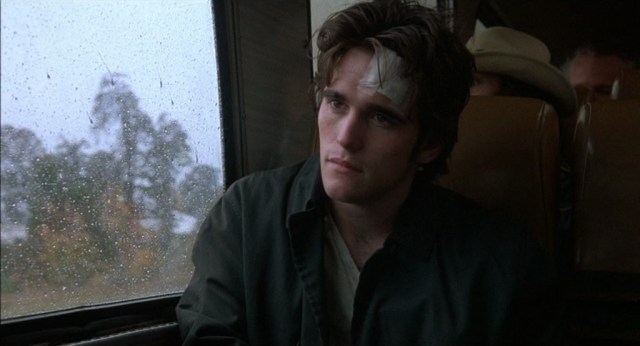
In Gus Van Sant’s Drugstore Cowboy (1989), set in 1971, Abbey Lincoln’s gut-wrenching interpretation is used repeatedly to speak of the dangerous tenacity of addiction – from the opening sequence, which introduces junkie Bob (Matt Dillon), sweating from a seeming overdose on an ambulance stretcher, to his earlier bus ride back to Portland to enter a methadone programme, to the film’s final moments, which return us to the ambulance.

The first ambulance scene, accompanied by the song, has an ironic, hallucinatory quality, compounded with a cut to a cinefilm of Bob with his crew of fellow addicts and thieves.

Later, Bob gazes silently through the misted, rain-spattered window of the bus at the agricultural landscape around.

Matt Dillon--Drugstore Cowboy

Adrenalised pharmacy and hospital heists, obsessive superstitions, and violence have given way to a more prosaic reality, which the film complicates with the lyric ‘For all we know / This may only be a dream’. ‘We come and we go / Like the ripples in a stream’ plays over shots of street drinkers gathered outside decrepit storefronts. ‘So love me tonight / Tomorrow was made for some / Tomorrow may never come / For all we know’ suggests both hope and desperation as Bob enters his new abode, the St Francis Hotel.

The last moments in the ambulance, as he struggles not with an overdose but a revenge gunshot injury from a dealer, make clear that Bob intends to abandon clock-time and production line work, and return to his life as a junkie. As Abbey Lincoln sings the song’s final choruses, contemplating the ebbs and flows of time and love, Bob explains.

It’s this fucking life. You never know what’s going to happen next. […] See, most people, they don’t know how they’re going to feel from one minute to the next. But a dope fiend has a pretty good idea. All you gotta do is look at the labels on the little bottles.

On his way to ‘the fattest pharmacy in town’, he wants to live. It’s an incredible use of the subtleties of this wonderful song, which can accommodate the paradox of hedonistic control as well as gentle acceptance of the future’s sadnesses and joys, which so quickly become the past.

10: Everything Happens To Me (1941)

This song is a primer in magical thinking.

Matt Dennis and Tom Adair wrote ‘Everything Happens To Me’ in 1941. Frank Sinatra’s winsome recording with Tommy Dorsey that same year made it a hit.

Surprisingly, despite the vividness of its story of chronic misfortune, there are far more instrumental than vocal versions. And no movie seems to have incorporated the song into its action.** Three films share its title – a 1938 comedy caper about a by-election in a seaside town starring vaudevillean Max Miller, a 2001 Spanish romantic comedy entitled Todo me pasa a mí adapted from a play, and a 2018 single-shot short about an actor’s terrible audition. Then there is Chissà perché… capitano tutte a me (1980), a supremely How Did This Get Madeable buddy cop drama which teams a preternaturally strong sheriff (Bud Spencer) with a gizmo-toting alien boy (Cary Guffey, of Close Encounters of the Third Kind fame). Its Anglicised title, Why Did You Pick On Me?, is the repeated refrain of the sheriff as the two of them get into scrapes. For exposure to its full range of battiness, including Mary Poppins-esque magical home improvements, Kraftwerk alien villains, and at least one hundred slapstick brawls, it can be seen in full here.

Lucky for my purposes then that the album cover of Chet Baker Sings: It Could Happen To You (1958), on which ‘Everything Happens To Me’ appears, is acutely cinematic. In his review piece about this album and Chet Baker as a cultural icon, John Bergstrom doesn’t love it:

Baker was cool, all right. But he exhibited none of the aggressive, chest-puffing, downright intimidating cool that went with most of the other big names of the day. His coolness was passive rather than active, accidental rather than inevitable, devoid of sexuality. Just look at the flat-out hokey cover art for It Could Happen To You. This guy isn’t dangerous. At least not yet.

Rollneck notwithstanding, Baker’s lupine gaze in that image feels pretty intense to me. It Could Happen To You as 1950s werewolf romcom: seemingly anodyne heartthrob lures unsuspecting dates and turns them; under the light of the waxing crescent moon, he meets his match in this laughing girl, who also happens to be a werewolf. I’d watch it.

Johnny Burke’s lyrics for ‘It Could Happen To You’ (1944) and Tom Adair’s for ‘Everything Happens To Me’ are two sides of the same narrative coin: the one, a story of the exhilarating terror of Cupid’s arrow, and the other, a melancholic account of perpetual adversity in life and love.

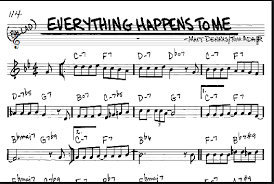
Everything Happens To Me

The verse – which Chet Baker’s performance excludes, and which is absent from the chart above – begins with superstitious high drama: “Black cats creep across my path until I’m almost mad / I must have roused the devil’s wrath, ’cause all my luck is bad”. (Ella Fitzgerald retains it; following a misleadingly jaunty introduction, so does Billie Holiday.) Dennis’s composition then modulates from minor to major, and Adair’s resigned tale of woe unfolds. Magic is replaced by a thoroughly modern kind of predestination: golf dates made will guarantee rain, card games played will engender inevitable defeat. The wordplay of the phrases “I guess I’ll go through life just catching colds and missing trains” and “I never miss a thing, I’ve had the measles and the mumps” suggest interminable negativity. And it’s always the protagonist’s own fault: “I guess I’m just a fool who never looks before he jumps / Everything happens to me”.

A love affair with the person to whom the song is addressed seemed briefly to present a solution to the “jinx”, but alas: “I’ve mortgaged all my castles in the air”. (I find this artful line really hard to get my head around. Dreams have crashed down to earth as crippling debts? To whom?) For the lost object of desire has cut ties with the hapless character altogether. Dealing with this unhappy turn, the penultimate couplet is legitimately funny: “I’ve telegraphed and phoned, sent an Air Mail Special, too / Your answer was ‘Goodbye’, and there was even postage due”.

The song concludes on a note of fatalism. “I fell in love just once and then it had to be with you / Everything happens to me”.

To be described as someone’s one and only true love, never to be replaced, is classic ‘romance’. But as the narrative plays itself out in Chet Baker’s delicate performance, the protagonist’s misery and self-reproach are all-encompassing and of long duration. The brilliance of the song is in its presentation of the failed love affair as the icing on the cake of this person’s beleaguered life: the mantra ‘everything happens to me’ hints at another, untold story of loss and disappointment.

**Update: actually there are four, a similar miscellany: romantic comedy Playing By Heart (1998) (“if romance is a mystery, there’s only one way to figure it out”), The Guard (2011) (“the FBI are about to discover that things work a little differently around here”), Dolphin Tale (2011) (“inspired by the amazing true story of Winter”), and Woody Allen’s A Rainy Day in New York (2019) (no tagline, but much controversy).

9: More Than You Know (1929)

This song disturbs.

In The Fabulous Baker Boys (1989), as novice vocalist Susie Diamond, Michelle Pfeiffer delivers a captivating performance of a section from ‘More Than You Know’. Former escort Susie has rocked up extremely late for an audition to join the struggling piano duo of Jack (Jeff Bridges) and Frank (Beau Bridges). Following a moment of antagonism with controlling jobsworth Frank, she casts a magic spell over the dilipidated piano showroom with an unexpectedly mesmerising rendition. The selection of lyrics anticipates their unfolding relationships, and the boom and catastrophic bust of the brothers’ business. Frank’s wedding ring gleams in shot as he fights back unexpected emotion.

‘More Than You Know’ first appeared in the short-lived Broadway musical Great Day! addressed by its plantation-owning protagonist to her love interest. For Thomas S. Hischak, the song is ‘a languid yet stately ballad that seems to tumble forth effortlessly as it explains how one’s love is greater than the object of affection can ever realize’. Definitely, but in terms of its overall structure and effect I tend to agree with Alec Wilder and James T. Maher:

The verse is very florid and ‘inspirational’. It isn’t a verse as much as an exclamatory introduction to the chorus. The latter for those who have never heard it, comes as a complete surprise in that it is much less dramatic than the verse.

Wilder and Maher are talking about Vincent Youman’s composition, but the same dynamic applies to Billy Rose and Edward Eliscu’s lyrics.

The sharp distinction between ‘florid’ verse and ‘stately’ chorus accentuates the song’s unfolding of insecurity in love. In the verse, nonchalance (‘Whether you remain or wander / I’m growing fonder of you’) quickly escalates to grandiosity (‘Wouldn’t I be glad to take you? / Give you the break you need’) before the chorus lays out a more consistent scenario: I’ll be around, how you must need me, I know this is just sex for you, please don’t get bored. It’s an extraordinary portrait of self-deception and brutal frankness all at once.

The ups and downs of the song’s story are discomfiting to read on the page – maybe why many versions redact the verse – but so much else is possible in performance.

One of the earliest of the song’s hundreds of recordings, by The Scamps, claws back agency on the part of the protagonist with gentle harmonies and unexpected humour. In a dramatic arrangement, Della Reese openly treads a line between anger and desperate tenderness. Beverly Kenney’s restrained and wistful delivery hints at volcanic passion. Jackie Paris offers unsteady yearning. Dee Dee Bridgewater’s rich performance admits to no vulnerability whatsover.

The song’s uses on-screen are similarly divergent – to take two examples of the five films in which it has featured, Hit the Deck (1955) and The Fabulous Baker Boys (1989). As films, despite massive differences in genre and tone, there are spooky affinities between them: both are about the entertainment business, and social and sexual legitimacy.

Hit The Deck tells the convoluted story of three couples getting it together. It hinges on a dodgy hotel suite audition undertaken by ingenue Susan (Jane Powell) with the vile actor-manager of a production, also entitled ‘Hit The Deck’, which features musical theatre actress Carol (Debbie Reynolds). Accompanied by fellow naval officers Bill (Tony Martin) and Rico (Vic Damone), all of whom are on shore leave, Danny (Walter Pidgeon) runs to the hotel suite to protect his sister’s chastity. Cue hijinks as the sailors attempt to escape disciplinary action for trashing the suite. Before this pivotal event, Bill sings in ‘Keepin’ Myself For You’ a club cabaret number danced by Ginger (Ann Miller), his fiancee of six years, and Danny horns in on Carol’s dress rehearsal of the suggestive song ‘A Kiss Or Two’.

While all this is going on, Ginger has had enough of waiting around to get married, and unconvincingly dumps Bill for ‘someone else’. ‘More Than You Know’ is his effort to win her back.

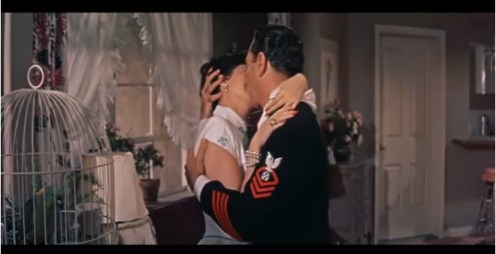
It’s a strange choice. The song far better suits Ginger’s own vulnerable position in their long-distance relationship. But then, as a cabaret performer, the film has presented her as from the wrong side of the theatrical and sexual abstinence tracks. Sung by Bill, ‘Whether you’re right / whether you’re wrong’ and ‘Loving may be all you can give’ take on an unpleasant moralising dimension. (Also dodgy: as in The Fabulous Baker Boys’ highly questionable representation of jazz club Henry’s, Ginger’s earlier number ‘The Lady from the Bayou’ racialises desire.) Bill croons, and Ginger distracts herself by tapping on her parakeet’s cage. With the kiss that seals the marital deal, the cage remains prominently in shot – an unusual, pro-Ginger moment of critique in a film that just can’t make up its mind about women and sex.

Hit the Deck--cage

8: You Go To My Head (1938)

This song is a struggle.

‘You Go To My Head’ was written by John Frederick Coots and Haven Gillespie in 1936, and first recorded in 1938. Its tone and story could not be further away from their earlier hit, the enduring Christmas earworm ‘Santa Claus Is Coming To Town’ (1934).

Gillespie’s lyrics give us a protagonist engulfed in the fog of infatuation. Addressing the object of their desire, the person speaks of incessant thoughts, flights of fancy, involuntary physical reaction to the ‘very mention’ of the other person, and straight up libidinal heat brought on by their eyes and smile. Rational self-talk (‘get a hold of yourself’) competes ineffectually with full-bodied feeling.

Philip Furia jokes that though the song’s many booze analogies are explicit only in the first A section, Gillespie returns to the theme later ‘by reminding us that alcohol, like mercury, rises in thermometers’. The abstraction of the cover sketch on the sheet music published by the Remick Music Corporation offers another sense of the body as machine. Meanwhile, in terms of its harmonic progressions, Ted Gioia proposes that ‘this song comes closer than any tune I know to capturing in musical form the feeling of losing control’. In form and content, it’s all about being under the influence.

More than twice the versions by vocalists have been recorded by women than men.

Wandering around Spotify in search of some of the nearly four hundred recordings of the song is an object lesson in interpretative variety. My current favourite is Reginald Chapman’s addictive funk arrangement featuring vocalist Sam Reed – which, like Dinah Washington’s live Latin take with Clifford Brown, is packed with energetic dilemma.


Meanwhile, Billie Holiday’s two recordings, made in 1938 and 1952, each overflow with tender sadness. Lush, expansive orchestral arrangements accompany Ella Fitzgerald and Frank Sinatra‘s gentle performances. Johnny Hartman’s intimate rendition speaks of solitary contemplation – and even more so, Stacey Kent’s, a stunning performance with pianist David Newton that summons up a moonlit landscape of ice.

And various interpretations imbue the song’s angst and sexuality with a drama adjacent to film noir – a move that reflects the song’s earliest uses in film, in Otto Preminger’s Laura (1944) and Howard Hawks’ The Big Sleep (1946).

Sarah Vaughan’s 1961 version with Count Basie has a vaguely sinister sensibility: a clamorous city is filled with threat, both from the self and from others. The texture of its horns echoes the anxiety-inducing arrangement on Stan Kenton’s New Concepts of Artistry in Rhythm (1953) – a more intensely swirling vortex of urban noise. Also unsettling is Lio‘s 1980 electropop interpretation, whose metallic vocals, synths and strings anticipate the narrative concerns of Ridley Scott’s Blade Runner (1982). Differently strange is Bryan Ferry’s 1975 performance. Its video sees a listless, tuxedo-clad Ferry visited by a self-objectifying femme fatale: her spidery hand pulls open the door to his weirdly daylit room, where she is revealed to be a figment of his imagination.

This video treads a fine line between critique and indulgence of misogynistic fetishism – a psychological concern at the heart of Preminger’s Laura.

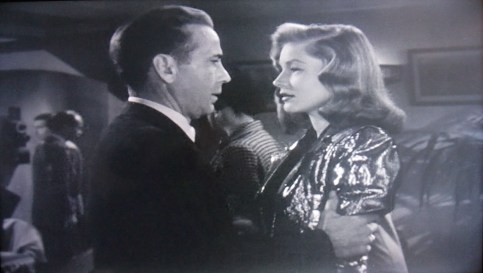
Both Laura and The Big Sleep feature restaurant scenes where instrumental performances of ‘You Go To My Head’ act as the backdrop to key events. In The Big Sleep, the song marks the acceleration of the attraction between detective Philip Marlowe (Humphrey Bogart) and client Vivian Rutledge (Lauren Bacall) – a narrative use of the song that extends no further than that electric moment.

IMG_20190424_113648

A different instrumental theme entitled ‘Laura’a standard subsequently recorded almost as many times as ‘You Go To My Head’ – conspicuously dominates Laura‘s action. But the film’s very brief, particular placement of ‘You Go To My Head’, and the lyrics which ghost its performance, signpost with mordant accuracy the identity of the murderer, and their motivation for killing its eponymous heroine.

The killer could be any of the three characters in the frame: Laura’s patron Waldo Lydecker (Clifton Webb), her fiance Shelby Carpenter (Vincent Price), and her aunt Ann Treadwell (Judith Anderson). Investigating officer Detective Mark McPherson (Dana Andrews) soon begins to succumb to an obsession with Laura (Gene Tierney) himself.

At one point in the film, Laura is seen to utter the crucial line: ‘I never have been and I never will be bound by anything I don’t do of my own free will’. As elsewhere in Preminger’s oeuvre, Laura dramatizes ‘the battle between a woman’s self-definition and a definition imposed by men’. It takes as its subtle text a beautiful song amenable to numerous interpretations – among them, obsessive fixation and self-undoing. In Laura, its ‘singer’, as it were, is not the film’s female heroine but someone entirely different.

Laura Mvula on screen

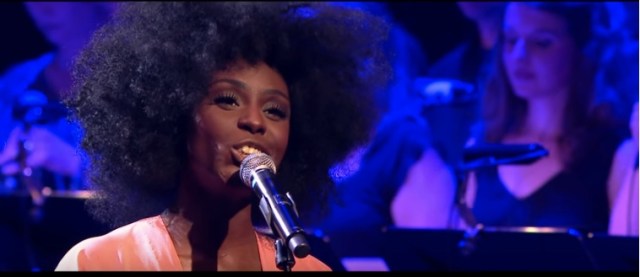
Watching Laura Mvula headline Love Supreme at the Roundhouse last night, I remembered this text sitting lonely on my computer, which I wrote the day after attending the 5 March 2015 cinema broadcast of her performance with Metropole Orkest, recorded at Paradiso Amsterdam on 28 November 2014.

At Screen 5 of the Ritzy in Brixton, the usher confirmed in a whisper that the screening of Laura Mvula’s gig hadn’t started yet (‘they are still doing the interviews’) and held open the door. The cinema was two-thirds empty and unusually chilly. Laura Mvula was on-screen in conversation with a male interviewer, responding to tweets coming in about the broadcast of the gig, displayed at the bottom of the screen. The interviewer advised the audience – the audience to their interview, wherever it was, and us, witnessing their exchange live – that we may have to pretend at various points that we have something in our eye, such was the emotive impact of what we were about to see.

Eating popcorn, I was curious. The camera filming the interview from the back of the venue suggested that the auditorium to which the artist was speaking was disappointingly half-empty – an image counterbalanced by a later view from the front, which showed row upon row filled with people. This, in combination with our own sparsely populated and cold auditorium, felt like something of an opening anticlimax.

The recorded gig itself begins with the conductor Jules Buckley entering the stage of the Paradiso in Amsterdam. The venue is a former church, and intricate blue stained-glass windows adorn the wall behind the orchestra. A gallery level rests on top of corniced pillars – an architectural arrangement smaller but not dissimilar in shape to the Palau Música de Catalana in Barcelona where I’d seen a slightly odd performance by Aloe Blacc the previous summer, which had concluded with the audience being encouraged to rush the stage while the artist slipped away. The cameras filming the gig reveal that the auditorium is heaving. The ensemble of more than fifty musicians is packed onto the stage, a choir standing beneath the gallery stage left, and three backing singers positioned downstage right. Jules Buckley makes a cheesy Jaws reference in relation to the sell-out gig (‘we’re going to need a bigger boat!’) and warmly introduces the Metropole Orkest, before welcoming Laura Mvula herself onto the stage.

She walks into the auditorium through a door to the left of the front of the audience, passing amongst people standing to ascend the shallow stage. In March 2015, Laura Mvula has a shaven head, and wears a long white jacket and black top. In November 2014, her afro and peach nylon dress, long sleeves draping down, speak of the 1970s. When she stretches her right arm towards the audience as if in supplication – a gesture she will make frequently during her performance – her sleeve punctuates the movement. At first, she doesn’t speak except to say ‘thank you’.

Laura Mvula

The performance is revelatory. The rich orchestration lends a new dimension to the songs, which now tell stories that are different to those of the intimate arrangements on Sing to the Moon (2013), on which the gig is based. The first number, ‘Like the Morning Dew’, describes the insubstantiality of a relationship: ‘Our love is / Like the morning clouds / Like the morning dew / That goes away / Early.’ The expansiveness of the arrangement envelops the voice of the soloist, speaking of the disappearance of the world that the song’s protagonist thought was there. Its resonant universe conjures imaginative flight, fantasy, and a strange kind of optimistic sadness about the flimsiness of that imagined world. ‘She’ describes a woman’s quest for intimacy, the lyric ‘she don’t stop / she don’t stop / she don’t stop’ underscored by percussion, giving the impression of a relentless progression forward. As she sings, her movement alludes to walking a path, although of course, standing on the spot, she goes nowhere. Whether the intended meaning or not, as she performs ‘Is There Anybody Out There?’ I think of how precious life must feel to someone facing death: ‘Is this the end / Before it’s even started / I can’t survive this way / I’m broken-hearted.’ The improvisation of the lead vocalist over the chorus constructs both a sense of internal dialogue and a conversation between people. As in the original arrangement, the tumbling strings give way to a dissonant passage, and the sensation of floating in space.

Laura Mvula 3

With ‘Father Father’, I recognize what the interviewer meant. Seated at the piano, she introduces the song by acknowledging Jules Buckley’s new arrangement for the orchestra (‘it’s better’). The purity of the brass at the start of the song seems to refer perfectly and incongruously to Vaughan Williams and Elgar. As she sings ‘I lost my heart / In the dark with you’, its attack is brutal. The texture of the song builds with the introduction of strings, piano, and timpani, creating an almost meteorological landscape of sound. Then, the song continues for as long again, with her beautiful improvisation around the lyrics ‘Father father / Please don’t let me go / Father father / Why’d you let me go’ as the music swells around her. Her gaze directed at no-one in particular, she speaks to herself, to the audience, to God. I now hear the song as the tragedy of the loss of faith, and wonder whether all of the songs in the concert are in some way circling that idea.

Laura Mvula 2

Huddled beneath my coat in the cold cinema, I moved in and out of absorption in the gig, fascinated by the technical execution of the music producing such intense emotional effects in the audience, occasionally feeling tears spring in my own eyes and roll down the side of my face. A large gathering of musicians had met an audience of 1,500, met in turn later by a much more disparately spread audience, watching silently in cinemas as the first audience clapped and cheered. At the end of each number, her face would wrinkle into a huge smile, puncturing the emotional world of the songs and reasserting the humour of the everyday.

The gig finished with an encore performance of ‘Make Me Lovely’.

Towards its end she said: ‘I just want to thank you all for being the most wonderful audience, ever’. At this, I smiled, feeling warmth toward this past audience but not feeling myself a part of it. Having concluded, the recorded concert was then unexpectedly followed up by a live performance from Laura Mvula in the venue of the interview, performing solo on a keyboard. It was unexpected, it seemed, to everyone – the screen showed a couple of audience members caught short attempting to get up. The much more minimal rendition of three of the numbers she had performed exposed again the texture of the orchestral arrangements, and the controlled power of her voice. Strangely, this live performance felt intimate, just for us, despite the ‘us’ being scattered in cinemas across the country. When she finished this reprise, she smiled, and said ‘thank you for coming’ again. In the Ritzy, the credits rolled silently, and no-one moved.

7: What’ll I Do (1923)

This song is saudade itself.

What'll I Do 2

Its story of love on the rocks was penned by Irving Berlin, with the champagne-fuelled assistance of Dorothy Parker on its last two lines. Addressing their (soon-to-be) estranged lover, its protagonist contemplates a lonely future absent of their company. In this future, the other person is a long way away, in the arms of another. All that is left is a photograph and castles in the air. It is the definition of ‘”a vague and constant desire for something that does not and probably cannot exist, for something other than the present”‘.

In a fascinating piece for The Atlantic, David Schiff talks of how Irving Berlin’s tunes ‘have a verbal tag and tell a story’, instilling in ‘common American phrases the nervous musical impulse of the modern city’.

Like many other Irving Berlin compositions, this song is deceptive in its simplicity. ‘What’ll I do?’ is its lyrical foundation. The boxy end rhymes of its two verses give a sense of stability – ‘divine’/’mine’, ‘mended’/’ended’, ‘bliss’/’kiss’, ‘descending’/’ending’ – which the choruses proceed to entirely undo. Internal rhymes surge through the choruses like gentle waves, softly eroding what formerly seemed secure. ‘What’ll I do when you are far away / And I am blue, what’ll I do?’ The only lines that lack these repeated internal rhymes are those reflecting on the protagonist’s memento – ‘What’ll I do with just a photograph / To tell my troubles to?’ The ebb and flow of the song’s emotion comes to a temporary moment of stillness with this melancholy image.

It’s been recorded numerous times in vocal and instrumental versions, very often with sentimental strings, as in Frank Sinatra’s 1947 performance. The major key and waltz time sit in a sad tension with the song’s sorrowful lyrics. But desolation and abandonment are not all there is to it. For example, Sarah Vaughan’s 1964 recording, arranged by Benny Carter, is razor-sharp.

What’ll I do? Immediately go on holiday, pound a bunch of drinks, and plot exuberant revenge. Vaughan’s sleek arpeggios are not really about pining. In this devastating live performance on her television show, Judy Garland makes an inspired lyrical adjustment following what seems like a pronunciation misstep: ‘What’ll I do when I am wondering how / You feel just now, what’ll I do?’ Chet Baker’s psychedelic interpretation, recorded in 1974, conjures a parallel universe. It’s beautiful, but I find it deeply antagonising: to me, this protagonist seems to be gaming his interlocutor.

I can’t remember how I first came to know ‘What’ll I Do’, but it’s highly likely that it was via the opening credits of the BBC sitcom Birds of a Feather, in which it is performed by co-stars Pauline Quirke and Linda Robson.

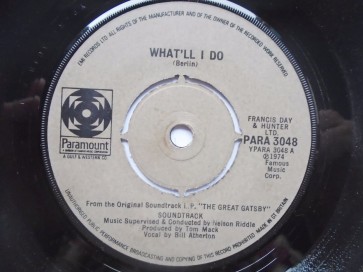
The series had originally used for its own credit sequences Bill Atherton’s recording for the opening credits of The Great Gatsby (1974), directed by Jack Clayton. The choice of ‘What’ll I Do’ for The Great Gatsby is itself a reference to the song’s own genesis: as a member of the Algonquin Round Table, Irving Berlin ran with a set that ‘often partied at the Long Island Gold Coast estate of Herbert Bayard Swope (a figure whom many believed to be the model for Fitzgerald’s Gatsby)’.

Atherton’s tender vocals accompany a gradual close-up on a newspaper clipping – Mia Farrow as Daisy – and a tracking shot of the dissolute, photograph-bedecked luxury of Gatsby’s mansion. The revised Birds of a Feather credits are likewise accompanied by the sweetness of strings, and a selection of photographs. But these are of the series’ two sisters, now cohabiting following the imprisonment of their husbands for armed robbery. And they are photographs of the two actors, taken at various stages of life, that appear to be genuine: Quirke and Robson had grown up together.

For both opening and closing credits of Birds of a Feather, only the first and last choruses are used, stripping the song of romantic association. It is possible to hear reference to the incarcerated husbands. But in juxtaposition to the photographs, it becomes much more prominently about the sisters’ relationship, and the sadness of their former separation through the process of adult life. The cinefilm that graces the closing credits is excruciatingly poignant – from one child’s impossible attempt to feed ice-cream to her bear, to their final wave to the camera, running up the grass into the future. It’s an extraordinary visual gesture to the final lines of F. Scott Fitzgerald’s novel: ‘So we beat on, boats against the current, borne back ceaselessly into the past’.

6: Dream Dancing/So Near And Yet So Far (1941)

These songs epitomise ‘romance’.

Cole Porter wrote ‘Dream Dancing’ and ‘So Near And Yet So Far’ for musical comedy You’ll Never Get Rich (1941), the Fred Astaire/Rita Hayworth vehicle that made Hayworth stratospherically famous. In its film context, ‘Dream Dancing’ is a blink-and-you’d-miss-it instrumental backdrop to a dinner dance attended by the protagonists. ‘So Near And Yet So Far’ is a killer showpiece rhumba danced by the two, with vocals from Astaire, presented as if in dress rehearsal towards the film’s finale extravaganza.

Within both songs, the object of desire is a fantasy: thrilling, distant, unreachable.

‘Dream Dancing’ narrates a person meeting their lover again in the reverie of sleep. Its interpretive possibilities are numerous. In Marlene VerPlanck’s lively and increasingly agitated version, sleep promises agonising separation. By contrast, this witty live performance by Mel Torme and George Shearing serves up unrequited passion, its melancholy becoming transmuted into frolicsome imaginary fun. Tony Bennett and Bill Evans’s stunning interpretation suggests the sadness of loss assuaged by dreams. Its aching optimism sets off the words of the verse: ‘When shades enfold / The sunset’s gold / And stars are bright above again / I smile, sweetheart / For then I know I can start / To live again, to love again.’

‘So Near And Yet So Far’ is more straightforwardly about someone playing hard to get.

Only a handful of artists have recorded it since 1941, largely sticking with the song’s original Latin feel. My favourite is Fred Astaire’s 1952 recording with Oscar Peterson, a more intimate, conversational rendition than his 1941 performance, relocating the verse and its dubious rhyme of ‘going native’ with ‘co-operative’ to mid-way through the song.

‘So Near And Yet So Far’ is an example of a latune, ‘a tune with a Latin beat and an English-language lyric’, a hybrid form keenly pursued by Cole Porter and many other popular songwriters during the twentieth century. In his fascinating history of the genre, Gustavo Perez Firmat contemplates its ambivalence:

Like Fred and Rita’s rhumba in You’ll Never Get Rich, this type of song is “so near” to and yet “so far” from indigenous Cuban music, for while the rhythm may transport us to Havana, the lyric strands us in the United States. […] Whether applied only to Cuba or to Latin America as a whole, atmospheric Latin Americanism is a mode of intimacy, a mechanism for cultural appropriation that, paradoxically, has the effect of keeping the appropriated object at a distance.

Rita Hayworth was herself a ‘Hollywood Latina’ of Spanish and Irish descent whose career was marked by an ‘evolution from dark-haired señorita to all-American strawberry blonde’. Priscilla Peña Ovalle interprets the self-possessed sexuality of Hayworth’s character in You’ll Never Get Rich in terms of this public transformation: ghosted by Hayworth’s perceived origins, the character is pitched to land ‘somewhere between virgin and siren’.

The plot of You’ll Never Get Rich is curious. The mutual admiration felt between choreographer Robert Curtis (Astaire) and dancer Sheila Winthrop (Hayworth) becomes a convoluted love story when Robert’s boss Martin Cortland (Robert Benchley) tries to hit on Sheila with a diamond bracelet – much to the chagrin of his wife Julia (Frieda Inescort), the theatre’s legal owner.

To ward off divorce, Robert agrees to pretend the gift was actually from him. Cue a sequence of misunderstandings consequent upon Martin’s catting around, compounded when Robert is conscripted and assigned to an army base overseen by Sheila’s boyfriend Captain Tom Barton (John Hubbard). Seeking to win her heart, Robert casts Sheila in a big show he is asked to stage for the troops, and egregiously commissions a real justice to marry them amidst a big theatrical wedding. Astonishingly, Robert’s deception ceases to be a problem for Sheila when another misunderstanding is cleared up. In the end he and Sheila are happily united.

Though these beautiful songs describe fantasy, the film in which they appear is an odd combination of escapism and pragmatism. Sheila has money, dances for fun rather than a wage, speaks her mind, expresses her desire, exploits her femininity when the occasion demands it. The war is not immediately threatening. Various characters take wearied jabs at the institution of marriage, yet a marital union is the film’s inevitable end, on the back of this extraordinary spectacle.

You'll Never Get Rich 2

And for the most part, the key female characters – a shrewd and capable dancer, a wronged wife, a many-times-married aunt – are strong, economically independent and well able to see through the men’s idiotic ruses towards romantic seduction. With its layers of exoticism, the story is so near and yet so far from idealism and mystery.

5: Where Or When (1937)

This song is unforgettable.

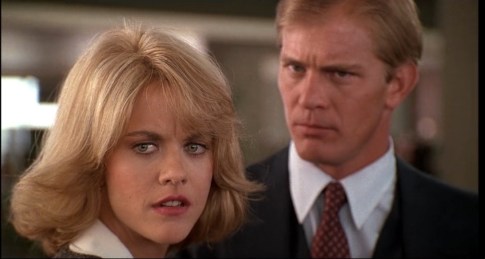
Nora Ephron’s enduringly excellent romantic comedy When Harry Met Sally (1989), directed by Rob Reiner, hooks various elements of its narrative on a selection of jazz standards, including ‘Where Or When’.

The opening chorus of Ella Fitzgerald’s bright version cues the film’s early airport scene, in which Sally (Meg Ryan) is saying goodbye to her new boyfriend Joe (Steven Ford). There, she re-encounters Harry (Billy Crystal), who, passing by, sees former fellow building occupant Joe and stops for small talk. ‘Thank god he couldn’t place me’, she says grimly, glaring after Harry down the airport concourse. ‘I drove from college to New York with him five years ago and it was the longest night of my life.’

When Harry Met Sally

Richard Rodgers and Lorenz Hart wrote ‘Where Or When’ for their musical Babes in Arms (1937). In that context, the song is talking about deja-vu. Its verse makes this theme clear: ‘Sometimes you think you’ve lived before / All that you live today.’ The chorus, where most jazz interpretations of the song start, ponders memory: ‘It seems we stood and talked like this before / We looked at each other in the same way then / But I can’t remember where or when.’ Amazingly, the performance history of the musical has active forgetting written into it, having been reimagined twice with various degrees of change to plot, racial politics and line-up of songs: as a 1939 film starring Judy Garland and Mickey Rooney, and as a stage version created by George Oppenheimer in 1959. ‘Where Or When’ features in all three versions.

The song can speak of casual flirtations.

On Etta Jones’ recording, easygoing puzzlement develops into joy, like a chance morningtime encounter that becomes a day-into-night date. Frank Sinatra’s live take with Count Basie on the other hand suggests cocktail-fuelled and quickly forgotten nights of carnal enjoyment. But the song is more than open to less celebratory, more emotionally searching interpretations.

For example, Harry Connick Jr’s rendition for the When Harry Met Sally soundtrack – a set of companion arrangements for which he won a Grammy – is intense and melancholy. It proposes forgiveness, a deliberate reckoning with a relationship’s beautiful past, whose patterns are re-emerging in the present. As the teen owner of this recording on cassette I fell completely in love with its piano solo (here, from 1.57-2.34), rewinding it repeatedly. Bryan Ferry’s folkish version, featured on his album of standards As Time Goes By (1999), performs an act of tremulous alchemy, making of the song a dreadfully sad story of memory loss and partial recognition. There, the line ‘But who knows where or when’ possesses terrible tragic irony: in the scenario that the song conjures, the experience of forgetting does not seem to be shared.

Donald Shirley’s solo piano version, released in 2001, is something else altogether. In the wake of the release of the controversial Academy Award-winner Green Book (2018), various features have reflected on his body of work: a concert pianist confronted with institutionalised racism, Shirley created beautiful interpretations of jazz compositions inflected with classical allusions. A New York Times piece refers to Kris Bowers, composer of Green Book‘s score:

“‘Lullaby of Birdland’ was one of the first ones that I knew I wanted to include, because he starts off quoting a couple of classical pieces, and then when he goes into the song, it’s almost like a false start, because he uses the melody as the beginning of a fugue,” Bowers said in an interview. “He’s doing a proper fugue, exposing the subject, et cetera, within a jazz context. I listened to that and said, ‘Wow, I’ve never heard anybody do that before.’”

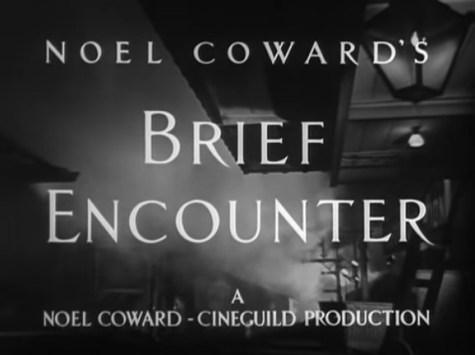
Shirley’s rendition of ‘Where Or When’ alludes poignantly to phrases and chord progressions from Rachmaninoff’s Piano Concerto No. 2 in C minor and Chopin’s Prelude in D flat (Raindrop Prelude). (These are the two I recognised; for sure there will be more that I can’t yet hear.) It evokes Noel Coward’s Brief Encounter (1945), directed by David Lean, a film indelibly associated with the Rachmaninoff work.

Brief Encounter

Shirley’s piece chimes painfully with the desperate longing dramatized by the film: a story of doomed interwar love ignited between Laura (Celia Johnson) and Alec (Trevor Howard), both of whom are married. Clouds gather at its outset. Snatches of melody promise to become more substantially themselves, but never do.

‘Some things that happen for the first time / Seem to be happening again.’ In Shirley’s exquisite performance, the ghosts of an earlier composition haunt ‘Where Or When’. Meanwhile, on-screen, a last tryst in a railway station cafe is tragically, irretrievably interrupted; love begins in a bookshop thanks to a re-meeting in ‘personal growth’.