9: More Than You Know (1929)

This song disturbs.

In The Fabulous Baker Boys (1989), as novice vocalist Susie Diamond, Michelle Pfeiffer delivers a captivating performance of a section from ‘More Than You Know’. Former escort Susie has rocked up extremely late for an audition to join the struggling piano duo of Jack (Jeff Bridges) and Frank (Beau Bridges). Following a moment of antagonism with controlling jobsworth Frank, she casts a magic spell over the dilipidated piano showroom with an unexpectedly mesmerising rendition. The selection of lyrics anticipates their unfolding relationships, and the boom and catastrophic bust of the brothers’ business. Frank’s wedding ring gleams in shot as he fights back unexpected emotion.

‘More Than You Know’ first appeared in the short-lived Broadway musical Great Day! addressed by its plantation-owning protagonist to her love interest. For Thomas S. Hischak, the song is ‘a languid yet stately ballad that seems to tumble forth effortlessly as it explains how one’s love is greater than the object of affection can ever realize’. Definitely, but in terms of its overall structure and effect I tend to agree with Alec Wilder and James T. Maher:

The verse is very florid and ‘inspirational’. It isn’t a verse as much as an exclamatory introduction to the chorus. The latter for those who have never heard it, comes as a complete surprise in that it is much less dramatic than the verse.

Wilder and Maher are talking about Vincent Youman’s composition, but the same dynamic applies to Billy Rose and Edward Eliscu’s lyrics.

The sharp distinction between ‘florid’ verse and ‘stately’ chorus accentuates the song’s unfolding of insecurity in love. In the verse, nonchalance (‘Whether you remain or wander / I’m growing fonder of you’) quickly escalates to grandiosity (‘Wouldn’t I be glad to take you? / Give you the break you need’) before the chorus lays out a more consistent scenario: I’ll be around, how you must need me, I know this is just sex for you, please don’t get bored. It’s an extraordinary portrait of self-deception and brutal frankness all at once.

The ups and downs of the song’s story are discomfiting to read on the page – maybe why many versions redact the verse – but so much else is possible in performance.

One of the earliest of the song’s hundreds of recordings, by The Scamps, claws back agency on the part of the protagonist with gentle harmonies and unexpected humour. In a dramatic arrangement, Della Reese openly treads a line between anger and desperate tenderness. Beverly Kenney’s restrained and wistful delivery hints at volcanic passion. Jackie Paris offers unsteady yearning. Dee Dee Bridgewater’s rich performance admits to no vulnerability whatsover.

The song’s uses on-screen are similarly divergent – to take two examples of the five films in which it has featured, Hit the Deck (1955) and The Fabulous Baker Boys (1989). As films, despite massive differences in genre and tone, there are spooky affinities between them: both are about the entertainment business, and social and sexual legitimacy.

Hit The Deck tells the convoluted story of three couples getting it together. It hinges on a dodgy hotel suite audition undertaken by ingenue Susan (Jane Powell) with the vile actor-manager of a production, also entitled ‘Hit The Deck’, which features musical theatre actress Carol (Debbie Reynolds). Accompanied by fellow naval officers Bill (Tony Martin) and Rico (Vic Damone), all of whom are on shore leave, Danny (Walter Pidgeon) runs to the hotel suite to protect his sister’s chastity. Cue hijinks as the sailors attempt to escape disciplinary action for trashing the suite. Before this pivotal event, Bill sings in ‘Keepin’ Myself For You’ a club cabaret number danced by Ginger (Ann Miller), his fiancee of six years, and Danny horns in on Carol’s dress rehearsal of the suggestive song ‘A Kiss Or Two’.

While all this is going on, Ginger has had enough of waiting around to get married, and unconvincingly dumps Bill for ‘someone else’. ‘More Than You Know’ is his effort to win her back.

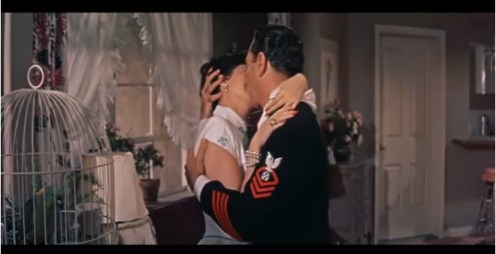
It’s a strange choice. The song far better suits Ginger’s own vulnerable position in their long-distance relationship. But then, as a cabaret performer, the film has presented her as from the wrong side of the theatrical and sexual abstinence tracks. Sung by Bill, ‘Whether you’re right / whether you’re wrong’ and ‘Loving may be all you can give’ take on an unpleasant moralising dimension. (Also dodgy: as in The Fabulous Baker Boys’ highly questionable representation of jazz club Henry’s, Ginger’s earlier number ‘The Lady from the Bayou’ racialises desire.) Bill croons, and Ginger distracts herself by tapping on her parakeet’s cage. With the kiss that seals the marital deal, the cage remains prominently in shot – an unusual, pro-Ginger moment of critique in a film that just can’t make up its mind about women and sex.
Hit the Deck--cage

8: You Go To My Head (1938)

This song is a struggle.

‘You Go To My Head’ was written by John Frederick Coots and Haven Gillespie in 1936, and first recorded in 1938. Its tone and story could not be further away from their earlier hit, the enduring Christmas earworm ‘Santa Claus Is Coming To Town’ (1934).

Gillespie’s lyrics give us a protagonist engulfed in the fog of infatuation. Addressing the object of their desire, the person speaks of incessant thoughts, flights of fancy, involuntary physical reaction to the ‘very mention’ of the other person, and straight up libidinal heat brought on by their eyes and smile. Rational self-talk (‘get a hold of yourself’) competes ineffectually with full-bodied feeling.

Philip Furia jokes that though the song’s many booze analogies are explicit only in the first A section, Gillespie returns to the theme later ‘by reminding us that alcohol, like mercury, rises in thermometers’. The abstraction of the cover sketch on the sheet music published by the Remick Music Corporation offers another sense of the body as machine. Meanwhile, in terms of its harmonic progressions, Ted Gioia proposes that ‘this song comes closer than any tune I know to capturing in musical form the feeling of losing control’. In form and content, it’s all about being under the influence.

More than twice the versions by vocalists have been recorded by women than men.

Wandering around Spotify in search of some of the nearly four hundred recordings of the song is an object lesson in interpretative variety. My current favourite is Reginald Chapman’s addictive funk arrangement featuring vocalist Sam Reed – which, like Dinah Washington’s live Latin take with Clifford Brown, is packed with energetic dilemma.


Meanwhile, Billie Holiday’s two recordings, made in 1938 and 1952, each overflow with tender sadness. Lush, expansive orchestral arrangements accompany Ella Fitzgerald and Frank Sinatra‘s gentle performances. Johnny Hartman’s intimate rendition speaks of solitary contemplation – and even more so, Stacey Kent’s, a stunning performance with pianist David Newton that summons up a moonlit landscape of ice.

And various interpretations imbue the song’s angst and sexuality with a drama adjacent to film noir – a move that reflects the song’s earliest uses in film, in Otto Preminger’s Laura (1944) and Howard Hawks’ The Big Sleep (1946).

Sarah Vaughan’s 1961 version with Count Basie has a vaguely sinister sensibility: a clamorous city is filled with threat, both from the self and from others. The texture of its horns echoes the anxiety-inducing arrangement on Stan Kenton’s New Concepts of Artistry in Rhythm (1953) – a more intensely swirling vortex of urban noise. Also unsettling is Lio‘s 1980 electropop interpretation, whose metallic vocals, synths and strings anticipate the narrative concerns of Ridley Scott’s Blade Runner (1982). Differently strange is Bryan Ferry’s 1975 performance. Its video sees a listless, tuxedo-clad Ferry visited by a self-objectifying femme fatale: her spidery hand pulls open the door to his weirdly daylit room, where she is revealed to be a figment of his imagination.

This video treads a fine line between critique and indulgence of misogynistic fetishism – a psychological concern at the heart of Preminger’s Laura.

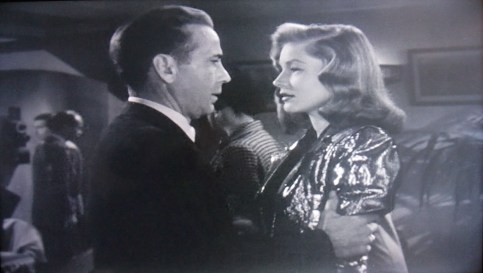
Both Laura and The Big Sleep feature restaurant scenes where instrumental performances of ‘You Go To My Head’ act as the backdrop to key events. In The Big Sleep, the song marks the acceleration of the attraction between detective Philip Marlowe (Humphrey Bogart) and client Vivian Rutledge (Lauren Bacall) – a narrative use of the song that extends no further than that electric moment.

IMG_20190424_113648

A different instrumental theme entitled ‘Laura’a standard subsequently recorded almost as many times as ‘You Go To My Head’ – conspicuously dominates Laura‘s action. But the film’s very brief, particular placement of ‘You Go To My Head’, and the lyrics which ghost its performance, signpost with mordant accuracy the identity of the murderer, and their motivation for killing its eponymous heroine.

The killer could be any of the three characters in the frame: Laura’s patron Waldo Lydecker (Clifton Webb), her fiance Shelby Carpenter (Vincent Price), and her aunt Ann Treadwell (Judith Anderson). Investigating officer Detective Mark McPherson (Dana Andrews) soon begins to succumb to an obsession with Laura (Gene Tierney) himself.

At one point in the film, Laura is seen to utter the crucial line: ‘I never have been and I never will be bound by anything I don’t do of my own free will’. As elsewhere in Preminger’s oeuvre, Laura dramatizes ‘the battle between a woman’s self-definition and a definition imposed by men’. It takes as its subtle text a beautiful song amenable to numerous interpretations – among them, obsessive fixation and self-undoing. In Laura, its ‘singer’, as it were, is not the film’s female heroine but someone entirely different.

7: What’ll I Do (1923)

This song is saudade itself.

What'll I Do 2

Its story of love on the rocks was penned by Irving Berlin, with the champagne-fuelled assistance of Dorothy Parker on its last two lines. Addressing their (soon-to-be) estranged lover, its protagonist contemplates a lonely future absent of their company. In this future, the other person is a long way away, in the arms of another. All that is left is a photograph and castles in the air. It is the definition of ‘”a vague and constant desire for something that does not and probably cannot exist, for something other than the present”‘.

In a fascinating piece for The Atlantic, David Schiff talks of how Irving Berlin’s tunes ‘have a verbal tag and tell a story’, instilling in ‘common American phrases the nervous musical impulse of the modern city’.

Like many other Irving Berlin compositions, this song is deceptive in its simplicity. ‘What’ll I do?’ is its lyrical foundation. The boxy end rhymes of its two verses give a sense of stability – ‘divine’/’mine’, ‘mended’/’ended’, ‘bliss’/’kiss’, ‘descending’/’ending’ – which the choruses proceed to entirely undo. Internal rhymes surge through the choruses like gentle waves, softly eroding what formerly seemed secure. ‘What’ll I do when you are far away / And I am blue, what’ll I do?’ The only lines that lack these repeated internal rhymes are those reflecting on the protagonist’s memento – ‘What’ll I do with just a photograph / To tell my troubles to?’ The ebb and flow of the song’s emotion comes to a temporary moment of stillness with this melancholy image.

It’s been recorded numerous times in vocal and instrumental versions, very often with sentimental strings, as in Frank Sinatra’s 1947 performance. The major key and waltz time sit in a sad tension with the song’s sorrowful lyrics. But desolation and abandonment are not all there is to it. For example, Sarah Vaughan’s 1964 recording, arranged by Benny Carter, is razor-sharp.

What’ll I do? Immediately go on holiday, pound a bunch of drinks, and plot exuberant revenge. Vaughan’s sleek arpeggios are not really about pining. In this devastating live performance on her television show, Judy Garland makes an inspired lyrical adjustment following what seems like a pronunciation misstep: ‘What’ll I do when I am wondering how / You feel just now, what’ll I do?’ Chet Baker’s psychedelic interpretation, recorded in 1974, conjures a parallel universe. It’s beautiful, but I find it deeply antagonising: to me, this protagonist seems to be gaming his interlocutor.

I can’t remember how I first came to know ‘What’ll I Do’, but it’s highly likely that it was via the opening credits of the BBC sitcom Birds of a Feather, in which it is performed by co-stars Pauline Quirke and Linda Robson.

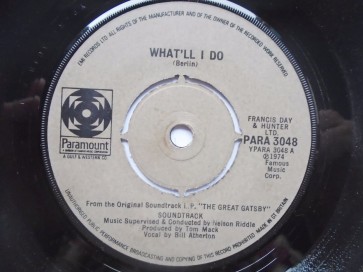
The series had originally used for its own credit sequences Bill Atherton’s recording for the opening credits of The Great Gatsby (1974), directed by Jack Clayton. The choice of ‘What’ll I Do’ for The Great Gatsby is itself a reference to the song’s own genesis: as a member of the Algonquin Round Table, Irving Berlin ran with a set that ‘often partied at the Long Island Gold Coast estate of Herbert Bayard Swope (a figure whom many believed to be the model for Fitzgerald’s Gatsby)’.

Atherton’s tender vocals accompany a gradual close-up on a newspaper clipping – Mia Farrow as Daisy – and a tracking shot of the dissolute, photograph-bedecked luxury of Gatsby’s mansion. The revised Birds of a Feather credits are likewise accompanied by the sweetness of strings, and a selection of photographs. But these are of the series’ two sisters, now cohabiting following the imprisonment of their husbands for armed robbery. And they are photographs of the two actors, taken at various stages of life, that appear to be genuine: Quirke and Robson had grown up together.

For both opening and closing credits of Birds of a Feather, only the first and last choruses are used, stripping the song of romantic association. It is possible to hear reference to the incarcerated husbands. But in juxtaposition to the photographs, it becomes much more prominently about the sisters’ relationship, and the sadness of their former separation through the process of adult life. The cinefilm that graces the closing credits is excruciatingly poignant – from one child’s impossible attempt to feed ice-cream to her bear, to their final wave to the camera, running up the grass into the future. It’s an extraordinary visual gesture to the final lines of F. Scott Fitzgerald’s novel: ‘So we beat on, boats against the current, borne back ceaselessly into the past’.

5: Where Or When (1937)

This song is unforgettable.

Nora Ephron’s enduringly excellent romantic comedy When Harry Met Sally (1989), directed by Rob Reiner, hooks various elements of its narrative on a selection of jazz standards, including ‘Where Or When’.

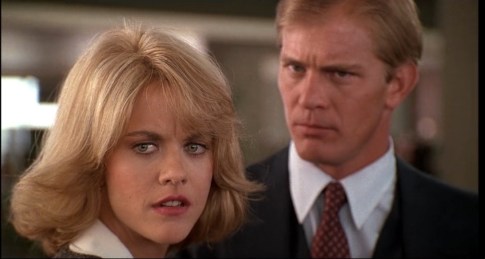
The opening chorus of Ella Fitzgerald’s bright version cues the film’s early airport scene, in which Sally (Meg Ryan) is saying goodbye to her new boyfriend Joe (Steven Ford). There, she re-encounters Harry (Billy Crystal), who, passing by, sees former fellow building occupant Joe and stops for small talk. ‘Thank god he couldn’t place me’, she says grimly, glaring after Harry down the airport concourse. ‘I drove from college to New York with him five years ago and it was the longest night of my life.’

When Harry Met Sally

Richard Rodgers and Lorenz Hart wrote ‘Where Or When’ for their musical Babes in Arms (1937). In that context, the song is talking about deja-vu. Its verse makes this theme clear: ‘Sometimes you think you’ve lived before / All that you live today.’ The chorus, where most jazz interpretations of the song start, ponders memory: ‘It seems we stood and talked like this before / We looked at each other in the same way then / But I can’t remember where or when.’ Amazingly, the performance history of the musical has active forgetting written into it, having been reimagined twice with various degrees of change to plot, racial politics and line-up of songs: as a 1939 film starring Judy Garland and Mickey Rooney, and as a stage version created by George Oppenheimer in 1959. ‘Where Or When’ features in all three versions.

The song can speak of casual flirtations.

On Etta Jones’ recording, easygoing puzzlement develops into joy, like a chance morningtime encounter that becomes a day-into-night date. Frank Sinatra’s live take with Count Basie on the other hand suggests cocktail-fuelled and quickly forgotten nights of carnal enjoyment. But the song is more than open to less celebratory, more emotionally searching interpretations.

For example, Harry Connick Jr’s rendition for the When Harry Met Sally soundtrack – a set of companion arrangements for which he won a Grammy – is intense and melancholy. It proposes forgiveness, a deliberate reckoning with a relationship’s beautiful past, whose patterns are re-emerging in the present. As the teen owner of this recording on cassette I fell completely in love with its piano solo (here, from 1.57-2.34), rewinding it repeatedly. Bryan Ferry’s folkish version, featured on his album of standards As Time Goes By (1999), performs an act of tremulous alchemy, making of the song a dreadfully sad story of memory loss and partial recognition. There, the line ‘But who knows where or when’ possesses terrible tragic irony: in the scenario that the song conjures, the experience of forgetting does not seem to be shared.

Donald Shirley’s solo piano version, released in 2001, is something else altogether. In the wake of the release of the controversial Academy Award-winner Green Book (2018), various features have reflected on his body of work: a concert pianist confronted with institutionalised racism, Shirley created beautiful interpretations of jazz compositions inflected with classical allusions. A New York Times piece refers to Kris Bowers, composer of Green Book‘s score:

“‘Lullaby of Birdland’ was one of the first ones that I knew I wanted to include, because he starts off quoting a couple of classical pieces, and then when he goes into the song, it’s almost like a false start, because he uses the melody as the beginning of a fugue,” Bowers said in an interview. “He’s doing a proper fugue, exposing the subject, et cetera, within a jazz context. I listened to that and said, ‘Wow, I’ve never heard anybody do that before.’”

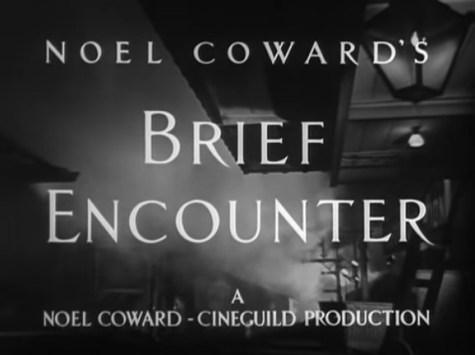
Shirley’s rendition of ‘Where Or When’ alludes poignantly to phrases and chord progressions from Rachmaninoff’s Piano Concerto No. 2 in C minor and Chopin’s Prelude in D flat (Raindrop Prelude). (These are the two I recognised; for sure there will be more that I can’t yet hear.) It evokes Noel Coward’s Brief Encounter (1945), directed by David Lean, a film indelibly associated with the Rachmaninoff work.

Brief Encounter

Shirley’s piece chimes painfully with the desperate longing dramatized by the film: a story of doomed interwar love ignited between Laura (Celia Johnson) and Alec (Trevor Howard), both of whom are married. Clouds gather at its outset. Snatches of melody promise to become more substantially themselves, but never do.

‘Some things that happen for the first time / Seem to be happening again.’ In Shirley’s exquisite performance, the ghosts of an earlier composition haunt ‘Where Or When’. Meanwhile, on-screen, a last tryst in a railway station cafe is tragically, irretrievably interrupted; love begins in a bookshop thanks to a re-meeting in ‘personal growth’.


2: Call Me Irresponsible (1962)

This song is not what it seems.

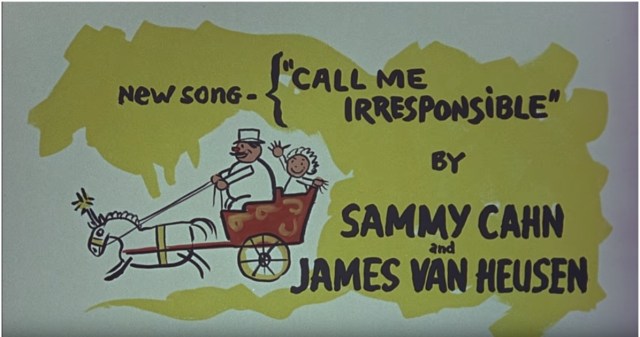
Scores of versions of ‘Call Me Irresponsible’ have been released since Jimmy Van Heusen and Sammy Cahn wrote it in 1962. It was prepared for film comedy Papa’s Delicate Condition (1963), in which it appears first as a wordless lullaby played by a child’s wind-up toy. In 1963 alone, at least seven artists recorded it, among them Frank Sinatra, Julie London and Dinah Washington – the exuberant cadenzas that Washington performs at the end of her version since featuring on numerous adverts and television trailers. (The YouTube link below lists its source as Totally Commercials: the Essential Commercials Albumreleased in 1998.) I’m so familiar with her performance’s passionate take that reflecting on the song recently, I realised I’d never really understood its lyrics.

https://www.youtube.com/watch?v=EO8jm9QmEf4

My superficial impression: reckless, spontaneous love!

It turns out the song is not about that.

Two short, magnificently crafted choruses give us an inconsistent character shamelessly cajoling their loved one. The character justifies their sketchy behaviour by virtue of their romantic sensibilities (“Rainbows, I’m inclined to pursue”) and their strength of feeling for the other person. In the extraordinary lines “Do my foolish alibis bore you? / Well, I’m not too clever, I just adore you”, a mere fifteen words deftly establish a relationship history and execute a smooth rhetorical confidence trick.

Set apart from the film, this Academy Award-winning song’s interpretative possibilities arguably range from ‘adorable if unrepentant’ to ‘sociopathic’. Compare and contrast Tony Bennett’s puppyish plaintiveness and Julie London’s Shere Khan.

On this basis, ‘Call Me Irresponsible’ is tough to accept in terms of love – unless being backed into an emotional corner is your thing. In its cinematic context, the song’s story takes on another aspect.

call me irresponsible

Papa’s Delicate Condition centres around the Griffith family and their salubrious small-town life in Texas. Jack Griffith (Jackie Gleason) is a railway superintendent whose excessive generosity and alcohol dependency together engender recurring marital crises. His church-going, recital-hosting wife Amberlyn (Glynis Johns) is status-conscious and controlling, though not without spark. Their teenage daughter Augusta (Laurel Goodwin) is likewise. Meanwhile, Jack is flamboyant and gregarious, qualities which delight their six year old daughter Corinne (Linda Bruhl) – in real life, a silent film actress and author of the memoir on which the film is based.

call me irresponsible

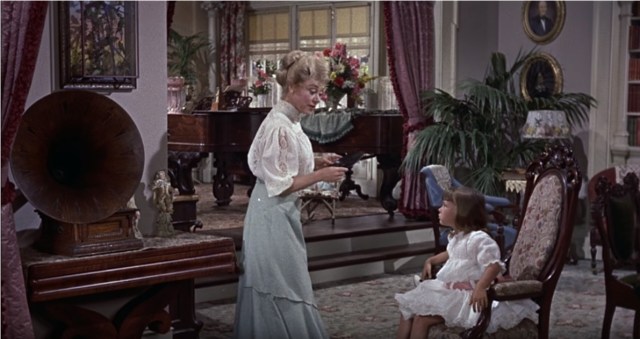
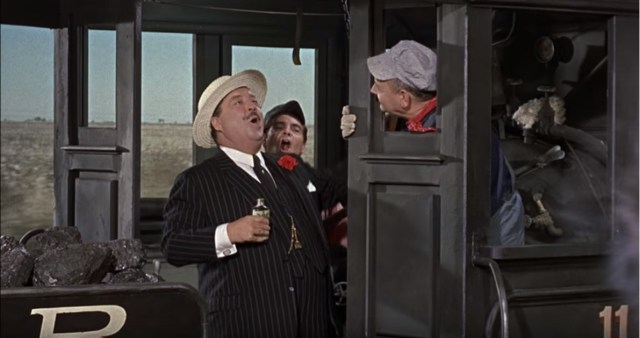
In the opening scene, Amberlyn distastefully removes from the gramophone a recording of ‘Bill Bailey, Won’t You Please Come Home‘ (1902) as Corinne protests. The film is critical of Amberlyn – jawdroppingly, in these introductory moments she calls the child “my little consolation prize” directly to her face – but though Jack is its hero, it is not uncritical of him: we first meet him on a steam train, enthusiastically belting out ‘Bill Bailey’ and enjoying the lion’s share of a bottle of bourbon in the company of a driver and stoker.

call me irresponsible

With modified lyrics, a harmonious family rendition of ‘Bill Bailey’ also wraps the whole drama up, raising a great many questions on the film’s uses of that song and their racial and historical politics.

Jack’s ‘delicate condition’ is his regular drunkenness, which leads him to engage in various rash schemes: tricking a man into repainting his ugly house to please Amberlyn, buying a drugstore to rescue a downtrodden assistant from its owner, and finally being hoodwinked himself into purchasing a failing circus so he can give its show-pony to Corinne. This is the last straw for Amberlyn, who gathers up her daughters and flees to her father’s house.

‘Call Me Irresponsible’ marks this moment of abandonment.

This scene – the first and only in this family-friendly comedy in which we see Jack unmistakably drunk – is incredibly sad.

The instrumentation is gentle, but Gleason’s performance of the song is unshrinking. The scene’s visual comparison of the automated and lifeless dolls in Corinne’s room with the bereft husband, his reproachful gaze at himself in the mirror, and his one-sided conversation with his surrogate wife-dummy all speak of patterns of (self) destruction. (The pat to the dummy’s hip is objectionable enough, but in a stunningly aggressive moment directly after this clip, he drops his empty glass into the dummy through its neck.)

By the end of the film, husband and wife will have reconciled. He will be sober; she will have ceded control. But this poignant scene shows the song’s narrative to be based not in the plenitude of love, but a man’s struggle with himself.

1: My Future Just Passed (1930)

This beautiful song has a dark heart.

Shirley Horn’s dreamy version, recorded in 1963, leads the listener gently into the woods: an idle fantasy about a man encountered by chance escalates to stalkerish obsession. Her phenomenal interpretation of this song made me want to start this blog.

Yikes, I thought, when I first listened to it in 2014. The character is decisive, even powerful, which makes it all the more unsettling. At the time I was reading Muriel Spark’s The Driver’s Seat (1970), which may or may not have had something to do with how I received it.

It wasn’t initially written to be sung by a woman.

‘My Future Just Passed’ was written by Richard A. Whiting and George Marion Jr. for musical comedy film Safety in Numbers (1930). The musical linchpin of the film, the song features as an instrumental overture accompanying the opening credits, and as a duet between its romantic protagonists.

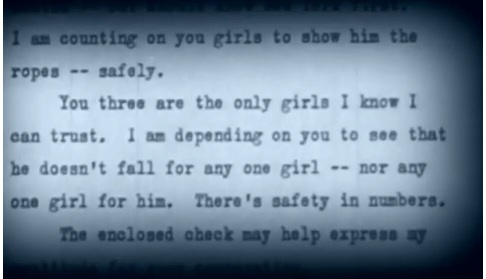
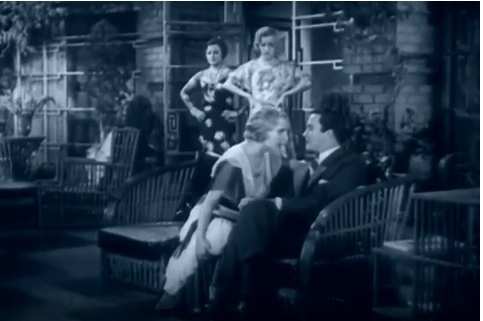
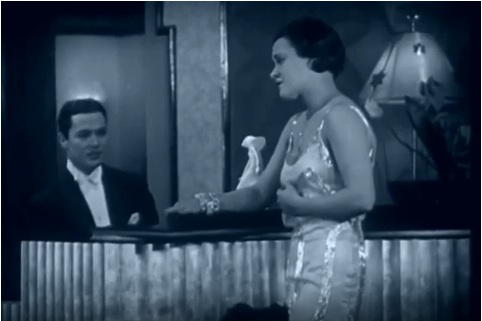
Naive young heir William Butler Reynolds (Charles ‘Buddy’ Rogers) arrives to New York City from the west, packed off by his uncle (Richard Tucker) to gain some practical knowledge of life. As he explains to his nephew in not so many words, the aim is to ensure that he doesn’t ultimately piss all of his gigantic fortune up the wall in nightclubs when he comes of age. In a letter, the uncle tasks Jacqueline (Kathryn Crawford), Maxine (Josephine Dunn) and Pauline (Carole Lombard), three Follies chorus girls, with introducing him to the city.

safety in numbers

The girls cohabit stylishly in a palatial Art Deco apartment with two servants. (The IMDb bio of Louise Beavers, who plays housekeeper Messalina, is amazing reading.) Their guest immediately demonstrates his maximal unworldliness. He drops his entire allowance on gifts of jewellery for them all, is unable to recognise a bra when confronted with one resting on a chair, and so on. But suddenly he discovers untapped Casanova potential, charming each girl in turn through song. They duly fight over him, abandoning their urbane shrewdness, yet also band together to protect him from the advances of other predatory chorus girls.

safety in numbers 2

In a move that is only surprising if you forget that the film is basically about heteronormative training, these independent performers also allow the inexperienced youth to negotiate salary on their behalf with their show’s producer.

Safety in Numbers inevitably resolves with a match: though barely any conversation seems to have been exchanged, Reynolds and Jacqueline have fallen in love.

safety in numbers 3

‘My Future Just Passed’ is Reynolds’ declaration of love for Jacqueline, followed by her mournful solo reply (here, at 1:04:55). The first chorus’ stride piano is laden with sentimentality. The song overall is anodyne. The film has made Reynolds the centre of its universe, and the girls orbit around him, so this is standard love story stuff: boy pledges undying affection to vacillating girl, and he will sever her existing “ties”, win out for sure.

In the year in which the film came out, Annette Hanshaw released a single version of ‘My Future Just Passed’ that combines Reynolds’ lyrics with additional choruses. Shirley Horn’s much later version uses these additional lyrics, but removes the cheeky verse about playing the field as a young person, and the chorus with references to school.

In Hanshaw’s version, the inclusion of the verse sets the song up as a tongue-in-cheek story of teenage flirtation and preoccupation. Her wry performance refuses to take the song’s romantic narrative seriously. She concludes the whole thing archly with a catlike ‘that’s all!’ Compared to the film’s presentation of the song, this rendition is positively subversive.

Meanwhile, Shirley Horn’s interpretation puts blissful instrumentation next to fatalistic obsession. We get to listen in on her character’s dicey inner life in the midst of sweeping strings. This juxtaposition makes the song’s theatrical metaphors pop. “Ring down the curtain, I’m certain at present / My future just passed” and “Here are my arms, may he find illusion there / Kiss my two lips, remove all the rouge on there”, sung by Horn with languid smoothness, troublingly emphasise the constructed relation between femininity and artifice. Magical thinking, manipulation, and a hopeful wish for the physical contact that would wipe lipstick traces clean away: pretty bleak. A dark heart, but so beautiful.