21: Willow Weep for Me (1932)

This song isn’t having it.

Ann Ronell – a female trailblazer in the sphere of Hollywood musical direction and Broadway composition – originated this wonderful chronicle of heartbreak in 1932. A publishing colleague of Irving Berlin rejected it for being too technically complicated, but support from Berlin himself brought the song to radio broadcast and wider critical and commercial success.

Willow weep for me
Willow weep for me
Bend your branches green along the stream that runs to sea
Listen to my plea
Hear me willow and weep for me
Gone my lovers’ dream
Lovely summer dream
Gone and left me here to weep my tears into the stream
Sad as I can be
Hear me willow and weep for me
Whisper to the wind and say that love has sinned
Left my heart a-breaking, and making a moan
Murmur to the night to hide its starry light
So none will see me sighing and crying all alone
Weeping willow tree
Weep in sympathy
Bend your branches down along the ground and cover me
When the shadows fall, hear me willow and weep for me

While hearing out their lonely protagonist’s pain, these lyrics wink theatrically: love in its entirety has “sinned” because the “lovely summer dream” of a seasonal romance hasn’t worked out for you? All the stars in the night sky should be obliterated to conceal your unique misery? Come on. There’s no shame in sadness.

Ronell’s celebrated, much recorded composition warmly presses that argument forward – in particular the major key in the A sections, its sing-song octave leap (Ted Gioia: “a vertiginous plunge followed by a reassuring triplet bounce unlike anything else in the jazz repertoire of the era”), and the way in which, as Alec Wilder notes, “the accompaniment moves into double time and out again the next measure”. Edward Jablonski interprets this choice as signifying “agitated stress”, but I’m not sure that’s it. Consider, for example, Ella Fitzgerald’s 1959 recording. “Listen to my plea”, entreats the song’s protagonist. Amid the dreaminess of Frank DeVol’s orchestral arrangement, this rhythmic shift counterargues: no, you need to shake things up.

The song’s appearance in the Marx Brothers’ Love Happy (1949) – a crime caper which brings together a diamond heist and a Broadway revue – sets off its refusal of the role of romantic victim in an utterly surprising way.

Ann Ronell scored Love Happy, and oversaw Frank Perkins’ instrumental arrangement of ‘Willow Weep for Me’ for one of the Broadway revue’s numbers. Choregraphed by Billy Daniel, it presents an extraordinary burlesque staging of the figure of Miss Sadie Thompson.
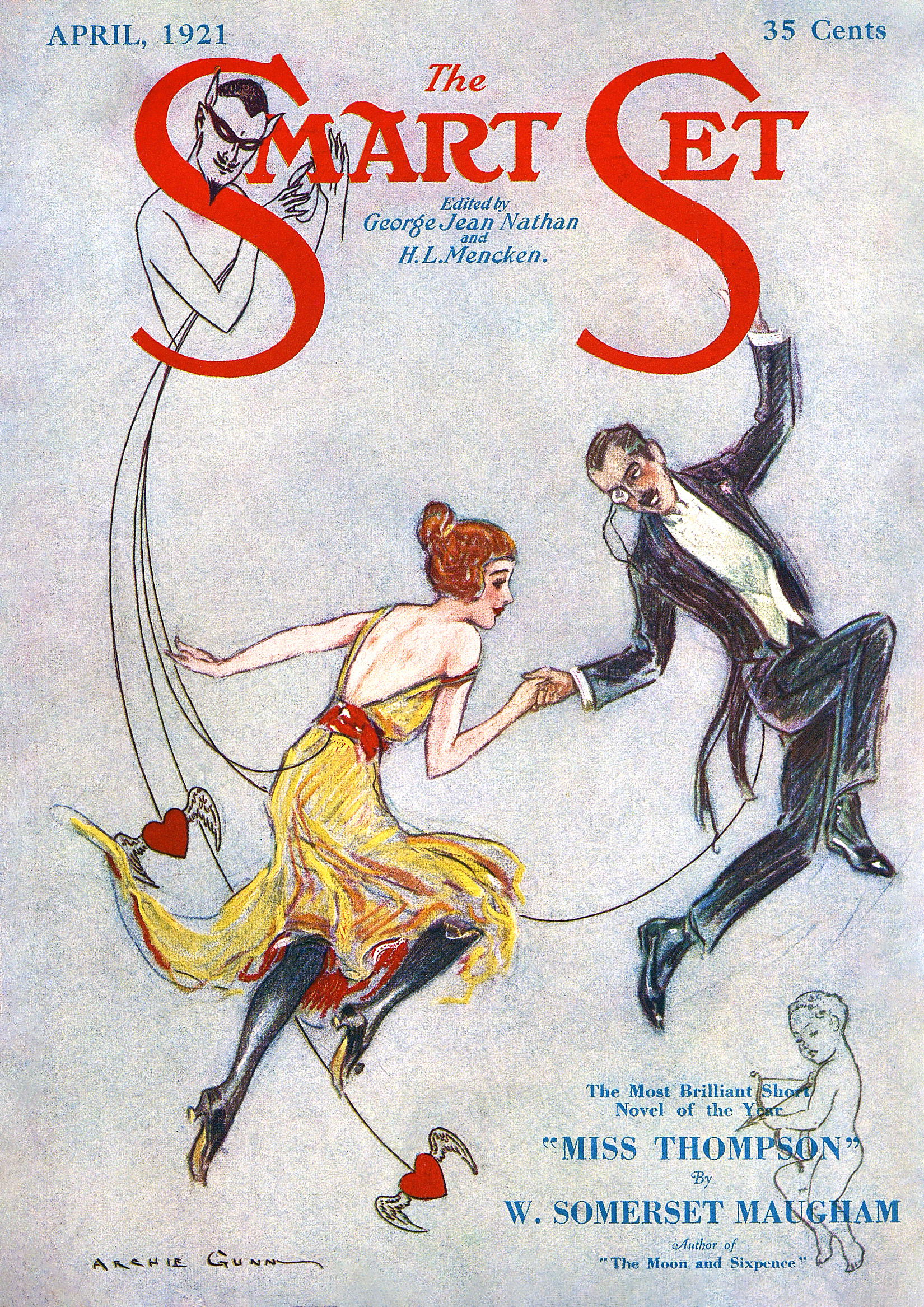
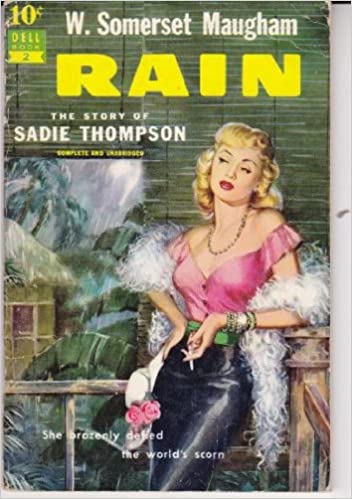
Sadie Thompson is a character in ‘Rain’ (1921), a short story by W. Somerset Maugham set in American Samoa. A ship’s crew member contracts measles, and its passengers are required to remain in port at Pago Pago for a period of quarantine: Dr and Mrs Macphail, missionary couple the Davidsons (ordinarily stationed elsewhere), and Sadie Thompson herself. All are offered accommodation in rooms above a shop. Sadie Thompson entertains sailors in her quarters, playing her gramophone loudly, to the the Davidsons’ infinite disapproval. They quickly infer that, having boarded at Iwelei (“plague spot of Honolulu. The Red Light district”), she is a prostitute, and Davidson himself undertakes to convert her. The missionary programme is vicious: the Davidsons expunge local practices of dancing and dress, impose fines on those who refuse to comply, and delight in destroying associates whose morality they deem insufficient. Davidson’s patriarchal fanaticism – of Sadie, he declares: “‘I want to put in her heart the passionate desire to be punished so that at the end, even if I offered to let her go, she would refuse'” – culminates in what the story very strongly implies is his rape of Sadie and his grisly death by cutting his own throat.

For Victoria Kuttainen, ‘Rain’ dramatises how missionary, medical and cultural regimes collide in the the “colonial, modernising Pacific”. She proposes that Somerset Maugham – both a literary figure and prolific writer for stage and screen – was acutely aware of the imagistic power of “fantasies of seductive starlets and beguiling tropical scenes”, and that his narrative choices comment on the performative power of speculation: other characters are given to report on Sadie’s conduct. In the diverse theatrical and cinematic adaptations of ‘Rain’,* meanwhile, “spectacle replaces speculation”. Stagings of Sadie melodramatically exoticise and evacuate the story of critical force.

The number in Love Happy quotes and exaggerates elements of these adaptations. It sweeps almost every hint of violence away, and reimagines the scenario as a comedy.

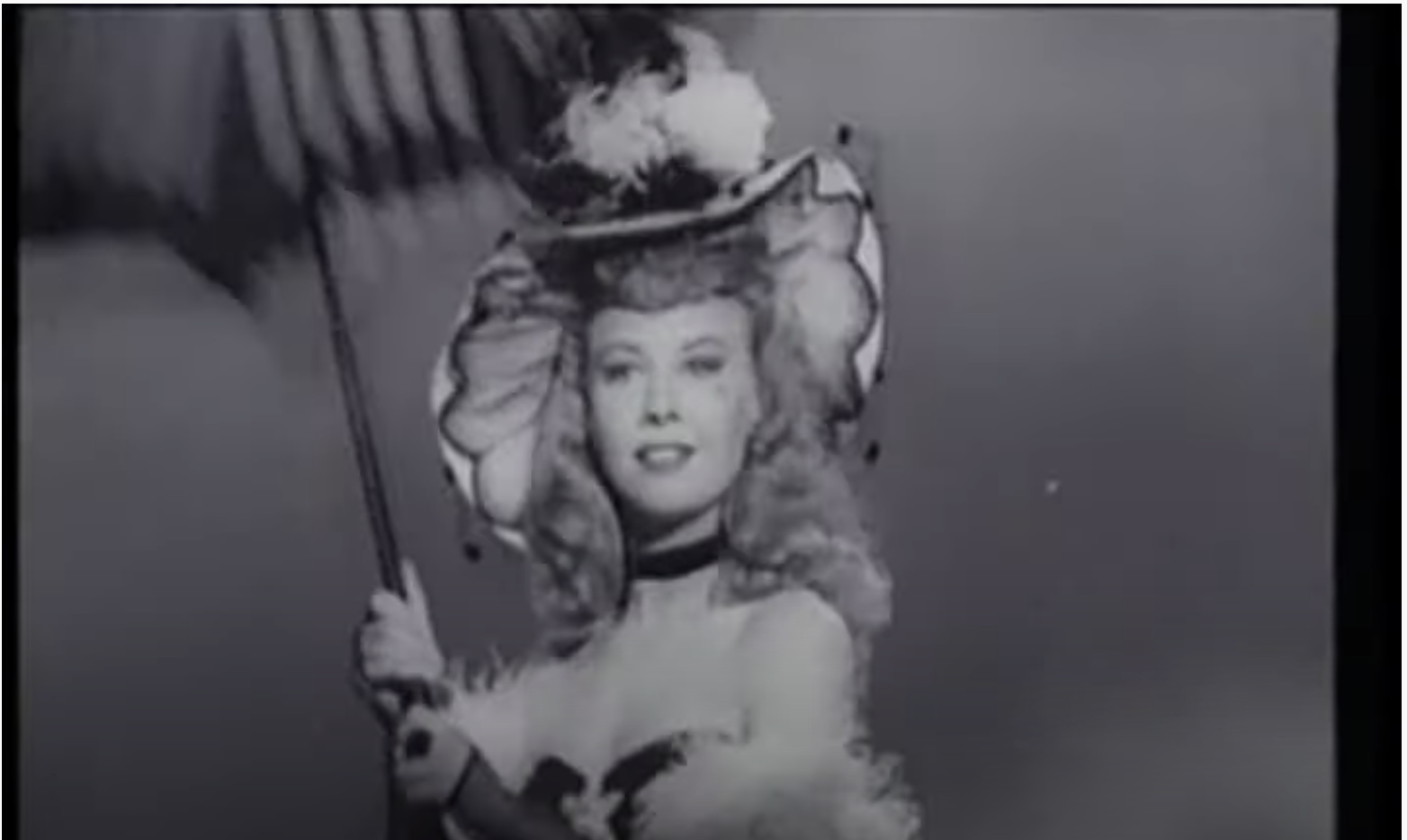
In this cartoon tropics, Sadie’s beau, Sergeant O’Hara (played by ‘Paul Valentine’, played by Mike Johnson) – a character introduced in these adaptations – places the needle on the gramophone, and the siren rasp of ‘Willow Weep For Me’ summons Sadie (played by ‘Maggie Phillips’, played by Vera-Ellen) to the stage. Marines gawp as she struts in, her hand magically conjuring her own spotlight. She roams about the stage with comic suggestiveness, occasionally knocking these uniformed men down like dominoes, while O’Hara gazes at her with deep desire. When, as in the story, Davidson (House Peters Jr.) stops the gramophone’s music, a drumbeat commences and a group representing Samoan dancers wearing what resemble lavalava enter the stage, supporting Sadie to continue – a section which trades in racialised stereotyping, places Sadie at its centre, but suggests collective solidarity between she and the islanders against the forces of missionary control. Davidson has failed, and exuberant music and dancing prevail. The gramophone resumes, and a whistle sends the Marines back, who have rushed Sadie like a pack of dogs. The number concludes softly: Sadie and O’Hara stand intimately together before the auditorium of the Broadway theatre to scattered applause.**

This larger-than-life musical rendition both sends up and luxuriates in the cultural habit of looking at Sadie. The lyrics and their sadness ghost the scene, a reminder of the tragedy of ‘Rain’, but here underscoring how Sadie just gets to go about her business.

Before watching the film, I had heard ‘Willow Weep for Me’ only in versions accentuating its bluesiness, as in the powerful recordings by Billie Holiday, Dinah Washington and Etta James, and Sarah Vaughan’s magical and hilarious live performance. With the exception of Stan Kenton’s 1946 arrangement featuring June Christy, the handful of recordings that precede Love Happy are a lively mix of foxtrot and cabaret, and a far cry from the sorrowful sentimentality of other later versions: Frank Sinatra, Julie London, Tony Bennett.

It begs so many questions: about the mood Ann Ronell originally intended for the song, how this scene in Love Happy was conceived and by whom,*** the direction of subsequent recordings. Regardless, it strikes me that its author’s well-documented determination, ambition, kindness and vivacity are of a piece with ‘Willow Weep for Me’. It is a song that “does exactly what it pleases”, recognising social and emotional limits, but isn’t about to accept them.

*John Colton & Clemence Randolph’s play Rain: a Play in Three Acts (1923); Sadie Thompson (1928), starring Gloria Swanson; Rain (1932), starring Joan Crawford; and Miss Sadie Thompson (1953), starring Rita Hayworth.

**Paul’s subsequent instruction to Maggie – “now go change into your ballet costume” – is arguably a misogynistic gag playing on the historical intersection of ballet and sex work.

***An edition of Film Music Notes speaks favourably of “the producer who allowed the composer select co-workers of her own choice wherever possible, thus assuring maximum of compatible tastes and efforts to musical production with minimum personnel”.

17: Almost Like Being In Love (1947)

This song is about time.

Right at the beginning of the lockdown, having missed the start of the National Theatre’s livestream launch of One Man, Two Guvnors, a friend and I decided to watch Groundhog Day (1993) in tandem in our respective flats instead. Nat King Cole’s sparkling version of Alan Jay Lerner and Frederick Loewe’s ‘Almost Like Being In Love’ brings the film to a close.

Lerner and Loewe wrote their by now much-recorded classic for the musical Brigadoon (1947), which received its pre-Broadway premiere on Groundhog Day that year. Over and above its lyrical aptness, was this choice a deliberate reference on the part of Groundhog Day‘s director Harold Ramis to the musical’s stage history? Encouraged by music editor Sally Boldt, Ramis resisted studio bosses’ demands for something poppier and more contemporary for the final moments of his film. Three months later, similarly distantly ensconced, we watched Vincente Minnelli’s film dramatisation of Brigadoon (1954). The song and this moment of calendrical serendipity only hint at the extent of what they share.

The golden thread that ties them together is their use of the single day as a narrative device. In Brigadoon, while lost with companion Jeff (Van Johnson) on a hunting trip in Scotland, jaded Tommy Albright (Gene Kelly) encounters the love of his life. Fiona Campbell (Cyd Charisse) is the denizen of an enchanted eighteenth century village that can reveal itself from the mist only once every one hundred years. Meanwhile, until he finds meaningful self-love, Groundhog Day‘s sardonic weatherman Phil Connors (Bill Murray) is condemned to repeatedly relive February 2 in the small town of Punxsutawney, whose annual groundhog ritual predicts the timeliness of spring.

‘Almost Like Being In Love’, Brigadoon‘s “only un-Scottish number”, places both punctuality and uncertainty at the heart of the experience of love. The full lyrics present a verse about the invigorating qualities of the Scottish Highlands and include the voice of the character Fiona, but the choruses, the basis of the majority of recordings, focus blissfully and more generally on the relationship between love and time’s markings.

What a day this has been! What a rare mood I’m in!
Why, it’s almost like being in love!
There’s a smile on my face for the whole human race!
Why, it’s almost like being in love!
All the music of life seems to be like a bell that is ringing for me!
And from the way that I feel when that bell starts to peal,
I could swear I was falling, I would swear I was falling,
It’s almost like being in love.

The present is of necessity constantly on the move. Likewise, the euphoria of love, which makes the person experiencing it a witness to their own self. These amazing lyrics achieve the perfect paradox of capturing the uncapturable – which may be why the final additional line of Frank Sinatra’s 1947 recording for Columbia (“In fact I have fallen in love”) feels so crashingly disappointing. (His infinitely livelier 1961 recording for Capitol, arranged by Billy May, doesn’t do this.)*

But what about the choice to characterise the music of life, which I understand to mean the divine energies that manifest as joy, as the sound of a bell ringing? With this phrase, modern timekeeping and the inevitability of wedlock threaten the song’s magical inbetweenness – reminiscent of the later lyric “get me to the church on time”, immortalised in My Fair Lady’s ‘I’m Getting Married in the Morning’ (1956), another famous Lerner and Loewe composition featuring bells.

Whatever. It’s hard to unthink these things, but to be honest I would rather focus on the song’s evocation of love as generous call and response, and music as sonorous vibration.

Still, both of these films are absolutely concerned with modernity – from the cultural and historical contrasts in Brigadoon between the villagers and their visitors Tommy and Jeff, and the screeching return of the two to a frenetic New York where Tommy’s fiancee (doppelganger of Fiona)** awaits, to Phil’s profession in Groundhog Day, which combines meterological prediction and small time celebrity and its discontents.

And the events that unfold in both rest on what modernity excludes. Magic isn’t supposed to happen in situations in which aeroplanes and cars are part of everyday life, and time marches forward relentlessly. Magic pauses that forward march, allowing different realities to emerge – the chance meeting of lovers from different historical times, a sequence of time that is endlessly replayed and reworked.

In this respect, these stories are both deeply theatrical too. Not unlike the weather forecast blue screen, Phil’s progress through the multiple reiterations of February 2 makes of Punxsutawney and its characters an ersatz stage setting for his cursed existential self-improvement – especially Rita (Andie MacDowell), the object of his desire, whose own kind self beneficently “makes him need himself”. Meanwhile, given the mystical threshold time of Brigadoon, Tommy struggles to take the reality of the feelings he and Fiona share seriously. As Serge Cardinal proposes in a wonderful discussion of the relation between temporality, music and image in Minnelli’s film, “music teaches him how to couple, to dance, in the deepest sense, with someone”.

When it appears at the end of Groundhog Day, ‘It’s Almost Like Being In Love’ sounds a bittersweet note. Phil knows Rita inside and out, but she, on a different temporal trajectory, hardly knows him at all. Not awesome in many respects.** But it’s also fitting that title lyric should become a hypothesis to be tested in a future that we won’t see. Set apart from the films’ narratives, the song expresses the radical uncertainty of all love as it begins. Worlds take on the character of contingency. These films literalise it. I said all this to my friend as we did post-match WhatsApp-ing about Brigadoon, and added that ‘almost like’ is just the maddest combination of words imaginable. “Which involves absolute risk”, he replied. “And all it is is… what you already hold, and is yours already.” So right. The beauty that lives in these films is how their protagonists move beyond fearful provisionality towards love for another, for themselves.


*Few recordings of ‘Almost Like Being In Love’ are as charming as Nat King Cole’s imo, but I really enjoy those by Beverley Kenny, Sallie Blair (“won’t you smoke the mood I’m in”), Chris Connor, Della Reese, Nancy Wilson, Etta Jones and Johnny Hartman. Michael Johnson’s takes the song in a unique direction.

**One million percent these are not feminist films. At all. Cf. the founding mythology of Brigadoon being flight from witches (Jeff: “Oh we have ’em. We pronounce it differently”), framing of almost every female bit part in Groundhog Day, etc etc.

16: So Rare (1937)

This song is quite something.


The transportative harmonies of Ahmad Jamal’s beautiful recording on Ballades (2019) suggest ‘So Rare’ to be a standard as beloved as Sammy Cahn, Axel Stordahl and Paul Weston’s ‘I Should Care’ (1944), also covered on that album. Not so: although it has topped the charts more than once, it’s actually sort of overlooked. Finding out more about it has been akin to an archaeological dig. Put together, its various pieces produce a totally unexpected picture, but one that (surprise surprise) nonetheless traces out contours of gender, ancient and modern. It is a trip.

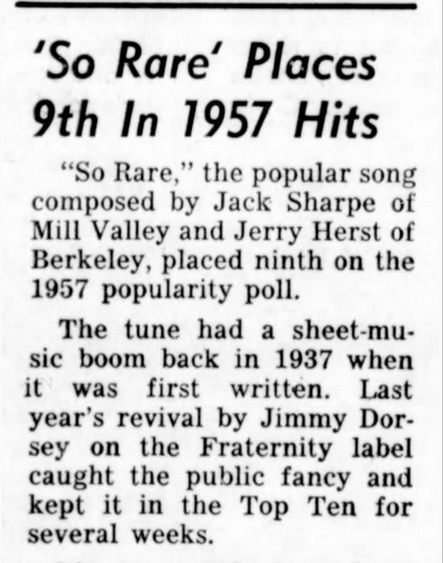
Written by Jerry Herst and Jack Sharpe, ‘So Rare’ is a rhapsody of love. It is jam-packed with images of heavenly hosts, exotic flowers, ethereal classical compositions and, most weirdly, the American flag. It was first recorded in 1937, no fewer than seven times that year, in various big band interpretations for dancing the foxtrot. Guy Lombardo and his Royal Canadians made it number one on popular radio show Your Hit Parade in the week of 11 September 1937. Then it was barely touched until 1957 – another bonanza year for the song, which saw the release of Jimmy Dorsey’s brash big band recording.

So Rare--clipping

Daily Independent Journal, San Rafael, California, 1 February 1958. https://www.newspapers.com/clip/3844368/jack-sharpe-1958/

Dorsey’s smash hit trailed several similar to near-identical arrangements in its wake – from Jimmy Carroll (1957), Billy Vaughn (1958), Les Brown’s Band of Renown (1960), Bill Black’s Combo (1964), and Willie Mitchell (1967).

Dorsey deletes most of the song’s lyrics. A raunchy saxophone solo takes the melodic lead in the A sections, while a chorus performs its first B section – the only words to appear.

You are perfection
You’re my ideal
You’re angels singing the Ave Maria
For you’re an angel
I breathe and live you
With every beat of the heart that I give you

Horns en masse deliver the second B section, while the chorus ‘do-do-doos’ along. The evil genius of this arrangement is in its juxtaposition of lyrics about putting virgins on pedestals, seductive sax, rasping horns, and a savage drum beat and tempo identical to that used in David Rose and his Orchestra’s ‘The Stripper’ (1962) (written in 1958) – both enactment and refusal of the nightmare Madonna-whore dichotomy that continues to be the bane of women’s lives.

In vocal recordings including more of the song’s lyrics, things take a series of different turns.

In full, ‘So Rare’ has a verse, and AABA twice over, with different lyrics each time around – one set normatively for a male voice (“You’re like the fragrance of blossoms fair / Sweet as a breath of air”), and the other for a female voice (“You have the warmth of a Schubert air / Charming and debonaire”), as if for a duet. The small number of vocalists who have tackled it (no duets) have picked and chosen between them. Ella Fitzgerald and Betty Johnson‘s gentle versions subversively go for the ‘male’ set, while Mavis Rivers rocks the ‘female’ set. So too does Vera Lynn‘s sentimental rendition, but – presumably on the basis of nationality – she rewrites the triumphalist second B section lines “You have that something, that certain manner / You thrill me more than the Star Spangled Banner”. Bing Crosby and Don Cherry weave those in, to all-American patriotic effect, while Andy Williams does not.

The two films that have used ‘So Rare’ in their soundtracks bring twenty year time lags, masculinity, femininity, and visions of America together in the most unlikely way.

Return to Macon County (1975) sees teenagers Bo (Nick Nolte, at least 33) and Harley (Don Johnson, 25) attempt to drive from Georgia to California in a ’57 Chevy to participate in a drag race. It is 1958. En route, they pick up manic pixie dream girl Junell (Robin Mattson), who, having been subject to harassment flirted with by the two in the roadside diner where she works, abandons her job to join them on the road. The film is like a less edgy Two-Lane Blacktop (1971), with couply scenes between Bo and Junell set in derelict and abandoned buildings that echo Rebel Without a Cause (1955).


Dorsey’s ‘So Rare’ is background to a motel room encounter between Harley and a random girl – full frontal, so we know she’s expendable – which only works for Harley when they head out to have sex in the car.

For Roger Ebert, this film was textbook nostalgia for the 1950s.

Ike and the rest of the adults were riled up about dragracing and juvenile delinquents, but 1958 was really a fairly innocent time, youth wise, and the characters in this movie would be chewed up in the first 10 minutes of a late 1960’s motorcycle picture, not to mention a contemporary ghetto violence exploiter.

Hustle (1975) is also preoccupied with the 1950s, but as the rotten foundation of the corruptions of the 1970s.


Lieutenant Phil Gaines (Burt Reynolds) is a Los Angeles cop, whose live-in lover Nicole Britton (Catherine Deneuve) is a high-end sex worker. He becomes embroiled in a case involving the death of young stripper Gloria Hollinger (Colleen Brennan), which her father Marty (Ben Johnson) refuses to accept as suicide. The film reveals the past as the seedbed of the present’s problems, all incubated in LA’s amorality. War trauma induced sexual apathy in Marty, thus infidelity in his wife Paula (Eileen Brennan), and thus a daughter who turned to sex work to cater to her insatiable desire for consumer goods – dysfunction as enmeshed as LA’s freeways, where ‘So Rare’ is introduced.

Hustle 3

Dorsey’s recording blasts from Gaines’ car, inaccurately trailed by an announcer: “For those of us who were alive in 1955, ‘So Rare’.”


Gaines repeats: “‘For those of us who were alive in 1955’. Christ.” His partner Sergeant Louis Belgrave (Paul Winfield) replies: “1955! That’s the year this little girl was born.” Gaines: “Yeah. Twenty years later, tissue specimens in a jar.” This dialogue about a twenty year old woman is the thin end of the wedge of the film’s misogyny, which is not inconsiderable. Idealised purity pitched against degradation: a vicious and enduring contrast.

14: Baby, It’s Cold Outside (1949)

This song mixes things up.

Frank Loesser wrote the duet ‘Baby, It’s Cold Outside’ in 1944 as a novelty party piece that he and his wife Lynn performed for friends at their housewarming. The song’s incongruous appearance in the romantic comedy Neptune’s Daughter (1949) garnered it an Academy Award and a clutch of other recordings in the same year by popular music and jazz greatsElla Fitzgerald & Louis Jordan, Margaret Whiting & Johnny Mercer, and Dinah Shore & Buddy Clark among them. Sixty years on, the song’s account of seduction fuels hot takes on sexual politics like no other. ‘Baby, It’s Cold Outside’: cute celebration of wintry flirtation, or vile dramatisation of sexual coercion?

The lyrics give us a couple who, in the score, are each assigned the nicknames ‘Wolf’ and ‘Mouse’. Gesturing to the bitter weather and his cosy living room’s roaring fire, the guy keenly insists that his gal should stay. Hyper-alert to the reputational consequences of such a choice, she invokes nosy neighbours and all her family members eagerly awaiting her chaste return – the most judgemental being her “maiden aunt”, whose “mind is vicious”. The story ends merrily with the Mouse’s seeming capitulation, the two singers delivering the song’s title lyric harmoniously together.

The contemporary debate about the song’s power dynamic has become frenzied. In 2018, an array of North American radio stations went so far as to ban it, one DJ making the assessment that “in a world where #MeToo has finally given women the voice they deserve, the song has no place”. In a similar vein, John Legend not uncontroversially adapted its lyrics with Natasha Rothwell for a 2019 #MeToo-responsive recording with Kelly Clarkson – who herself had previously recorded the song with Ronnie Dunn in 2013.

This fraught scene has given rise to some really amazing writing. I concur with Chris Willman’s hilarious view, which opens his 2018 survey piece for Variety:

There is one group, and one group only, that should be crusading against the performance of ‘Baby, It’s Cold Outside’ in public: vicious maiden aunts.

For Willman, Zoey Deschanel and Will Ferrell’s shower-scene performance in Elf (2003) is the fountainhead of the song’s becoming “ubiquitous almost to the point of torture” – a suggestion in interesting historical accordance with Amelia McDonell-Parry’s 2018 article for Rolling Stone. There, she writes that current critique of the song’s sexual politics first got underway in 2004. She refers to a truly brilliant 2016 Tumblr post by a “former English teacher/nerd”, who argues that the now-incendiary lyric “Say what’s in this drink?”, penned in 1944, was “a stock joke at the time, and the punchline was invariably that there’s actually pretty much nothing in the drink, not even a significant amount of alcohol”. This writer concludes:

it’s a song about a woman finding a way to exercise sexual agency in a patriarchal society designed to stop her from doing so. But it’s also, at the same time, one of the best illustrations of rape culture that pop culture has ever produced. It’s a song about a society where women aren’t allowed to say yes…which happens to mean it’s also a society where women don’t have a clear and unambiguous way to say no.

Unlike clickbait determined that ‘Baby, It’s Cold Outside’ should be either one thing or the other, the best recordings of the song find similar both-and depth.

Admittedly, Frank Sinatra’s performance with Dorothy Kirsten fully embraces predation: it features a cartoonish spoken word section in which, in Pepe Le Pew-style, he locks her in his house and swallows the key. But Carmen McRae and Sammy Davis Jr’s increasingly funny version gives us a boss female protagonist. Louis Armstrong and Velma Middleton’s is also packed with jokes. Like its fairytale fantasy video, Tom Jones and Cerys Matthews’s is almost psychedically hyperbolic, topped off with Matthews commenting “Bloody freezin’, innit?” in a broad Welsh accent.

Plus there are plenty that flip the heteronormative script, assigning the Wolf to the female vocalist, or presenting two male or female singers – Caroline Pennell, She&Him (Zooey Deschanel and M. Ward), Kelley Jakle & Shelley Regner, Nathaniel Rateliff & Julie Davis, John Travolta & Olivia Newton-John, the version from Glee. Scott Bradlee’s Postmodern Jukebox delightfully substitutes a tap dancer for the Wolf. In this context, rewritings of the song seem quite baffling. As I receive it, John Legend’s adaptation presents a controlling guy and an anxious girlfriend – similarly, Lydia Liza and Josiah Lemanski’s. (The comments on the Legend YouTube video are golden.) It’s notable that in both of these versions the Mouse’s lyrics remain largely unaltered.

In Neptune’s Daughter, the song’s first public outing was in fact performed with and without role reversal.

A comedy of mistaken identity, the film hinges on hot ‘South American’ masculinity and sexuality being compared to ‘North American’ schlubby haplessness, and ‘right’ and ‘wrong’ kinds of feminine conduct. Swimming champion turned swimsuit designer Eve Barrett (Esther Williams) is anxious to protect her man-obsessed sister Betty (Betty Garrett) from herself – in particular her yearning for José O’Rourke (Ricardo Montalban), the captain of the South American polo team (yes, all of South America). Betty confuses masseur Jack Spratt (Red Skelton) with José, and commences an aggressive programme of seduction, much to Jack’s initial terror. Meanwhile, Eve tackles José, and he cultivates her misapprehension that Betty is dating him.

The song takes place mid-way through the film, improbably on a “warm summer’s evening”, and contrasts the two couples: Eve sidestepping José’s wolfish overtures, and Betty ardently pinning Jack to a couch. The scene quickly segues to ‘Jungle Rhumba’, an extended dance number orchestrated by Xavier Cugat, an exoticising proxy for what Betty and Jack may or may not be getting up to.

It’s a strange, not unproblematic film. But with its pantomimic cross-dressing, presentation of desire, and a decidedly homoerotic massage scene between José and Jack, Neptune’s Daughter both establishes and messes with Eve’s opening gambit: “men are men, and women are women, and, well, that’s just the way it is” – as do the richest interpretations of Loesser’s ingenious song.

13: Violets For Your Furs (1941)

This song is the epitome of shifting sands.

Matt Dennis and Thomas Adair wrote ‘Violets For Your Furs’ together in 1941. Appearing on The Rosemary Clooney Show in 1957, Dennis reminisced about the process:

Well this is probably the corniest songwriting story of all time, but my partner and I were sitting in the pub one snowy night back in New York and he was having a beef with the girl he was dating at the time. Sitting there just listening to a combo play the blues, and well, feeling kind of moody anyway, he came up with this song title. It sounded pretty good to me, so I just started working on the melody right there. Believe it or not he wrote the lyrics right on the tablecloth too, and before the evening was over we’d written ourselves this song.

The wintry context of its creation makes its way into Adair’s lyrics. A kind of theatre of memory, the song sketches out a scene between two lovers, nostalgically recalled by the song’s protagonist. As snow drifts down in the Manhattan streets, a man buys a posy of violets for his beloved’s fur coat, which has the enchanting effect of making the chilly situation seem like spring. The song concludes adorably: “You smiled at me so sweetly, since then one thought occurs / That we fell in love completely, the day that I bought you violets for your furs”.
On one level, it’s a simple story of a simpler time: men were chivalrous, women were graceful, furs were the height of sartorial elegance, and love was new. But even on its own terms, setting aside any questions that may or may not arise concerning ‘men’, ‘women’, courtship, and who can procure fresh flowers and furs in Manhattan at the tail end of the Great Depression, the song contains multitudes.

Tommy Dorsey and Frank Sinatra recorded it first in 1941, in an interpretation that conjures divine dinner dances, and the giddy euphoria of falling in love. The moment on the Manhattan street feels like it happened just last week, but also that it’s yet to come. Meanwhile, Sinatra’s sleigh bell-sprinkled 1956 rendition – whose seasonal phrasing is taken by Barry Manilow’s recording – seems to look back to a happy event many Christmasses ago. Johnny Hartman’s extraordinary performance – a tribute to John Coltrane’s – is heavy with deep disappointment. Shirley Horn’s sublime version aches with remembered longing. Beverly Kenney serves up bright and naive entitlement, with a tiny hint of rage: maybe this character didn’t get what they wanted in the end. Stacey Kent delivers a poignant reverie.

Alec Wilder and James T. Maher delight in the way ‘Violets For Your Furs’ “moves and does lovely inventive things”, comparing singer and composer Matt Dennis’s writings to Johnny Mercer’s, which each “suggest the presence of the performer in their composition”. It’s so rich. Its embrace of then and now, whenever these times are in the universe of a given interpretation and whatever has taken place in-between, is magic. Even still, it’s comparatively neglected as a standard, with recordings only in the double digits. No films seem to have taken it up, although it is fleetingly mentioned in a scene in the ninth episode of cancelled ABC drama Six Degrees (2006-2007).

Is that neglect to do with anti-fur politics, as this piano studio proprietor suggests?

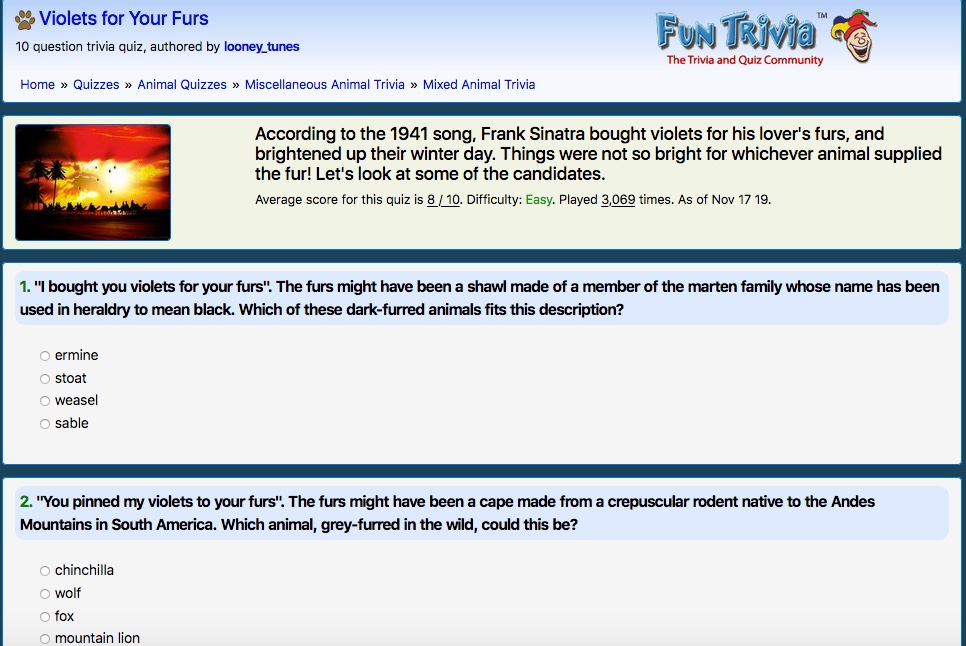
(On that issue, this highly specialised quiz about animals = in the running for my most favourite weird internet thing.)

Violets For Your Furs

Or is it to do with the somewhat antiquated ritual it describes?

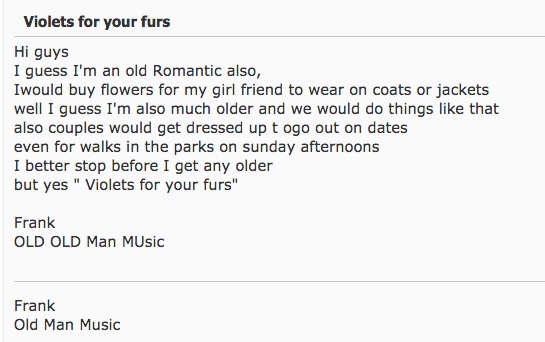
This 2003 sinatrafamily.com thread is started by a forum member who can’t ‘get’ the song, and thinks it’s ‘asinine’. Her contribution prompts a flurry of rebuttals from fellow posters fantasising trips down all kinds of real and imagined memory lanes, some lamenting the decline of civilisation as manifest in casual dress. A lengthy discourse on hats unfolds. Its kind and friendly online banter is a world away from the cultivated vitriol of the contemporary social industry.

Violets Sinatra forum

These thoughts of animal rights, old school gallantry and polite conversation were front of mind as I wandered around the internet seeking out links to various versions of ‘Violets For Your Furs’. Seeing the cover art for Marty Paich’s I Get A Boot Out Of You (1959) took me aback.

Paich’s magnificently louche arrangement of ‘Violets For Your Furs’ on this album suggests lovers in smoky late night bars. The racy cover art is like a cutesified sexy and highly unsettling anticipation of the shower scene from Hitchcock’s Psycho (1960).

Similarly, Dave Brubeck’s Angel Eyes (1965) features a tremendous hard-swinging version of the song, and a glassy-eyed Terry Reno on its cover. Twenty or so years after ‘Violets For Your Furs’ was composed, second wave feminism was burgeoning, and at the same time beautiful girls stared out from a lot of cover art, in varying states of undress. (I’d call it Playboy-ification, but these album covers are ahead of the Playboy game.) Plus ça change, etc. Romantic love may be protean, and the gentle attentions of ‘Violets For Your Furs’ out of joint with the softcore objectifications of the 1960s. But the patriarchal structures that prop up ‘romance’ are doggedly persistent, for sure.

12: I Only Have Eyes For You (1934)

This song is a fantasy.

Harry Warren and Al Dubin wrote ‘I Only Have Eyes For You’ for the movie Dames (1934), a satire on theatrical censorship featuring Busby Berkeley’s choreography. In context, the song is a sweet serenade given by budding Broadway composer and impresario Jimmy (Dick Powell) to his dancer girlfriend Barbara (Ruby Keeler). Their love story is a slight vehicle for Dubin’s intense lyrics. But thematically the song suits the film – a comedy of errors about gazing at beautiful actresses.

‘I Only Have Eyes For You’ asks how somebody smitten sees the world. Or rather, what they see. As the (very infrequently performed) verse has it, love is selectively ‘blind’, an ‘optical illusion’. The choruses describe how, to a person in love, all things – stars, gardens, crowded avenues – confusedly ‘disappear from view’. This feat is performed cinematically in Dames, which magically vanishes people from the street and the subway as Jimmy croons to Barbara.

The song’s massive recording history kind of reflects this disappearing act. There are plenty of straight ahead interpretations by jazz greats – Louis Armstrong’s story of gentle flirtation, Frank Sinatra’s confident seducer, Billie Holiday’s effervescent party-goer, coquettish Carmen McRae. Mary Wells gives a big Motown rendition, while Etta Jones swings languidly, weaving in Billie Holiday’s invented lyric ‘big, bulging eyes’ towards the end. But the haunting doo-wop recording made by The Flamingos in 1959, exquisitely arranged by band member Terry Johnson, has influenced so many others that it almost comes to substitute for the original.

‘My love must be a kind of blind love’, it begins. ‘I can’t see anyone but you.’ Having collaged these two lines from the verse to the top, this version then unfolds the choruses. Its mesmerising sound suggests being underwater, at the top of a mountain, inside a cathedral of ice. But its defining aesthetic characteristic is the cold – which sort of makes sense of the really odd apres-ski mise-en-scene of The Flamingos’ TV performance in the clip above. According to the YouTube poster, that edition of The Dick Clark Show was shot in the sticky New York heights of July.

There are also plenty of recordings that are simple covers of The Flamingos’ version – from Boyz II Men’s to Tashaki Miyaki’s – while others, like Catherine Russell’s, draw momentarily on its variation of the melody. Liane Carroll’s fierce shuffle funk interpretation is absolutely stunning. Differently captivating is Oneohtrix Point Never’s hypnotic composition, which seems to bring an android into conversation with a sinister gang of monks.

For ‘I Only Have Eyes For You’, one of the finest episodes of Buffy the Vampire Slayer (1997-2003), The Flamingos’ version is pretext for and backdrop to its story.

The spirit of James Stanley, class of Sunnydale 1955, is stalking the school’s halls. He is compulsively re-enacting the night when, crazed with controlling grief, he shot teacher and ex-lover Grace Newman. Both spirits are possessing current students, caretakers and teachers, almost always resulting in a death. Buffy correctly and angrily surmises that he wants forgiveness, a recognition based on her own recent catastrophe: sex with her boyfriend Angel, which transformed him back into murderous vampire Angelus, who then promptly killed her watcher Giles’ beloved partner, teacher and Clan Kalderash member Jenny Calendar.

James calls Buffy to the school by night, where she finds Angelus lurking. They become surrogates in James and Grace’s unhappy story, which uncannily echoes their own.

https://www.youtube.com/watch?v=SM2eLr9nIsM

Following these events, Buffy, in shock, places the ethereal Flamingos’ record on a turntable, and gazes into a mirror, where she sees James’ reflection look back at her. But embodying Grace, Angelus’s vampiric undeadness allows both stories to be resolved. Instead of falling for the umpteenth time over the school’s balcony to her death, Grace/Angel returns, declaring love for James/Buffy and the shooting (sexual metaphor alert) an accident, releasing them both.

(Historical accuracy quibble: why not make James class of 1959? The answer is probably Back To The Future (1985). I mean, ok. But come on.)

In this phenomenal episode, ‘I Only Have Eyes For You’ means obsession, grief, not-seeing, the same scene playing out across different bodies. Though different in kind, it shares spooky parallels with the song’s appearances in Dames.

First, Jimmy serenades Barbara on the Staten Island ferry, the Statue of Liberty in the background. Couples coo around them. Love is heteronormative sequence and sameness.

Later, extending the scene of Jimmy’s flight of fancy on the subway train, in which ads bearing women’s faces blend into Barbara’s, Busby Berkeley’s spectacular choreography presents a proliferation of Barbaras, suggesting women as interchangeable commodities, everywhere different but the same. As Lucy Fischer brilliantly puts it, the doppelganger girls’ ‘aimless, repetitive movement‘ embodies a kind of ‘zombiism‘.

The end of the Buffy episode sets all these stagings of surrogacy off. Buffy tentatively ventures to Giles: ‘part of me just doesn’t understand why she would forgive him’. Her sideways look of guilt reveals that really she is asking why Giles would forgive her. Anthony Stewart Head’s delivery of Giles’ patient response ‘does it matter?’ is magnificent. Anger, pain and loss commingle and dissolve in his performance. The scene evokes a unique unconditional love, but equally, how different stories of love can bear a resemblance.

5: Where Or When (1937)

This song is unforgettable.

Nora Ephron’s enduringly excellent romantic comedy When Harry Met Sally (1989), directed by Rob Reiner, hooks various elements of its narrative on a selection of jazz standards, including ‘Where Or When’.

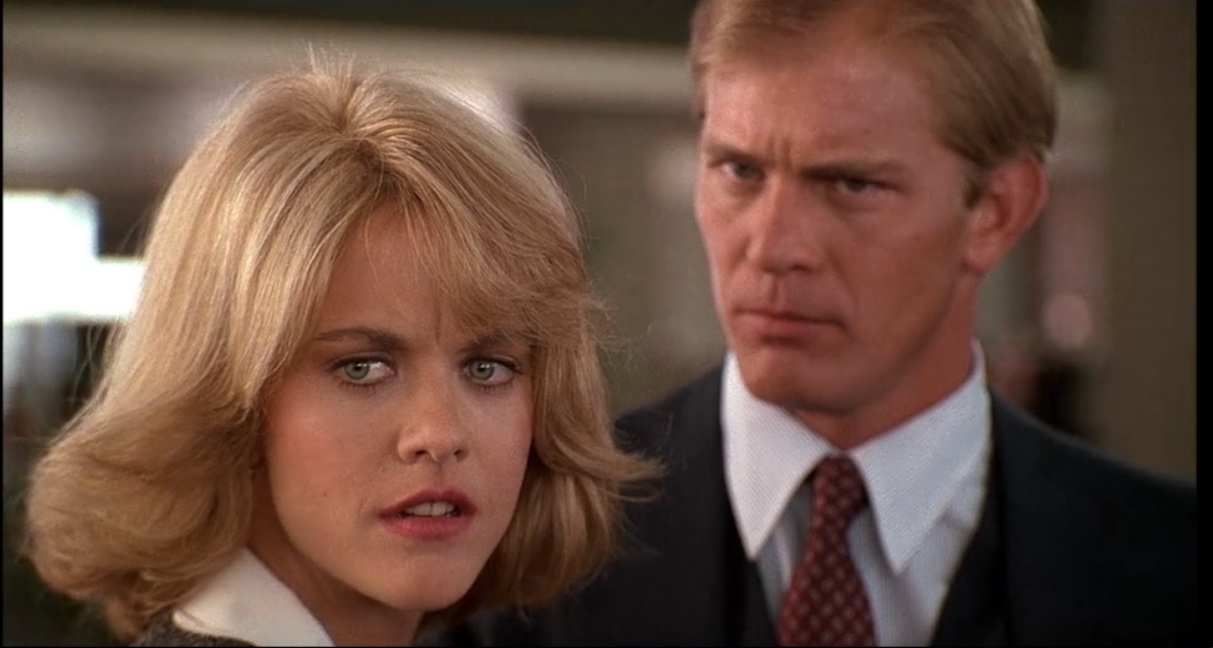
The opening chorus of Ella Fitzgerald’s bright version cues the film’s early airport scene, in which Sally (Meg Ryan) is saying goodbye to her new boyfriend Joe (Steven Ford). There, she re-encounters Harry (Billy Crystal), who, passing by, sees former fellow building occupant Joe and stops for small talk. ‘Thank god he couldn’t place me’, she says grimly, glaring after Harry down the airport concourse. ‘I drove from college to New York with him five years ago and it was the longest night of my life.’

When Harry Met Sally

Richard Rodgers and Lorenz Hart wrote ‘Where Or When’ for their musical Babes in Arms (1937). In that context, the song is talking about deja-vu. Its verse makes this theme clear: ‘Sometimes you think you’ve lived before / All that you live today.’ The chorus, where most jazz interpretations of the song start, ponders memory: ‘It seems we stood and talked like this before / We looked at each other in the same way then / But I can’t remember where or when.’ Amazingly, the performance history of the musical has active forgetting written into it, having been reimagined twice with various degrees of change to plot, racial politics and line-up of songs: as a 1939 film starring Judy Garland and Mickey Rooney, and as a stage version created by George Oppenheimer in 1959. ‘Where Or When’ features in all three versions.

The song can speak of casual flirtations.

On Etta Jones’ recording, easygoing puzzlement develops into joy, like a chance morningtime encounter that becomes a day-into-night date. Frank Sinatra’s live take with Count Basie on the other hand suggests cocktail-fuelled and quickly forgotten nights of carnal enjoyment. But the song is more than open to less celebratory, more emotionally searching interpretations.

For example, Harry Connick Jr’s rendition for the When Harry Met Sally soundtrack – a set of companion arrangements for which he won a Grammy – is intense and melancholy. It proposes forgiveness, a deliberate reckoning with a relationship’s beautiful past, whose patterns are re-emerging in the present. As the teen owner of this recording on cassette I fell completely in love with its piano solo (here, from 1.57-2.34), rewinding it repeatedly. Bryan Ferry’s folkish version, featured on his album of standards As Time Goes By (1999), performs an act of tremulous alchemy, making of the song a dreadfully sad story of memory loss and partial recognition. There, the line ‘But who knows where or when’ possesses terrible tragic irony: in the scenario that the song conjures, the experience of forgetting does not seem to be shared.

Donald Shirley’s solo piano version, released in 2001, is something else altogether. In the wake of the release of the controversial Academy Award-winner Green Book (2018), various features have reflected on his body of work: a concert pianist confronted with institutionalised racism, Shirley created beautiful interpretations of jazz compositions inflected with classical allusions. A New York Times piece refers to Kris Bowers, composer of Green Book‘s score:

“‘Lullaby of Birdland’ was one of the first ones that I knew I wanted to include, because he starts off quoting a couple of classical pieces, and then when he goes into the song, it’s almost like a false start, because he uses the melody as the beginning of a fugue,” Bowers said in an interview. “He’s doing a proper fugue, exposing the subject, et cetera, within a jazz context. I listened to that and said, ‘Wow, I’ve never heard anybody do that before.’”

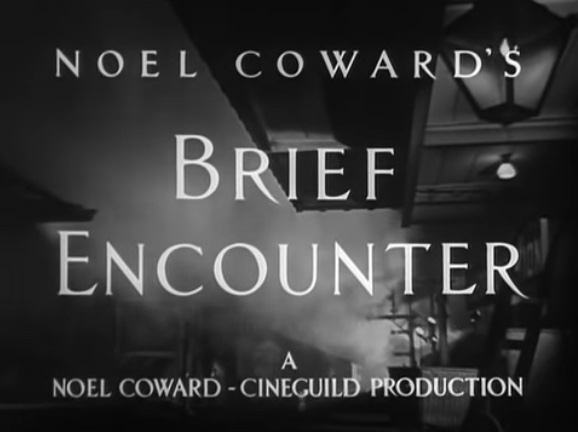
Shirley’s rendition of ‘Where Or When’ alludes poignantly to phrases and chord progressions from Rachmaninoff’s Piano Concerto No. 2 in C minor and Chopin’s Prelude in D flat (Raindrop Prelude). (These are the two I recognised; for sure there will be more that I can’t yet hear.) It evokes Noel Coward’s Brief Encounter (1945), directed by David Lean, a film indelibly associated with the Rachmaninoff work.

Brief Encounter

Shirley’s piece chimes painfully with the desperate longing dramatized by the film: a story of doomed interwar love ignited between Laura (Celia Johnson) and Alec (Trevor Howard), both of whom are married. Clouds gather at its outset. Snatches of melody promise to become more substantially themselves, but never do.

‘Some things that happen for the first time / Seem to be happening again.’ In Shirley’s exquisite performance, the ghosts of an earlier composition haunt ‘Where Or When’. Meanwhile, on-screen, a last tryst in a railway station cafe is tragically, irretrievably interrupted; love begins in a bookshop thanks to a re-meeting in ‘personal growth’.


4: Gee, Baby, Ain’t I Good To You (1929)

This song assumes many guises.

‘Gee, Baby, Ain’t I Good To You’ was written in 1929 as a collaboration between bandleader Don Redman and songwriter Andy Razaf. Its lyrics present a person contemplating love and fidelity, and the furs, cars and jewels they give to their significant other as token and guarantee. Recorded first in New York under the name of Redman’s band, McKinney’s Cotton Pickers, in a session featuring a host of Harlem jazz luminaries, Redman performed the lyrics himself.

It’s since been recorded hundreds of times, most recently in a live set by Jeff Goldblum and the Mildred Snitzer Orchestra, with a virtuosic vocal performance by Haley Reinhart which builds from quiet seduction to full-throated euphoria.

In his beautiful biography of Andy Razaf, Barry Singer discusses the ‘pristine craftsmanship’ of the song and its multidimensionality.

‘Ain’t I Good To You?”s lyric question – “Gee baby, ain’t I good to you?” – was in many ways a perfect blues phrase: bittersweet, wry, and plaintive all at once, a question that readily absorbed whatever emotional experience a singer might bring to it – insistence, recalcitrance, determination, despair – the range of possible inflection was endless.

Jose James’ powerful version of the song uneasily suggests control masquerading as love. Redman’s original spoken word performance seems a milder, more hesitant variation on that theme. Meanwhile, Nat King Cole’s 1944 interpretation is kindly and vulnerable: his character sounds like a soft touch being taken for a ride in a situation that will not end well, as the song’s discordant finish hints. In Peggy Lee’s version, her wistful vocal performance is in dialogue with spiky piano improvisation, as if it’s her guy arguing with her, wriggling to get free. Ella Fitzgerald and Louis Armstrong’s duet, which tweaks the lyrics, presents a fiery conjugality in which a couple showers one another with gifts. Two additional lines conclude the song: ‘Get me paying taxes of what I gave to you / Gee baby, ain’t I good to you’.

This handful of versions toys with constraints of gender, money and power, exposing the torturous difficulty of human connection. A universe of possibility lives in the song.

At YouTube links to these recordings, references to the problematic Jim Carrey movie The Mask (1994) pop up repeatedly in the comments – ‘SSSSSSSSSSOMEBODY STOP ME! SSSSSSMOKIN”, ‘Just watched The Mask and it brought me here :-)’. Having never seen the film in full before, I didn’t know that mid-way through The Mask is a performance of ‘Gee, Baby, Ain’t I Good To You’ by Cameron Diaz, dubbed by vocalist Susan Boyd.

Mask 9

Carrey stars as Jekyll and Hyde character Stanley Ipkiss, a downtrodden bank clerk living in the Chicago-like Edge City. His accidental acquisition of the magical mask of Loki transforms him into the libidinal Mask by night, unleashing his subdued inner self, which to this point has been given expression only through his fandom of Tex Avery cartoons. (This recent Den of Geek post interprets the film as a parable of alcohol consumption.)

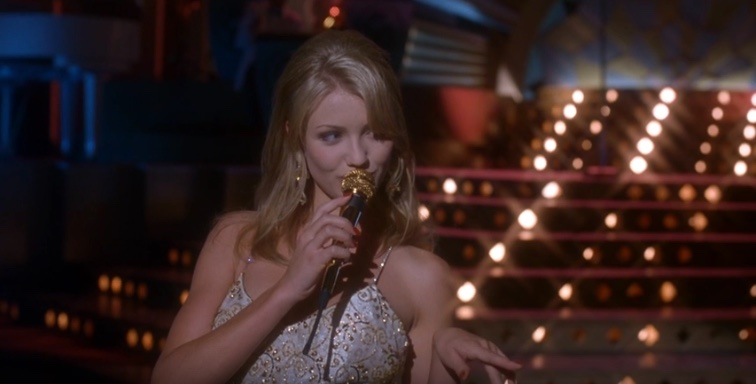
Ipkiss has developed a crush on singer Tina Carlyle (Diaz) thanks to her rain-drenched visit to his bank on a reconnaisance mission for her gangster boyfriend Dorian, who intends to rob the bank as part of a larger city takeover. Hearing that she will give a performance, Ipkiss transforms into the Mask to gain entry to the exclusive Coco Bongo, the club where Carlyle works and Dorian is based, having robbed the bank himself first to pay for his night out.

https://www.youtube.com/watch?v=GlarHBBQ5tA

From the stretch limo that carries the Mask to the club, to Diaz’s appearance onstage and his racy response, the scene draws heavily on the Tex Avery animation ‘Red Hot Riding Hood’ (1943) which appeared earlier in the film, a short which jazzes up Little Red Riding Hood.

https://vimeo.com/218354742

Where ‘Red Hot Riding Hood’ satirises the male gaze, The Mask fully signs up to it, and nowhere more explicitly than in this scene. Red Riding Hood’s performance of Bobby Troup’s ‘Daddy’ (1941), a song about getting and being given fancy stuff, begins sweetly and becomes increasingly physically exaggerated, even grotesque. In The Mask, the opposite is the case: here, ‘Gee, Baby, Ain’t I Good To You’ manifests as a story of male satisfaction, and the vehicle for the consistent presentation of Cameron Diaz’s body as alluring temptation. With a lyrical adjustment – ‘I know how to make a good man happy, I treat you right / With lots of love just about every night’ – the overwhelming visuality of the scene veils the delicate ambivalence of Redman and Razaf’s composition about love and gifts.

3: Peel Me A Grape (1962)

This song has many layers.

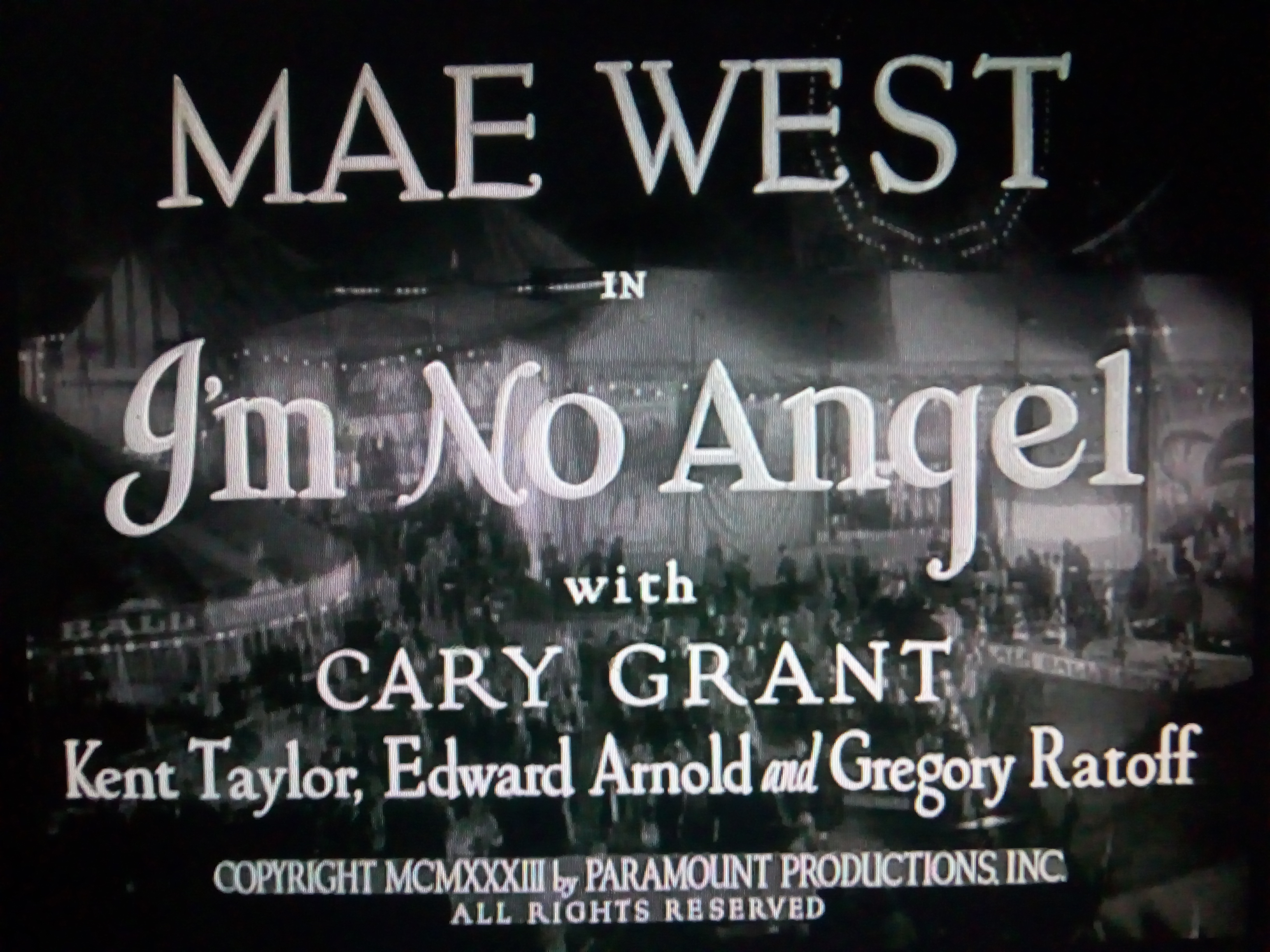
The phrase ‘peel me a grape’ was Mae West’s invention, an ad-libbed wisecrack rattled off by her character Tira, the brassy protagonist of I’m No Angel (1933).

First recorded by Anita O’Day and Cal Tjader nearly thirty years later, Dave Frishberg’s ‘Peel Me A Grape’ consists of a list of splendid demands made by a woman to a lover. She wants Scotch on delivery, polar bear rugs, peach fuzz for a pillow. “Here’s how to be an agreeable chap”, she explains. “Love me and leave me in luxury’s lap.” In case of any doubt as to who is calling the shots: “When I say do it / Jump to it.” Peel me a grape: gratify my fancies. Immediately.

Frishberg wrote the song in response to a request for “a cute, sexy piece” for singer Fran Jeffries (magnificent in The Pink Panther (1963)). The New Yorker‘s Whitney Balliett celebrated how Frishberg’s post-war composition “laughs at social ennui”. Listening to it with my female ears, a comic jab at baby boomer boredom doesn’t immediately strike me as its main thing. I hear power play and not only the obvious one.

To that extent, the story of Mae West’s I’m No Angel is fully written into the song’s DNA.

IMG_20190202_144934

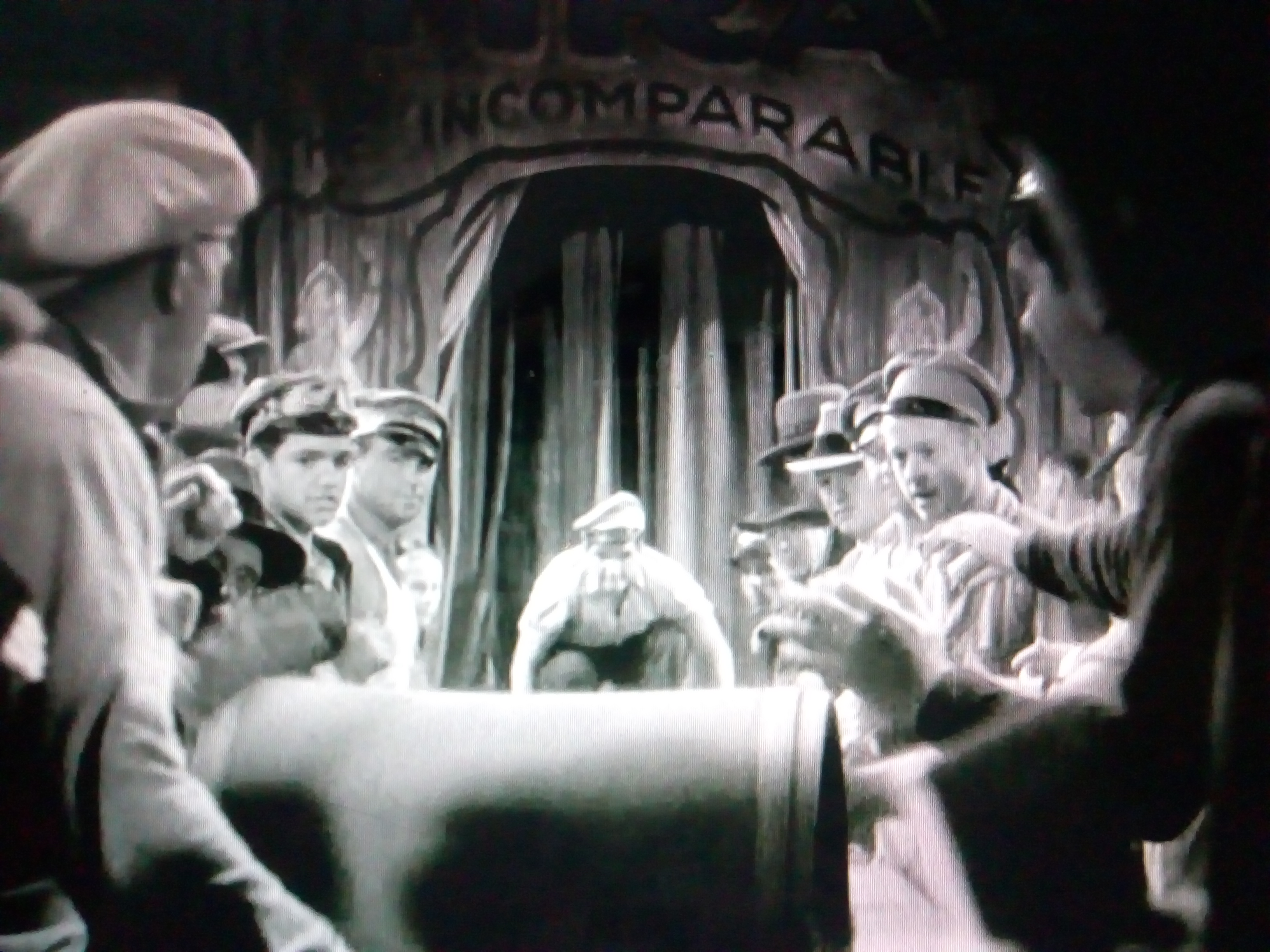
Tira is a hustling circus dancer. Her ascent to the big time through a daring lion-taming act delivers her personal wealth, access to the well-to-do, and ultimately Jack Clayton (Cary Grant), with whom she falls passionately in love.

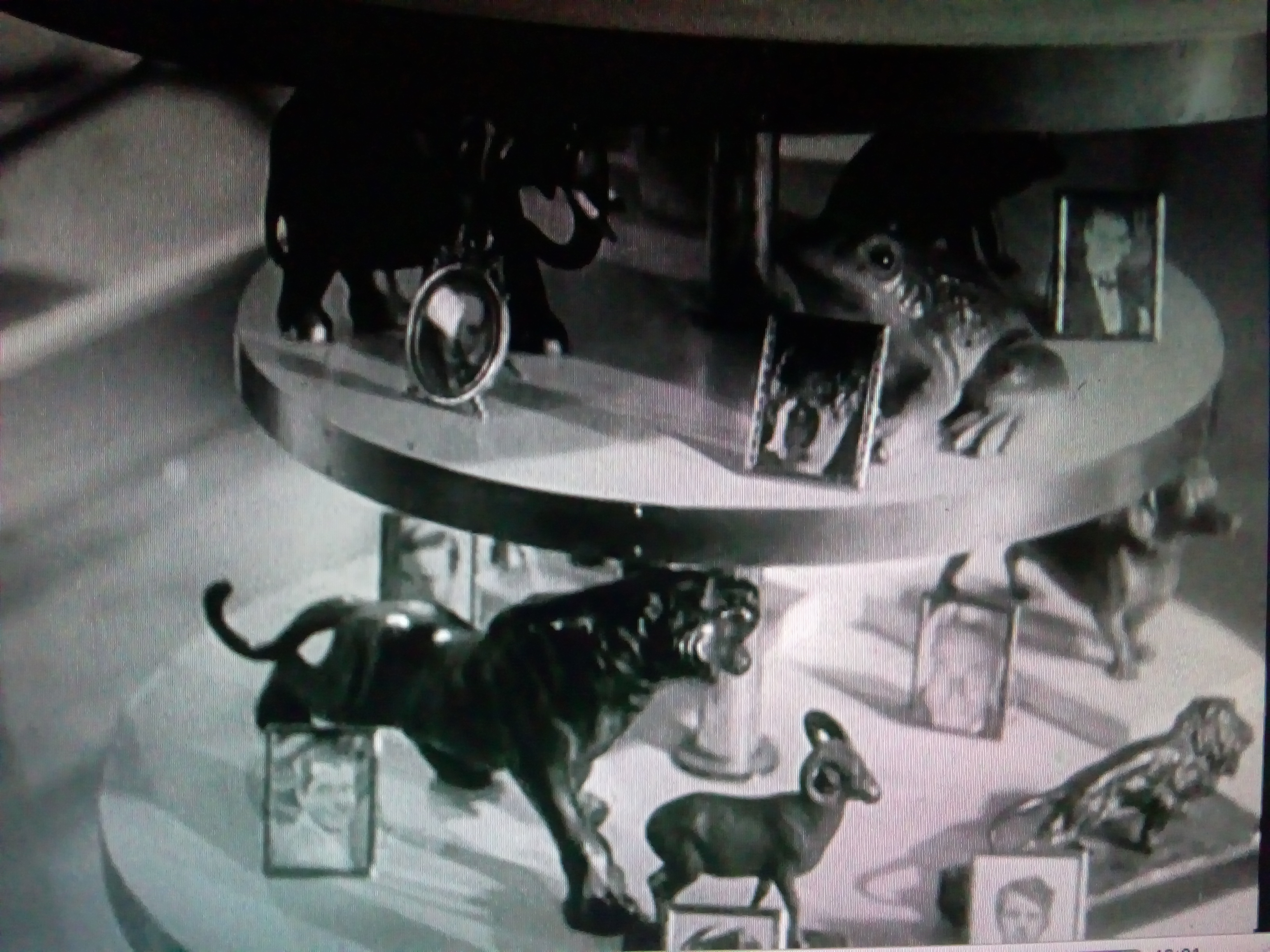
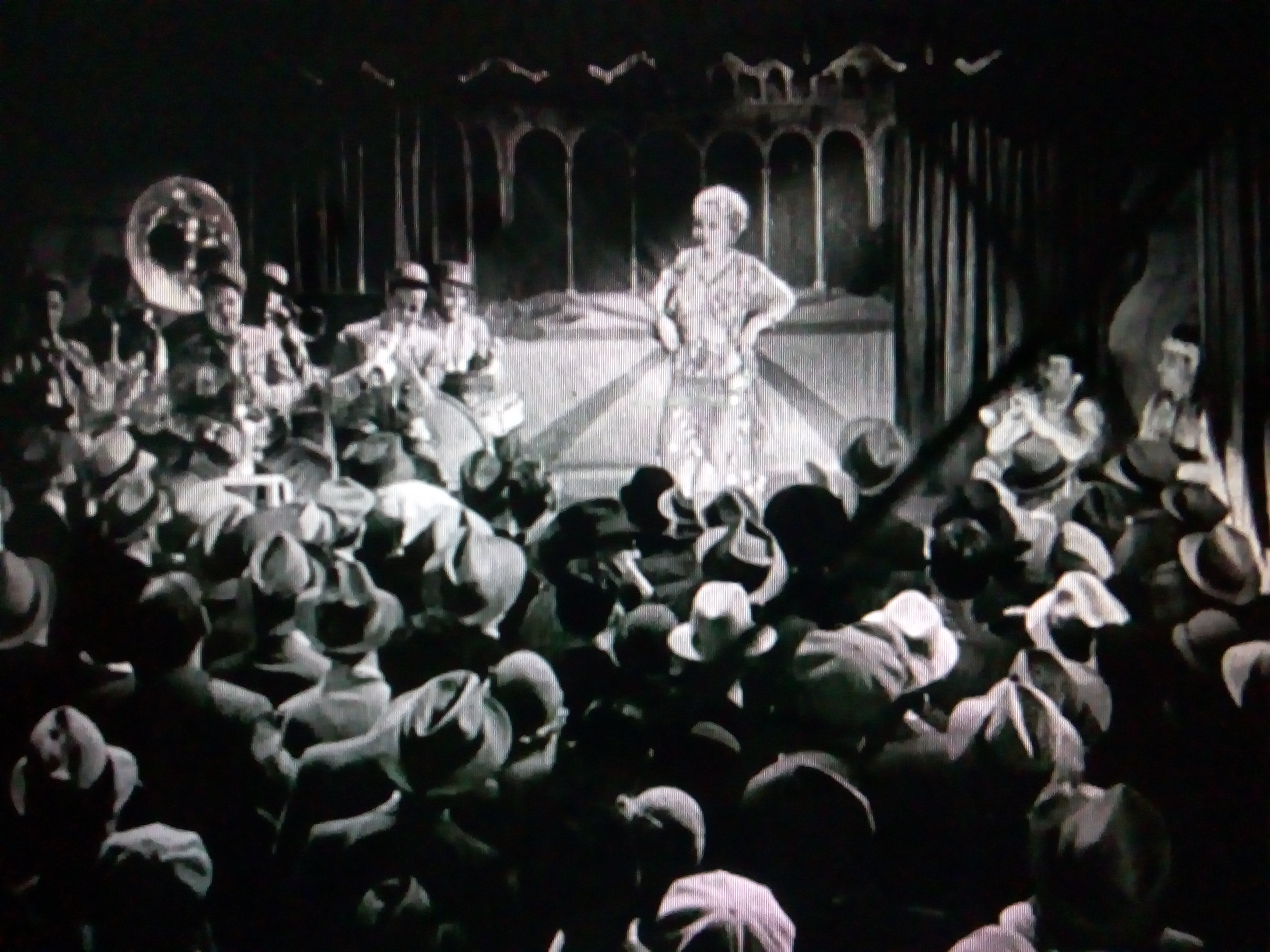
Encountering baying hordes of men who crowd in tents to watch her dance, and later, in her dealings with high society, Tira is feisty and funny. She navigates the many bear traps of a society hostile to sexually and economically independent women, and works her advantages. In respect of men, she is both huntress and hunted. Her astrological sign is Leo the Lion. Her meetings with lovers and her interactions with the circus lions share the frisson of physical danger. Meanwhile, she labels the gifts of clothing, jewellery and trinkets she receives from her conquests with their images, a kind of sexual taxonomy. This shot of animal ornaments couldn’t really be clearer on the issue.

IMG_20190202_161624

The hunt, and the evasion of capture, each involve theatre. Tira is spectacular. She’s introduced with stagehands rolling out a catwalk carpet –

IMG_20190202_145358

– and in performance, her costume gestures towards nudity.

IMG_20190202_145645

Exiting the stage following her dance, she purrs “Am I makin’ myself clear, boys?” – and approaching the wings, mutters smilingly to herself: “Suckers.” As she advises an unhappy fellow showgirl, to whom she donates one of her many necklaces: “Take all you can get, and give as little as possible.” Asked by rich showgoer The Chump whether she believes in marriage – this from a five-times, still married man who grasps at her body greedily – she quips: “Only as a last resort.”

The song’s catchy title appears mid-way through the film, in a scene in which society girl Alicia attempts to bribe Tira to leave her fiance alone with cold, hard cash. In disbelief at her idiotic complicity and snobbish rudeness, Tira shoves Alicia out of the door. Turning back to her apartment, Tira marks her victory by issuing this instruction to one of her African American maids:

“Oh Beulah.”

“Yes ma’am?”

“Peel me a grape.”

https://www.youtube.com/watch?v=FeRm1T9V5wc

Patricia Spears Jones unfolds the objectionable racial politics of this moment of class domination, against the desperate backdrop of the 1930s, and in complex tribute to ‘Miss Lil’, in an extraordinary poem dedicated to Gertrude Howard, the actress who played Beulah.

‘Peel Me A Grape’ isn’t talking about this episode of course, but it is about subordination. Though a demanding woman is its protagonist, I can’t help but hear as strongly the structural power of the man who is buying the mink furs and champagne.

Interpretations of the song slip and slide into a theatricality that spins the given role, plays with domination and submission, just as Mae West’s Tira negotiates her way through life. Anita O’Day sings with a sly smile in her voice. Patti LaBelle delivers a huge cabaret performance that entirely withholds access to an inner life (and, like O’Day’s, finishes up with some talk of grape varieties). Blossom Dearie performs shallow entitlement. Nancy Wilson offers the seasoned, non-serious voice of experience. In Ariana Savalas‘ hot interpretation, she whispers burlesque-ly. But the one that really gets me is Diana Krall‘s. Her delivery is tough, her piano solos alive with wit. Yet when she sings the line “Just hang around” quite quietly, the situation suddenly seems very lonely.


2: Call Me Irresponsible (1962)

This song is not what it seems.

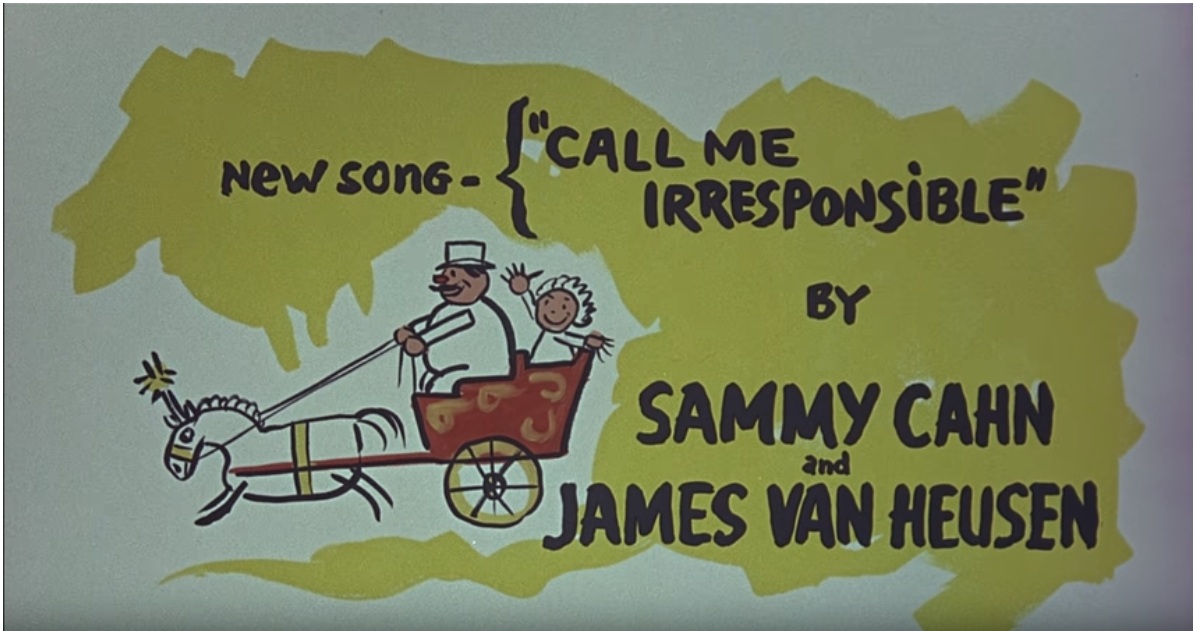
Scores of versions of ‘Call Me Irresponsible’ have been released since Jimmy Van Heusen and Sammy Cahn wrote it in 1962. It was prepared for film comedy Papa’s Delicate Condition (1963), in which it appears first as a wordless lullaby played by a child’s wind-up toy. In 1963 alone, at least seven artists recorded it, among them Frank Sinatra, Julie London and Dinah Washington – the exuberant cadenzas that Washington performs at the end of her version since featuring on numerous adverts and television trailers. (The YouTube link below lists its source as Totally Commercials: the Essential Commercials Albumreleased in 1998.) I’m so familiar with her performance’s passionate take that reflecting on the song recently, I realised I’d never really understood its lyrics.

https://www.youtube.com/watch?v=EO8jm9QmEf4

My superficial impression: reckless, spontaneous love!

It turns out the song is not about that.

Two short, magnificently crafted choruses give us an inconsistent character shamelessly cajoling their loved one. The character justifies their sketchy behaviour by virtue of their romantic sensibilities (“Rainbows, I’m inclined to pursue”) and their strength of feeling for the other person. In the extraordinary lines “Do my foolish alibis bore you? / Well, I’m not too clever, I just adore you”, a mere fifteen words deftly establish a relationship history and execute a smooth rhetorical confidence trick.

Set apart from the film, this Academy Award-winning song’s interpretative possibilities arguably range from ‘adorable if unrepentant’ to ‘sociopathic’. Compare and contrast Tony Bennett’s puppyish plaintiveness and Julie London’s Shere Khan.

On this basis, ‘Call Me Irresponsible’ is tough to accept in terms of love – unless being backed into an emotional corner is your thing. In its cinematic context, the song’s story takes on another aspect.

call me irresponsible

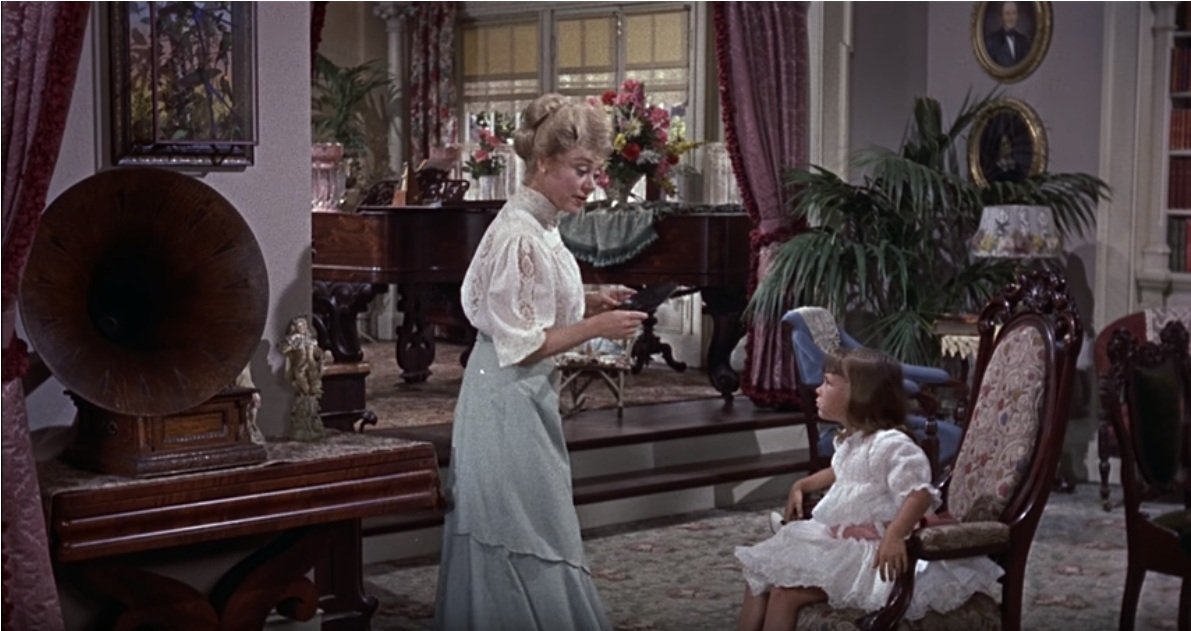
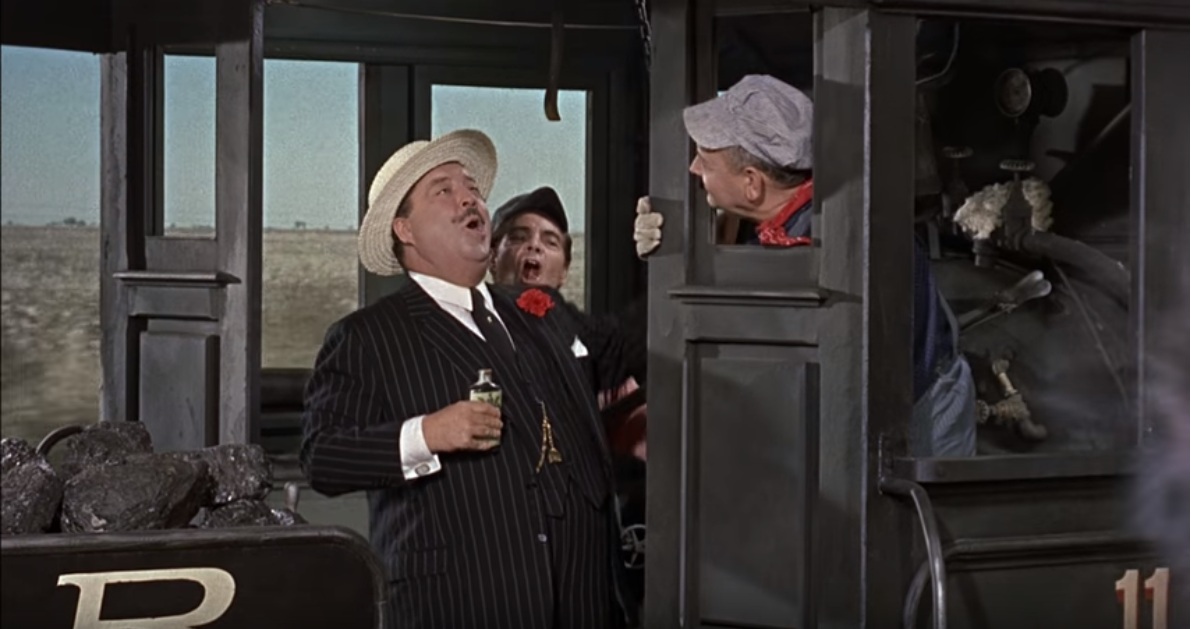
Papa’s Delicate Condition centres around the Griffith family and their salubrious small-town life in Texas. Jack Griffith (Jackie Gleason) is a railway superintendent whose excessive generosity and alcohol dependency together engender recurring marital crises. His church-going, recital-hosting wife Amberlyn (Glynis Johns) is status-conscious and controlling, though not without spark. Their teenage daughter Augusta (Laurel Goodwin) is likewise. Meanwhile, Jack is flamboyant and gregarious, qualities which delight their six year old daughter Corinne (Linda Bruhl) – in real life, a silent film actress and author of the memoir on which the film is based.

call me irresponsible

In the opening scene, Amberlyn distastefully removes from the gramophone a recording of ‘Bill Bailey, Won’t You Please Come Home‘ (1902) as Corinne protests. The film is critical of Amberlyn – jawdroppingly, in these introductory moments she calls the child “my little consolation prize” directly to her face – but though Jack is its hero, it is not uncritical of him: we first meet him on a steam train, enthusiastically belting out ‘Bill Bailey’ and enjoying the lion’s share of a bottle of bourbon in the company of a driver and stoker.

call me irresponsible

With modified lyrics, a harmonious family rendition of ‘Bill Bailey’ also wraps the whole drama up, raising a great many questions on the film’s uses of that song and their racial and historical politics.

Jack’s ‘delicate condition’ is his regular drunkenness, which leads him to engage in various rash schemes: tricking a man into repainting his ugly house to please Amberlyn, buying a drugstore to rescue a downtrodden assistant from its owner, and finally being hoodwinked himself into purchasing a failing circus so he can give its show-pony to Corinne. This is the last straw for Amberlyn, who gathers up her daughters and flees to her father’s house.

‘Call Me Irresponsible’ marks this moment of abandonment.

This scene – the first and only in this family-friendly comedy in which we see Jack unmistakably drunk – is incredibly sad.

The instrumentation is gentle, but Gleason’s performance of the song is unshrinking. The scene’s visual comparison of the automated and lifeless dolls in Corinne’s room with the bereft husband, his reproachful gaze at himself in the mirror, and his one-sided conversation with his surrogate wife-dummy all speak of patterns of (self) destruction. (The pat to the dummy’s hip is objectionable enough, but in a stunningly aggressive moment directly after this clip, he drops his empty glass into the dummy through its neck.)

By the end of the film, husband and wife will have reconciled. He will be sober; she will have ceded control. But this poignant scene shows the song’s narrative to be based not in the plenitude of love, but a man’s struggle with himself.