21: Willow Weep for Me (1932)

This song isn’t having it.

Ann Ronell – a female trailblazer in the sphere of Hollywood musical direction and Broadway composition – originated this wonderful chronicle of heartbreak in 1932. A publishing colleague of Irving Berlin rejected it for being too technically complicated, but support from Berlin himself brought the song to radio broadcast and wider critical and commercial success.

Willow weep for me
Willow weep for me
Bend your branches green along the stream that runs to sea
Listen to my plea
Hear me willow and weep for me
Gone my lovers’ dream
Lovely summer dream
Gone and left me here to weep my tears into the stream
Sad as I can be
Hear me willow and weep for me
Whisper to the wind and say that love has sinned
Left my heart a-breaking, and making a moan
Murmur to the night to hide its starry light
So none will see me sighing and crying all alone
Weeping willow tree
Weep in sympathy
Bend your branches down along the ground and cover me
When the shadows fall, hear me willow and weep for me

While hearing out their lonely protagonist’s pain, these lyrics wink theatrically: love in its entirety has “sinned” because the “lovely summer dream” of a seasonal romance hasn’t worked out for you? All the stars in the night sky should be obliterated to conceal your unique misery? Come on. There’s no shame in sadness.

Ronell’s celebrated, much recorded composition warmly presses that argument forward – in particular the major key in the A sections, its sing-song octave leap (Ted Gioia: “a vertiginous plunge followed by a reassuring triplet bounce unlike anything else in the jazz repertoire of the era”), and the way in which, as Alec Wilder notes, “the accompaniment moves into double time and out again the next measure”. Edward Jablonski interprets this choice as signifying “agitated stress”, but I’m not sure that’s it. Consider, for example, Ella Fitzgerald’s 1959 recording. “Listen to my plea”, entreats the song’s protagonist. Amid the dreaminess of Frank DeVol’s orchestral arrangement, this rhythmic shift counterargues: no, you need to shake things up.

The song’s appearance in the Marx Brothers’ Love Happy (1949) – a crime caper which brings together a diamond heist and a Broadway revue – sets off its refusal of the role of romantic victim in an utterly surprising way.

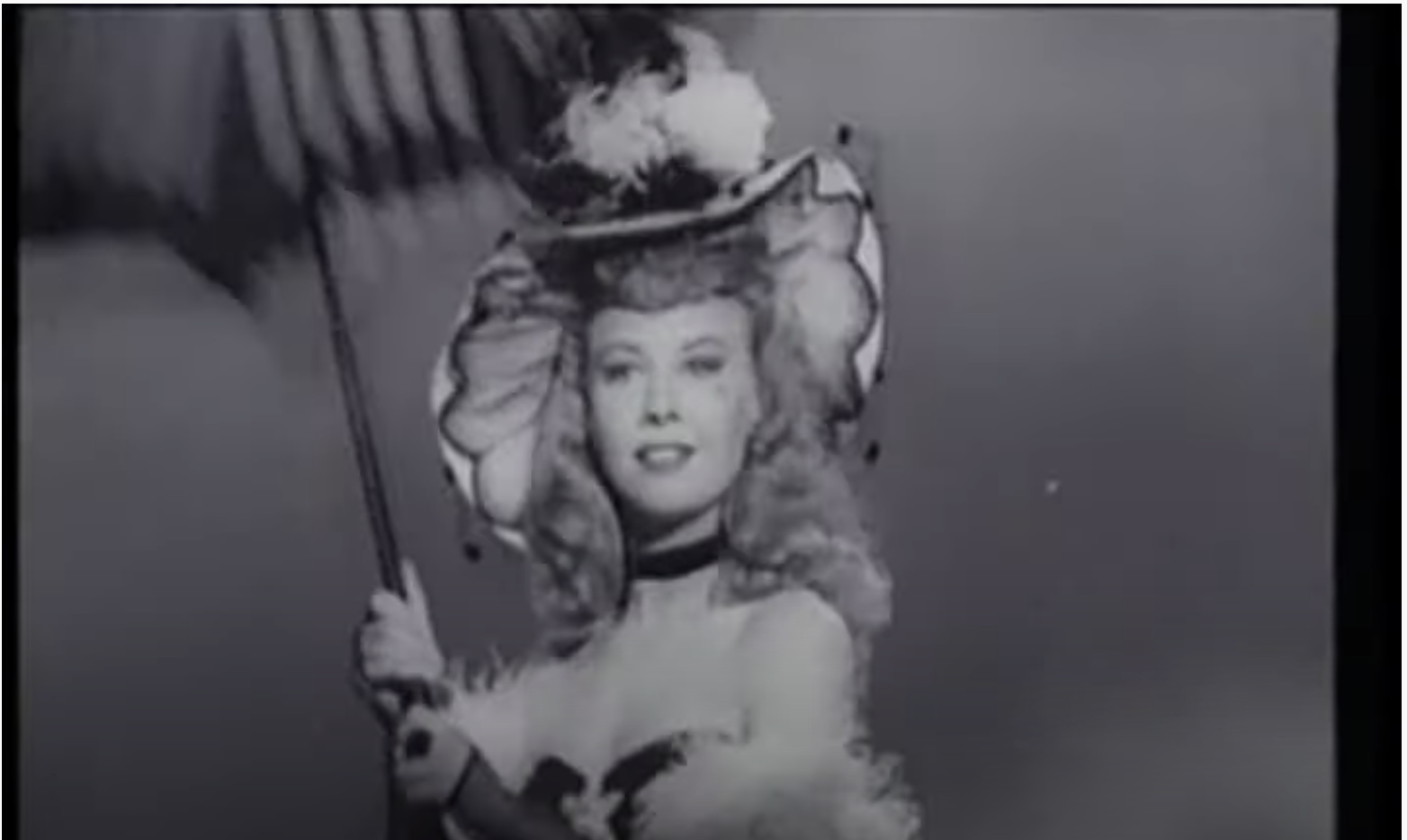
Ann Ronell scored Love Happy, and oversaw Frank Perkins’ instrumental arrangement of ‘Willow Weep for Me’ for one of the Broadway revue’s numbers. Choregraphed by Billy Daniel, it presents an extraordinary burlesque staging of the figure of Miss Sadie Thompson.
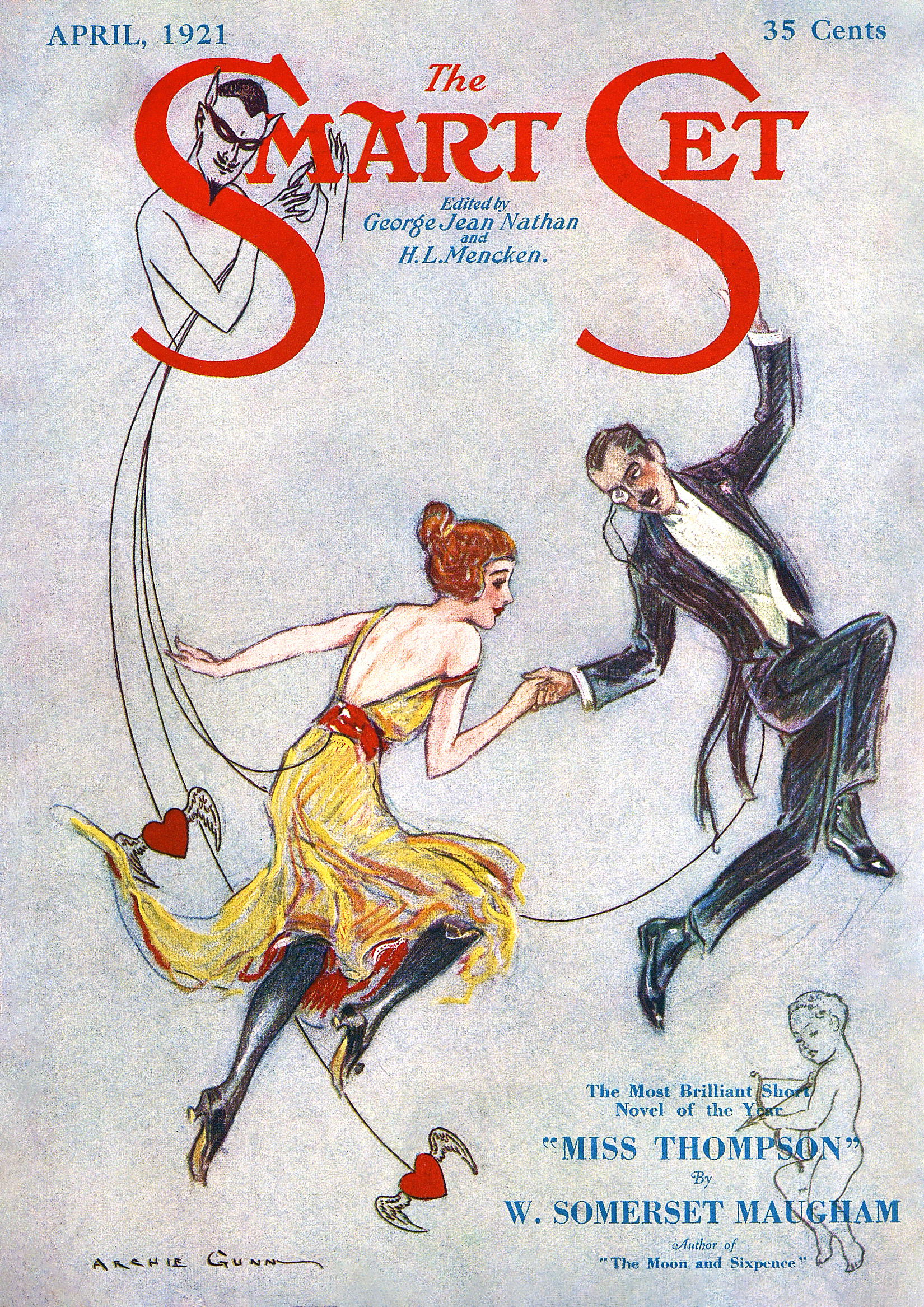
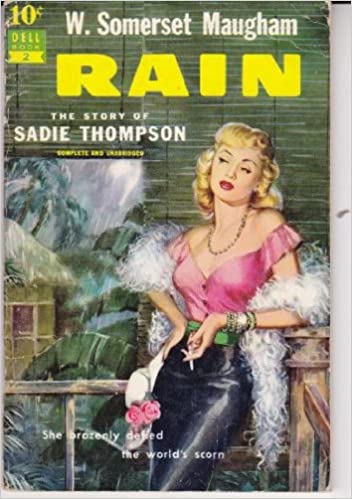
Sadie Thompson is a character in ‘Rain’ (1921), a short story by W. Somerset Maugham set in American Samoa. A ship’s crew member contracts measles, and its passengers are required to remain in port at Pago Pago for a period of quarantine: Dr and Mrs Macphail, missionary couple the Davidsons (ordinarily stationed elsewhere), and Sadie Thompson herself. All are offered accommodation in rooms above a shop. Sadie Thompson entertains sailors in her quarters, playing her gramophone loudly, to the the Davidsons’ infinite disapproval. They quickly infer that, having boarded at Iwelei (“plague spot of Honolulu. The Red Light district”), she is a prostitute, and Davidson himself undertakes to convert her. The missionary programme is vicious: the Davidsons expunge local practices of dancing and dress, impose fines on those who refuse to comply, and delight in destroying associates whose morality they deem insufficient. Davidson’s patriarchal fanaticism – of Sadie, he declares: “‘I want to put in her heart the passionate desire to be punished so that at the end, even if I offered to let her go, she would refuse'” – culminates in what the story very strongly implies is his rape of Sadie and his grisly death by cutting his own throat.

For Victoria Kuttainen, ‘Rain’ dramatises how missionary, medical and cultural regimes collide in the the “colonial, modernising Pacific”. She proposes that Somerset Maugham – both a literary figure and prolific writer for stage and screen – was acutely aware of the imagistic power of “fantasies of seductive starlets and beguiling tropical scenes”, and that his narrative choices comment on the performative power of speculation: other characters are given to report on Sadie’s conduct. In the diverse theatrical and cinematic adaptations of ‘Rain’,* meanwhile, “spectacle replaces speculation”. Stagings of Sadie melodramatically exoticise and evacuate the story of critical force.

The number in Love Happy quotes and exaggerates elements of these adaptations. It sweeps almost every hint of violence away, and reimagines the scenario as a comedy.

In this cartoon tropics, Sadie’s beau, Sergeant O’Hara (played by ‘Paul Valentine’, played by Mike Johnson) – a character introduced in these adaptations – places the needle on the gramophone, and the siren rasp of ‘Willow Weep For Me’ summons Sadie (played by ‘Maggie Phillips’, played by Vera-Ellen) to the stage. Marines gawp as she struts in, her hand magically conjuring her own spotlight. She roams about the stage with comic suggestiveness, occasionally knocking these uniformed men down like dominoes, while O’Hara gazes at her with deep desire. When, as in the story, Davidson (House Peters Jr.) stops the gramophone’s music, a drumbeat commences and a group representing Samoan dancers wearing what resemble lavalava enter the stage, supporting Sadie to continue – a section which trades in racialised stereotyping, places Sadie at its centre, but suggests collective solidarity between she and the islanders against the forces of missionary control. Davidson has failed, and exuberant music and dancing prevail. The gramophone resumes, and a whistle sends the Marines back, who have rushed Sadie like a pack of dogs. The number concludes softly: Sadie and O’Hara stand intimately together before the auditorium of the Broadway theatre to scattered applause.**

This larger-than-life musical rendition both sends up and luxuriates in the cultural habit of looking at Sadie. The lyrics and their sadness ghost the scene, a reminder of the tragedy of ‘Rain’, but here underscoring how Sadie just gets to go about her business.

Before watching the film, I had heard ‘Willow Weep for Me’ only in versions accentuating its bluesiness, as in the powerful recordings by Billie Holiday, Dinah Washington and Etta James, and Sarah Vaughan’s magical and hilarious live performance. With the exception of Stan Kenton’s 1946 arrangement featuring June Christy, the handful of recordings that precede Love Happy are a lively mix of foxtrot and cabaret, and a far cry from the sorrowful sentimentality of other later versions: Frank Sinatra, Julie London, Tony Bennett.

It begs so many questions: about the mood Ann Ronell originally intended for the song, how this scene in Love Happy was conceived and by whom,*** the direction of subsequent recordings. Regardless, it strikes me that its author’s well-documented determination, ambition, kindness and vivacity are of a piece with ‘Willow Weep for Me’. It is a song that “does exactly what it pleases”, recognising social and emotional limits, but isn’t about to accept them.

*John Colton & Clemence Randolph’s play Rain: a Play in Three Acts (1923); Sadie Thompson (1928), starring Gloria Swanson; Rain (1932), starring Joan Crawford; and Miss Sadie Thompson (1953), starring Rita Hayworth.

**Paul’s subsequent instruction to Maggie – “now go change into your ballet costume” – is arguably a misogynistic gag playing on the historical intersection of ballet and sex work.

***An edition of Film Music Notes speaks favourably of “the producer who allowed the composer select co-workers of her own choice wherever possible, thus assuring maximum of compatible tastes and efforts to musical production with minimum personnel”.
13: Violets For Your Furs (1941)

This song is the epitome of shifting sands.

Matt Dennis and Thomas Adair wrote ‘Violets For Your Furs’ together in 1941. Appearing on The Rosemary Clooney Show in 1957, Dennis reminisced about the process:

Well this is probably the corniest songwriting story of all time, but my partner and I were sitting in the pub one snowy night back in New York and he was having a beef with the girl he was dating at the time. Sitting there just listening to a combo play the blues, and well, feeling kind of moody anyway, he came up with this song title. It sounded pretty good to me, so I just started working on the melody right there. Believe it or not he wrote the lyrics right on the tablecloth too, and before the evening was over we’d written ourselves this song.

The wintry context of its creation makes its way into Adair’s lyrics. A kind of theatre of memory, the song sketches out a scene between two lovers, nostalgically recalled by the song’s protagonist. As snow drifts down in the Manhattan streets, a man buys a posy of violets for his beloved’s fur coat, which has the enchanting effect of making the chilly situation seem like spring. The song concludes adorably: “You smiled at me so sweetly, since then one thought occurs / That we fell in love completely, the day that I bought you violets for your furs”.

On one level, it’s a simple story of a simpler time: men were chivalrous, women were graceful, furs were the height of sartorial elegance, and love was new. But even on its own terms, setting aside any questions that may or may not arise concerning ‘men’, ‘women’, courtship, and who can procure fresh flowers and furs in Manhattan at the tail end of the Great Depression, the song contains multitudes.

Tommy Dorsey and Frank Sinatra recorded it first in 1941, in an interpretation that conjures divine dinner dances, and the giddy euphoria of falling in love. The moment on the Manhattan street feels like it happened just last week, but also that it’s yet to come. Meanwhile, Sinatra’s sleigh bell-sprinkled 1956 rendition – whose seasonal phrasing is taken by Barry Manilow’s recording – seems to look back to a happy event many Christmasses ago. Johnny Hartman’s extraordinary performance – a tribute to John Coltrane’s – is heavy with deep disappointment. Shirley Horn’s sublime version aches with remembered longing. Beverly Kenney serves up bright and naive entitlement, with a tiny hint of rage: maybe this character didn’t get what they wanted in the end. Stacey Kent delivers a poignant reverie.

Alec Wilder and James T. Maher delight in the way ‘Violets For Your Furs’ “moves and does lovely inventive things”, comparing singer and composer Matt Dennis’s writings to Johnny Mercer’s, which each “suggest the presence of the performer in their composition”. It’s so rich. Its embrace of then and now, whenever these times are in the universe of a given interpretation and whatever has taken place in-between, is magic. Even still, it’s comparatively neglected as a standard, with recordings only in the double digits. No films seem to have taken it up, although it is fleetingly mentioned in a scene in the ninth episode of cancelled ABC drama Six Degrees (2006-2007).

Is that neglect to do with anti-fur politics, as this piano studio proprietor suggests?

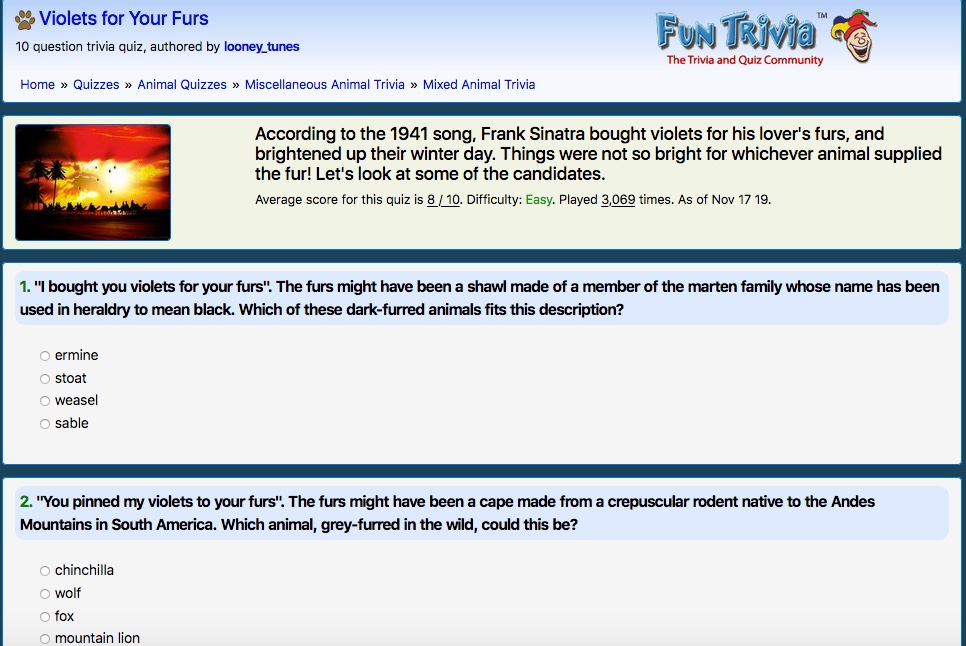
(On that issue, this highly specialised quiz about animals = in the running for my most favourite weird internet thing.)

Violets For Your Furs

Or is it to do with the somewhat antiquated ritual it describes?

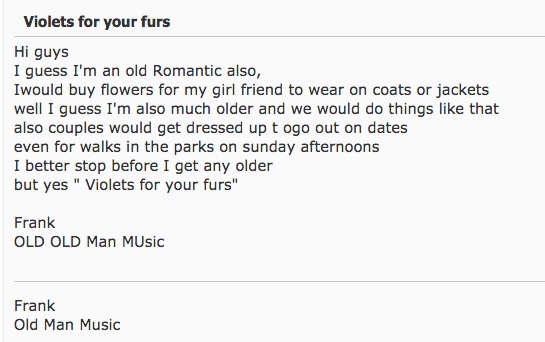
This 2003 sinatrafamily.com thread is started by a forum member who can’t ‘get’ the song, and thinks it’s ‘asinine’. Her contribution prompts a flurry of rebuttals from fellow posters fantasising trips down all kinds of real and imagined memory lanes, some lamenting the decline of civilisation as manifest in casual dress. A lengthy discourse on hats unfolds. Its kind and friendly online banter is a world away from the cultivated vitriol of the contemporary social industry.

Violets Sinatra forum

These thoughts of animal rights, old school gallantry and polite conversation were front of mind as I wandered around the internet seeking out links to various versions of ‘Violets For Your Furs’. Seeing the cover art for Marty Paich’s I Get A Boot Out Of You (1959) took me aback.

Paich’s magnificently louche arrangement of ‘Violets For Your Furs’ on this album suggests lovers in smoky late night bars. The racy cover art is like a cutesified sexy and highly unsettling anticipation of the shower scene from Hitchcock’s Psycho (1960).

Similarly, Dave Brubeck’s Angel Eyes (1965) features a tremendous hard-swinging version of the song, and a glassy-eyed Terry Reno on its cover. Twenty or so years after ‘Violets For Your Furs’ was composed, second wave feminism was burgeoning, and at the same time beautiful girls stared out from a lot of cover art, in varying states of undress. (I’d call it Playboy-ification, but these album covers are ahead of the Playboy game.) Plus ça change, etc. Romantic love may be protean, and the gentle attentions of ‘Violets For Your Furs’ out of joint with the softcore objectifications of the 1960s. But the patriarchal structures that prop up ‘romance’ are doggedly persistent, for sure.

Laura Mvula on screen

Watching Laura Mvula headline Love Supreme at the Roundhouse last night, I remembered this text sitting lonely on my computer, which I wrote the day after attending the 5 March 2015 cinema broadcast of her performance with Metropole Orkest, recorded at Paradiso Amsterdam on 28 November 2014.

At Screen 5 of the Ritzy in Brixton, the usher confirmed in a whisper that the screening of Laura Mvula’s gig hadn’t started yet (‘they are still doing the interviews’) and held open the door. The cinema was two-thirds empty and unusually chilly. Laura Mvula was on-screen in conversation with a male interviewer, responding to tweets coming in about the broadcast of the gig, displayed at the bottom of the screen. The interviewer advised the audience – the audience to their interview, wherever it was, and us, witnessing their exchange live – that we may have to pretend at various points that we have something in our eye, such was the emotive impact of what we were about to see.

Eating popcorn, I was curious. The camera filming the interview from the back of the venue suggested that the auditorium to which the artist was speaking was disappointingly half-empty – an image counterbalanced by a later view from the front, which showed row upon row filled with people. This, in combination with our own sparsely populated and cold auditorium, felt like something of an opening anticlimax.

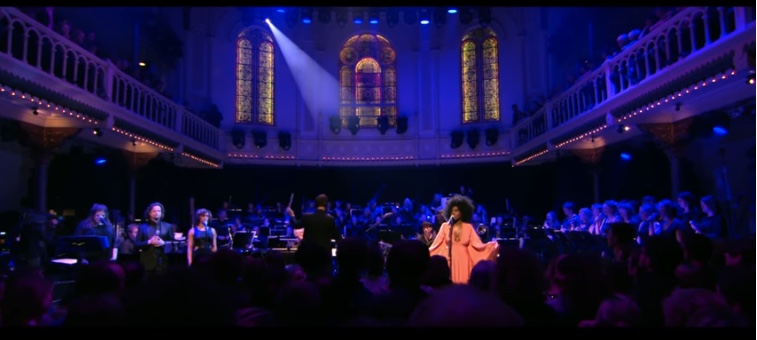
The recorded gig itself begins with the conductor Jules Buckley entering the stage of the Paradiso in Amsterdam. The venue is a former church, and intricate blue stained-glass windows adorn the wall behind the orchestra. A gallery level rests on top of corniced pillars – an architectural arrangement smaller but not dissimilar in shape to the Palau Música de Catalana in Barcelona where I’d seen a slightly odd performance by Aloe Blacc the previous summer, which had concluded with the audience being encouraged to rush the stage while the artist slipped away. The cameras filming the gig reveal that the auditorium is heaving. The ensemble of more than fifty musicians is packed onto the stage, a choir standing beneath the gallery stage left, and three backing singers positioned downstage right. Jules Buckley makes a cheesy Jaws reference in relation to the sell-out gig (‘we’re going to need a bigger boat!’) and warmly introduces the Metropole Orkest, before welcoming Laura Mvula herself onto the stage.

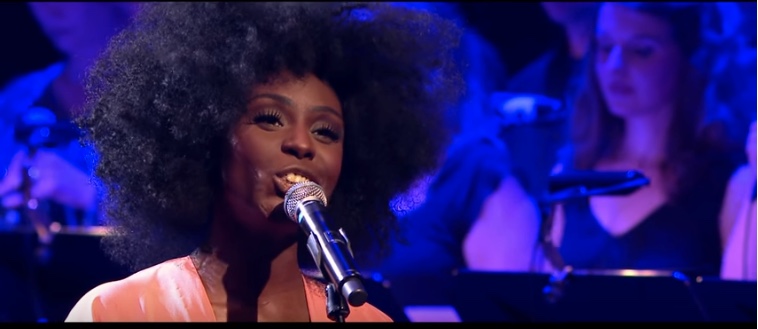
She walks into the auditorium through a door to the left of the front of the audience, passing amongst people standing to ascend the shallow stage. In March 2015, Laura Mvula has a shaven head, and wears a long white jacket and black top. In November 2014, her afro and peach nylon dress, long sleeves draping down, speak of the 1970s. When she stretches her right arm towards the audience as if in supplication – a gesture she will make frequently during her performance – her sleeve punctuates the movement. At first, she doesn’t speak except to say ‘thank you’.

Laura Mvula

The performance is revelatory. The rich orchestration lends a new dimension to the songs, which now tell stories that are different to those of the intimate arrangements on Sing to the Moon (2013), on which the gig is based. The first number, ‘Like the Morning Dew’, describes the insubstantiality of a relationship: ‘Our love is / Like the morning clouds / Like the morning dew / That goes away / Early.’ The expansiveness of the arrangement envelops the voice of the soloist, speaking of the disappearance of the world that the song’s protagonist thought was there. Its resonant universe conjures imaginative flight, fantasy, and a strange kind of optimistic sadness about the flimsiness of that imagined world. ‘She’ describes a woman’s quest for intimacy, the lyric ‘she don’t stop / she don’t stop / she don’t stop’ underscored by percussion, giving the impression of a relentless progression forward. As she sings, her movement alludes to walking a path, although of course, standing on the spot, she goes nowhere. Whether the intended meaning or not, as she performs ‘Is There Anybody Out There?’ I think of how precious life must feel to someone facing death: ‘Is this the end / Before it’s even started / I can’t survive this way / I’m broken-hearted.’ The improvisation of the lead vocalist over the chorus constructs both a sense of internal dialogue and a conversation between people. As in the original arrangement, the tumbling strings give way to a dissonant passage, and the sensation of floating in space.

Laura Mvula 3

With ‘Father Father’, I recognize what the interviewer meant. Seated at the piano, she introduces the song by acknowledging Jules Buckley’s new arrangement for the orchestra (‘it’s better’). The purity of the brass at the start of the song seems to refer perfectly and incongruously to Vaughan Williams and Elgar. As she sings ‘I lost my heart / In the dark with you’, its attack is brutal. The texture of the song builds with the introduction of strings, piano, and timpani, creating an almost meteorological landscape of sound. Then, the song continues for as long again, with her beautiful improvisation around the lyrics ‘Father father / Please don’t let me go / Father father / Why’d you let me go’ as the music swells around her. Her gaze directed at no-one in particular, she speaks to herself, to the audience, to God. I now hear the song as the tragedy of the loss of faith, and wonder whether all of the songs in the concert are in some way circling that idea.

Laura Mvula 2

Huddled beneath my coat in the cold cinema, I moved in and out of absorption in the gig, fascinated by the technical execution of the music producing such intense emotional effects in the audience, occasionally feeling tears spring in my own eyes and roll down the side of my face. A large gathering of musicians had met an audience of 1,500, met in turn later by a much more disparately spread audience, watching silently in cinemas as the first audience clapped and cheered. At the end of each number, her face would wrinkle into a huge smile, puncturing the emotional world of the songs and reasserting the humour of the everyday.

The gig finished with an encore performance of ‘Make Me Lovely’.

Towards its end she said: ‘I just want to thank you all for being the most wonderful audience, ever’. At this, I smiled, feeling warmth toward this past audience but not feeling myself a part of it. Having concluded, the recorded concert was then unexpectedly followed up by a live performance from Laura Mvula in the venue of the interview, performing solo on a keyboard. It was unexpected, it seemed, to everyone – the screen showed a couple of audience members caught short attempting to get up. The much more minimal rendition of three of the numbers she had performed exposed again the texture of the orchestral arrangements, and the controlled power of her voice. Strangely, this live performance felt intimate, just for us, despite the ‘us’ being scattered in cinemas across the country. When she finished this reprise, she smiled, and said ‘thank you for coming’ again. In the Ritzy, the credits rolled silently, and no-one moved.