This song is a struggle.
‘You Go To My Head’ was written by John Frederick Coots and Haven Gillespie in 1936, and first recorded in 1938. Its tone and story could not be further away from their earlier hit, the enduring Christmas earworm ‘Santa Claus Is Coming To Town’ (1934).


Gillespie’s lyrics give us a protagonist engulfed in the fog of infatuation. Addressing the object of their desire, the person speaks of incessant thoughts, flights of fancy, involuntary physical reaction to the ‘very mention’ of the other person, and straight up libidinal heat brought on by their eyes and smile. Rational self-talk (‘get a hold of yourself’) competes ineffectually with full-bodied feeling.
Philip Furia jokes that though the song’s many booze analogies are explicit only in the first A section, Gillespie returns to the theme later ‘by reminding us that alcohol, like mercury, rises in thermometers’. The abstraction of the cover sketch on the sheet music published by the Remick Music Corporation offers another sense of the body as machine. Meanwhile, in terms of its harmonic progressions, Ted Gioia proposes that ‘this song comes closer than any tune I know to capturing in musical form the feeling of losing control’. In form and content, it’s all about being under the influence.
More than twice the versions by vocalists have been recorded by women than men.
Wandering around Spotify in search of some of the nearly four hundred recordings of the song is an object lesson in interpretative variety. My current favourite is Reginald Chapman’s addictive funk arrangement featuring vocalist Sam Reed – which, like Dinah Washington’s live Latin take with Clifford Brown, is packed with energetic dilemma.
Meanwhile, Billie Holiday’s two recordings, made in 1938 and 1952, each overflow with tender sadness. Lush, expansive orchestral arrangements accompany Ella Fitzgerald and Frank Sinatra‘s gentle performances. Johnny Hartman’s intimate rendition speaks of solitary contemplation – and even more so, Stacey Kent’s, a stunning performance with pianist David Newton that summons up a moonlit landscape of ice.
And various interpretations imbue the song’s angst and sexuality with a drama adjacent to film noir – a move that reflects the song’s earliest uses in film, in Otto Preminger’s Laura (1944) and Howard Hawks’ The Big Sleep (1946).
Sarah Vaughan’s 1961 version with Count Basie has a vaguely sinister sensibility: a clamorous city is filled with threat, both from the self and from others. The texture of its horns echoes the anxiety-inducing arrangement on Stan Kenton’s New Concepts of Artistry in Rhythm (1953) – a more intensely swirling vortex of urban noise. Also unsettling is Lio‘s 1980 electropop interpretation, whose metallic vocals, synths and strings anticipate the narrative concerns of Ridley Scott’s Blade Runner (1982). Differently strange is Bryan Ferry’s 1975 performance. Its video sees a listless, tuxedo-clad Ferry visited by a self-objectifying femme fatale: her spidery hand pulls open the door to his weirdly daylit room, where she is revealed to be a figment of his imagination.
This video treads a fine line between critique and indulgence of misogynistic fetishism – a psychological concern at the heart of Preminger’s Laura.
Both Laura and The Big Sleep feature restaurant scenes where instrumental performances of ‘You Go To My Head’ act as the backdrop to key events. In The Big Sleep, the song marks the acceleration of the attraction between detective Philip Marlowe (Humphrey Bogart) and client Vivian Rutledge (Lauren Bacall) – a narrative use of the song that extends no further than that electric moment.
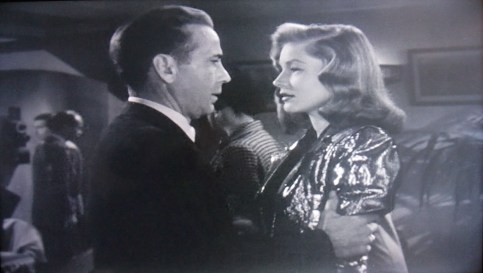
A different instrumental theme entitled ‘Laura’ – a standard subsequently recorded almost as many times as ‘You Go To My Head’ – conspicuously dominates Laura‘s action. But the film’s very brief, particular placement of ‘You Go To My Head’, and the lyrics which ghost its performance, signpost with mordant accuracy the identity of the murderer, and their motivation for killing its eponymous heroine.
The killer could be any of the three characters in the frame: Laura’s patron Waldo Lydecker (Clifton Webb), her fiance Shelby Carpenter (Vincent Price), and her aunt Ann Treadwell (Judith Anderson). Investigating officer Detective Mark McPherson (Dana Andrews) soon begins to succumb to an obsession with Laura (Gene Tierney) himself.
At one point in the film, Laura is seen to utter the crucial line: ‘I never have been and I never will be bound by anything I don’t do of my own free will’. As elsewhere in Preminger’s oeuvre, Laura dramatizes ‘the battle between a woman’s self-definition and a definition imposed by men’. It takes as its subtle text a beautiful song amenable to numerous interpretations – among them, obsessive fixation and self-undoing. In Laura, its ‘singer’, as it were, is not the film’s female heroine but someone entirely different.
 People Think This Is Romantic