This song is within and without.
Bob Haggart and Johnny Burke’s ‘What’s New?’ dramatises one side of an at-first casual conversation between two ex-lovers, set in some social gathering or other. Time has elapsed (“You haven’t changed a bit”). As the song unfolds, the protagonist’s studiously dispassionate small talk (“How is the world treating you?”, “How did that romance come through? / We haven’t met since then”) is revealed as a cover for their still-interested broken heart. The final choruses subtly speak of the pain of being pitied, with an ending that could be delivered either as a lonely retreat into the self or a moment of confessional exposure.
What’s new
Probably I’m boring you
But seeing you is grand
And you were sweet to offer your handI understand, adieu
Pardon my asking, what’s new
Of course you couldn’t know
I haven’t changed, I still love you so
(I didn’t realise the line was “I understand, adieu” until I saw it written down, having consistently misheard it as “I understand, I do”. “Goodbye forever” is definitely in keeping with the song’s tragedy, but I think I prefer the mistake.)
‘What’s New?’ offers plenty of scope for lovelorn wretchedness – for example, the orchestral melancholy of the recordings by Frank Sinatra and Linda Ronstadt – but others take it in unexpected directions.
One of the earliest, by Jess Stacy & His All Stars with singer Carlotta Dale, is supremely self-assured: this woman knows her worth and has no issue admitting how she feels. Maxine Sullivan’s is not remotely tortured. Carmen McRae and Betty Carter exude joy in female friendship and mutual admiration. Then the acres of instrumental interpretations that exist, way outnumbering vocal performances, conjure a million different, sometimes optimistic, situations – from the undulating sea of Ahmad Jamal’s recent solo version, to Hal McKusick’s deserted after-hours bar, or George Benson’s hot dance floor reunion. And the exquisite ambiguity achieved in Helen Merrill’s 1954 recording, stunningly arranged by Quincy Jones, bears no trace of nostalgic melodrama. The arctic sadness of her engrossing performance fuses public words and private thoughts. At any moment in the song she could be talking to someone directly, or imagining to herself how their conversation would go, gazing across a crowded room. Its beauty verges on the uncanny.
What goes said and unsaid is at the centre of two of the films that feature ‘What’s New’ – Michael Curtiz’s WWII aviation medicine story Dive Bomber (1941), and Harvey Fierstein’s four-hour Broadway comedy drama Torch Song Trilogy (1988), radically cut for the screen. Both tell stories of intimacy between men, though only Fierstein’s is explicit on the matter. In Dive Bomber, as in so much literature, rituals of smoking stand in for physical connection, and unusually, caring relationships. Female romantic interests fall a distant second to the initially abrasive relationship between Lieutenant Doug Lee (Errol Flynn) and Lieutenant Commander Joe Blake (Fred MacMurray).


The song’s line “Probably I’m boring you” cues in a dinner dance to which Doug and Joe have taken dates Linda (Alexis Smith) and Helen (Ann Doran). The men distractedly ignore both women, preoccupied by their shared task: the design of a pressure suit to combat pilots’ altitude sickness.


The scene is rich with subtle and not-so-subtle clues regarding the dynamics of the pilots’ friendship, from the visual emblazoned on the band’s bass drum –
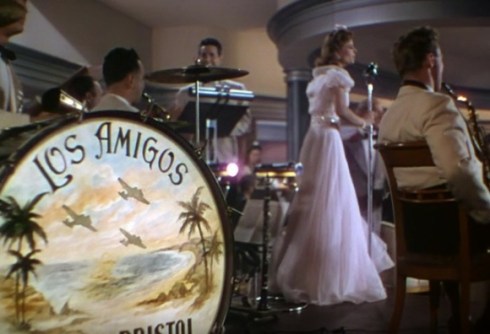
– to a sequence in which, as they sketch suit designs on a tablecloth, Linda’s lipstick furnishes the inspiration for “a slide valve with a fine screw on the stem. Each turn opens it just a hair. This is it!”


The phallic emergence of the red lipstick from its tube, seen in close-up, is eye-popping. Bored and annoyed, the women go, despatching a young waiter to recite a short poem to Doug and Joe: “We don’t like quarrels, we don’t like scenes / The Navy’s too busy, we’ll try the Marines”.


After Joe sacrifices his life in testing the pressure suit prototype, Doug commemorates him at a naval ceremony as “my friend and co-worker, Lieutenant Commander Blake, a very gallant gentleman”. In a solitary moment at this event, he kisses his hand and plants it on Joe’s plane, before taking to the skies with other pilots, and ritually throwing Joe’s special cigarette case into the clouds (an act that would surely kill anyone unfortunate enough to be standing where it landed). It is a story of love, but the film can claim it’s just about men working together for the war effort.
The three acts of Torch Song Trilogy give us years in the life of New York drag performer Arnold (Harvey Fierstein). At the end of the second act, a gang of men murder Alan (Matthew Broderick), his first real love, in a homophobic attack. Billie Holiday’s recording of ‘What’s New’ accompanies a scene early in the third (here, at 1:24.56), starting mid-way through the penultimate chorus. Arnold returns home to find his on-again, off-again lover Ed (Brian Kerwin) asleep on the couch, where he removes Ed’s glasses tenderly. At this point the song seems to signify Arnold’s affection, and the extent of what Ed, a man who isn’t open about his sexuality, can offer in their relationship. But then Benny Carter’s saxophone solo begins, and we see Arnold get into bed, now in his pyjamas. He takes Alan’s portrait, which sits on his bedside table, in his arms, then rolls his eyes, saying “how Alice Faye can I get?!” The shot cuts to the morning kitchen radio, where Carter’s solo continues. Time jumps but the song flows on unbroken: love is unending and loss ever-present.


Torch Song Trilogy ultimately refuses a tragic ending. Put together, I see both films mapping and subverting the sexual limits heteropatriarchy laid down in the twentieth-century. What they share with ‘What’s New?’ goes beyond the specific lines they use concerning conversational distraction and lost love: all speak of how social convention and desire interact.


 People Think This Is Romantic