22: Answer Me, My Love (1953)

This song has been through a lot.

Lyrically speaking, ‘Answer Me, My Love’ is a text of self-torture. But it started life as the diametric opposite: a rose-tinted homage to maternal love and protection.

German composer and lyricist Gerhard Winkler wrote ‘Mütterlein’ (1952) as a nostalgic waltz and birthday tribute to his 75 year old mother – a tune quick to be translated and recorded by other artists in Swedish, Icelandic, Finnish and Danish. It is idealising in the extreme: a paean to unending, self-sacrificing support. Then in 1953, two adaptations took it in a radically different and tragic direction.

American songwriter Carl Sigman set ‘Answer Me, Lord Above’ to Winkler’s music. It is a story of abandonment: a person demanding of God why their lover has left them. And either before, after or during Sigman’s process of writing – it is not clear which – Fred Rauch wrote German lyrics for the song with the title ‘Glaube Mir (Believe Me)’.* Rauch’s protagonist, like Sigman’s, has been rejected by a lover out of the blue – but here they speak to them, not God, directly. Affirming the depth of their love, they plaintively request an explanation.

As Carl Sigman’s son Michael describes in a terrific 2013 Huffington Post piece, the song’s subsequent trajectory is absolutely wild.

What 60 year-old song co-written by a German and an American reached No. 1 on the UK singles charts by two different singers at the same time; was penned by an atheist but banned by the BBC for its “religious” content; was secularized by said atheist via a change of three syllables; subsequently became a U.S. chart smash; has been covered by hundreds of pop, doo wop, rock, country, r&b, folk, jazz, gospel and classical artists; and bears a fascinating (though not remotely plagiaristic!) resemblance to a 48 year-old number that happens to be the most popular pop song of all time?

The “two different singers” were American crooner Frankie Laine and British singer David Whitfield, whose releases of ‘Answer Me’ in the UK in the winter of 1953 spent many weeks in the charts, despite the BBC’s ban on the basis of the song’s supposed “‘sentimental mockery of Christian prayer'”.** In the interests of his song’s commercial viability, Sigman was persuaded to delete reference to God. His substitution of “Lord Above” with “Oh My Love” reflects the address of Rauch’s lyrics. Nat King Cole scored a US hit with Sigman’s revised version in 1954, a recording bearing credits for Winkler, Rauch and Sigman together. And as Michael Sigman writes, these popular recordings of ‘Answer Me’ may well have earwormed an 11 year old Paul McCartney: according to musicologists, its formal and thematic aspects echo through the Beatles’ ‘Yesterday’ (1965).

This is an extraordinary story, and I have Spotify’s algorithm to thank for learning about it.

A few weekends ago, while I was absent-mindedly washing dishes, something amazing and surprising popped up on my Discover Weekly playlist: Swamp Dogg’s phenomenal 2018 version of ‘Answer Me, My Love’. The kitchen resounded with the song’s introduction: dark brass redolent of a disaster movie, melodious woodwind and strings, and then the artist’s voice, deep in a sonic mist bouncing with electric harpsichord. I stopped what I was doing and laughed spontaneously in delight: I thought it was fucking awesome. “Answer me, oh my love / Just what sins have I been guilty of / Tell me how I came to lose your love” – here the brass phrase crashed in again – “Please answer me, my love”. More strings and brass announced the sadness of the minor B section, but the words – “If you’re happier without me / I’ll try not to care / But if you still think about me / Please listen to my prayer” – were now robotic with autotune, a screech of despair that persisted into the next verse, as if the human had been taken over by an uncertain machine. Comforting gospel harmonies commingled with electronic noise and glissando strings on secondment from sci-fi and horror. It was stunning: a voice reverberating through the past, present, and future – ethereal, material, godly and diabolic.

A Rolling Stone review quotes Swamp Dogg on this song, his choice of opener for his album Love, Loss and Autotune (2018):

“‘Answer Me, My Love’ is what we call a ‘money record’ and since I need money, I recorded it,” Swamp Dogg said in a statement. “You can’t go wrong with a Nat ‘King’ Cole hit! He never recorded a bad song and always got hits. I need to pay some bills.”

Pitchfork has the album as dealing in “the ecstasies of love, the misery of loss, and the economic desperation of life in Trumpland”, themes shared by Chloe Zhao’s Nomadland (2020), a film which briefly features Nat King Cole’s ‘Answer Me, My Love’.

Enclosed in the living space of her van, by the dim light of a battery-operated lamp hanging above and her radio’s tinny sound, the recently widowed and now nomadic Fern (Frances McDormand) peruses a box of photographs. “I believed that love was here to stay / Won’t you tell me where I’ve gone astray / Please answer me my love”. She gazes upon her family members’ images with a giggle, then a wry smile. “If you’re happier without me / I’ll try not to care / But if you still think about me / Please listen to my prayer”. She turns a slightly torn photograph of her husband as a young man in her fingers, and we are given time to look upon him, as she does. Joy in her face drops as grief takes over – “You must know I’ve been true / Won’t you say that we can start anew / In my sorrow now I turn to you” – and quickly the scene cuts to outdoors late some other day.

This solitary moment is beautiful: a scene of less than a minute that juxtaposes lyrics and images with tenderness and subtlety in a totally unreductive way.

It may be that Swamp Dogg’s version has flooded my sense of how ‘Answer Me’ expresses time, action and even age, but against Nat King Cole’s voice, Fern’s simple act of reflecting on photographs seems to take on a numinous quality. Like the song and its numerous lives, this moment questions the mysterious substance and longevity of love, life, bonds with others, and how stories play their part in constructing them.***

*Music writers John Kutner and Spencer Leigh say that Rauch wrote ‘Glaube Mir’ “following Sigman’s lead”, but if so why is Rauch’s credit on Nat King Cole’s recording? Did Sigman’s first adaptation come first, then Rauch’s, then Sigman’s revisions? Or both of Sigman’s, then Rauch’s?

**Frankie Laine released a recording of Sigman’s revised version in 1955. Whether or not the Whitfield recording that went to #1 was definitely the “secularized” one remains unclear imo, despite the decisive account of Kutner and Leigh. The Decca catalogue number for Whitfield’s chart-topper was F10192: ‘Answer Me, Lord Above’. A contributor to discography forum 45worlds.com, mister_tmg, notes the September and October 1953 recording dates for Whitfield’s two versions, specifies two slightly different matrix DR numbers, and notes that the song “first made #1 on 7 November 1953, so the re-pressed version may have been in the shops by that point. It certainly would have been by the time it returned to the top on 12 December”. I was today years old when I learned what a matrix number was. Main overall finding: people are amazing and social media isn’t always horrific.

***This song harbours so many: I enjoy Gene Ammons, Donald Shirley, Etta Jones, Barbara Dickson, Owen Gray, Renee Fleming, Hilde Hefte, Keith Jarrett. Joni Mitchell’s beautiful orchestral performance inspires this absorbing experimental text by Geraldine Finn, which brilliantly asks ‘what kind of a saying is a song?’ in a deep exploration of attachment, family, desire, and interlocution.
16: So Rare (1937)

This song is quite something.


The transportative harmonies of Ahmad Jamal’s beautiful recording on Ballades (2019) suggest ‘So Rare’ to be a standard as beloved as Sammy Cahn, Axel Stordahl and Paul Weston’s ‘I Should Care’ (1944), also covered on that album. Not so: although it has topped the charts more than once, it’s actually sort of overlooked. Finding out more about it has been akin to an archaeological dig. Put together, its various pieces produce a totally unexpected picture, but one that (surprise surprise) nonetheless traces out contours of gender, ancient and modern. It is a trip.

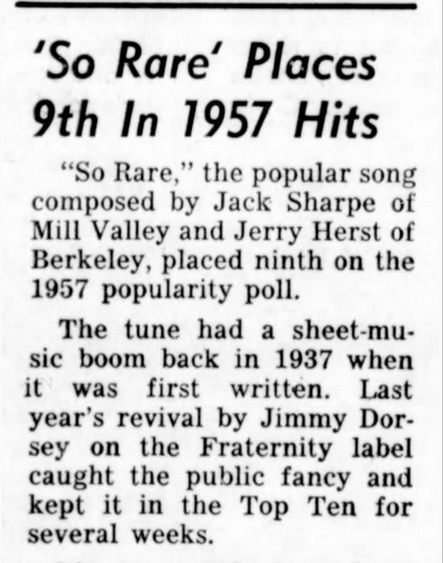
Written by Jerry Herst and Jack Sharpe, ‘So Rare’ is a rhapsody of love. It is jam-packed with images of heavenly hosts, exotic flowers, ethereal classical compositions and, most weirdly, the American flag. It was first recorded in 1937, no fewer than seven times that year, in various big band interpretations for dancing the foxtrot. Guy Lombardo and his Royal Canadians made it number one on popular radio show Your Hit Parade in the week of 11 September 1937. Then it was barely touched until 1957 – another bonanza year for the song, which saw the release of Jimmy Dorsey’s brash big band recording.

So Rare--clipping

Daily Independent Journal, San Rafael, California, 1 February 1958. https://www.newspapers.com/clip/3844368/jack-sharpe-1958/

Dorsey’s smash hit trailed several similar to near-identical arrangements in its wake – from Jimmy Carroll (1957), Billy Vaughn (1958), Les Brown’s Band of Renown (1960), Bill Black’s Combo (1964), and Willie Mitchell (1967).

Dorsey deletes most of the song’s lyrics. A raunchy saxophone solo takes the melodic lead in the A sections, while a chorus performs its first B section – the only words to appear.

You are perfection
You’re my ideal
You’re angels singing the Ave Maria
For you’re an angel
I breathe and live you
With every beat of the heart that I give you

Horns en masse deliver the second B section, while the chorus ‘do-do-doos’ along. The evil genius of this arrangement is in its juxtaposition of lyrics about putting virgins on pedestals, seductive sax, rasping horns, and a savage drum beat and tempo identical to that used in David Rose and his Orchestra’s ‘The Stripper’ (1962) (written in 1958) – both enactment and refusal of the nightmare Madonna-whore dichotomy that continues to be the bane of women’s lives.

In vocal recordings including more of the song’s lyrics, things take a series of different turns.

In full, ‘So Rare’ has a verse, and AABA twice over, with different lyrics each time around – one set normatively for a male voice (“You’re like the fragrance of blossoms fair / Sweet as a breath of air”), and the other for a female voice (“You have the warmth of a Schubert air / Charming and debonaire”), as if for a duet. The small number of vocalists who have tackled it (no duets) have picked and chosen between them. Ella Fitzgerald and Betty Johnson‘s gentle versions subversively go for the ‘male’ set, while Mavis Rivers rocks the ‘female’ set. So too does Vera Lynn‘s sentimental rendition, but – presumably on the basis of nationality – she rewrites the triumphalist second B section lines “You have that something, that certain manner / You thrill me more than the Star Spangled Banner”. Bing Crosby and Don Cherry weave those in, to all-American patriotic effect, while Andy Williams does not.

The two films that have used ‘So Rare’ in their soundtracks bring twenty year time lags, masculinity, femininity, and visions of America together in the most unlikely way.

Return to Macon County (1975) sees teenagers Bo (Nick Nolte, at least 33) and Harley (Don Johnson, 25) attempt to drive from Georgia to California in a ’57 Chevy to participate in a drag race. It is 1958. En route, they pick up manic pixie dream girl Junell (Robin Mattson), who, having been subject to harassment flirted with by the two in the roadside diner where she works, abandons her job to join them on the road. The film is like a less edgy Two-Lane Blacktop (1971), with couply scenes between Bo and Junell set in derelict and abandoned buildings that echo Rebel Without a Cause (1955).


Dorsey’s ‘So Rare’ is background to a motel room encounter between Harley and a random girl – full frontal, so we know she’s expendable – which only works for Harley when they head out to have sex in the car.

For Roger Ebert, this film was textbook nostalgia for the 1950s.

Ike and the rest of the adults were riled up about dragracing and juvenile delinquents, but 1958 was really a fairly innocent time, youth wise, and the characters in this movie would be chewed up in the first 10 minutes of a late 1960’s motorcycle picture, not to mention a contemporary ghetto violence exploiter.

Hustle (1975) is also preoccupied with the 1950s, but as the rotten foundation of the corruptions of the 1970s.


Lieutenant Phil Gaines (Burt Reynolds) is a Los Angeles cop, whose live-in lover Nicole Britton (Catherine Deneuve) is a high-end sex worker. He becomes embroiled in a case involving the death of young stripper Gloria Hollinger (Colleen Brennan), which her father Marty (Ben Johnson) refuses to accept as suicide. The film reveals the past as the seedbed of the present’s problems, all incubated in LA’s amorality. War trauma induced sexual apathy in Marty, thus infidelity in his wife Paula (Eileen Brennan), and thus a daughter who turned to sex work to cater to her insatiable desire for consumer goods – dysfunction as enmeshed as LA’s freeways, where ‘So Rare’ is introduced.

Hustle 3

Dorsey’s recording blasts from Gaines’ car, inaccurately trailed by an announcer: “For those of us who were alive in 1955, ‘So Rare’.”


Gaines repeats: “‘For those of us who were alive in 1955’. Christ.” His partner Sergeant Louis Belgrave (Paul Winfield) replies: “1955! That’s the year this little girl was born.” Gaines: “Yeah. Twenty years later, tissue specimens in a jar.” This dialogue about a twenty year old woman is the thin end of the wedge of the film’s misogyny, which is not inconsiderable. Idealised purity pitched against degradation: a vicious and enduring contrast.

15: What’s New? (1939)

This song is within and without.

Bob Haggart and Johnny Burke’s ‘What’s New?’ dramatises one side of an at-first casual conversation between two ex-lovers, set in some social gathering or other. Time has elapsed (“You haven’t changed a bit”). As the song unfolds, the protagonist’s studiously dispassionate small talk (“How is the world treating you?”, “How did that romance come through? / We haven’t met since then”) is revealed as a cover for their still-interested broken heart. The final choruses subtly speak of the pain of being pitied, with an ending that could be delivered either as a lonely retreat into the self or a moment of confessional exposure.

What’s new
Probably I’m boring you
But seeing you is grand
And you were sweet to offer your hand

I understand, adieu
Pardon my asking, what’s new
Of course you couldn’t know
I haven’t changed, I still love you so

(I didn’t realise the line was “I understand, adieu” until I saw it written down, having consistently misheard it as “I understand, I do”. “Goodbye forever” is definitely in keeping with the song’s tragedy, but I think I prefer the mistake.)

‘What’s New?’ offers plenty of scope for lovelorn wretchedness – for example, the orchestral melancholy of the recordings by Frank Sinatra and Linda Ronstadt – but others take it in unexpected directions.

One of the earliest, by Jess Stacy & His All Stars with singer Carlotta Dale, is supremely self-assured: this woman knows her worth and has no issue admitting how she feels. Maxine Sullivan’s is not remotely tortured. Carmen McRae and Betty Carter exude joy in female friendship and mutual admiration. Then the acres of instrumental interpretations that exist, way outnumbering vocal performances, conjure a million different, sometimes optimistic, situations – from the undulating sea of Ahmad Jamal’s recent solo version, to Hal McKusick’s deserted after-hours bar, or George Benson’s hot dance floor reunion. And the exquisite ambiguity achieved in Helen Merrill’s 1954 recording, stunningly arranged by Quincy Jones, bears no trace of nostalgic melodrama. The arctic sadness of her engrossing performance fuses public words and private thoughts. At any moment in the song she could be talking to someone directly, or imagining to herself how their conversation would go, gazing across a crowded room. Its beauty verges on the uncanny.

What goes said and unsaid is at the centre of two of the films that feature ‘What’s New’ – Michael Curtiz’s WWII aviation medicine story Dive Bomber (1941), and Harvey Fierstein’s four-hour Broadway comedy drama Torch Song Trilogy (1988), radically cut for the screen. Both tell stories of intimacy between men, though only Fierstein’s is explicit on the matter. In Dive Bomber, as in so much literature, rituals of smoking stand in for physical connection, and unusually, caring relationships. Female romantic interests fall a distant second to the initially abrasive relationship between Lieutenant Doug Lee (Errol Flynn) and Lieutenant Commander Joe Blake (Fred MacMurray).

The song’s line “Probably I’m boring you” cues in a dinner dance to which Doug and Joe have taken dates Linda (Alexis Smith) and Helen (Ann Doran). The men distractedly ignore both women, preoccupied by their shared task: the design of a pressure suit to combat pilots’ altitude sickness.

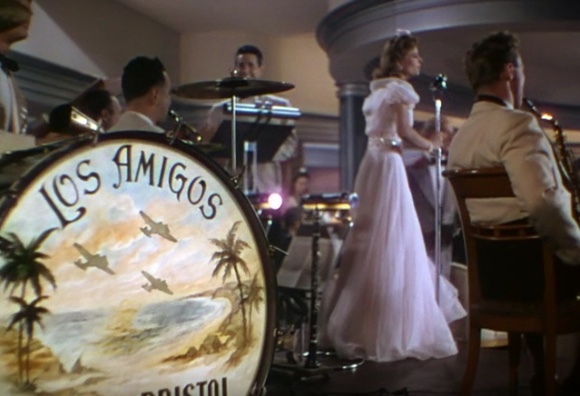
The scene is rich with subtle and not-so-subtle clues regarding the dynamics of the pilots’ friendship, from the visual emblazoned on the band’s bass drum –

Dive Bomber 20--band

– to a sequence in which, as they sketch suit designs on a tablecloth, Linda’s lipstick furnishes the inspiration for “a slide valve with a fine screw on the stem. Each turn opens it just a hair. This is it!”

The phallic emergence of the red lipstick from its tube, seen in close-up, is eye-popping. Bored and annoyed, the women go, despatching a young waiter to recite a short poem to Doug and Joe: “We don’t like quarrels, we don’t like scenes / The Navy’s too busy, we’ll try the Marines”.

After Joe sacrifices his life in testing the pressure suit prototype, Doug commemorates him at a naval ceremony as “my friend and co-worker, Lieutenant Commander Blake, a very gallant gentleman”. In a solitary moment at this event, he kisses his hand and plants it on Joe’s plane, before taking to the skies with other pilots, and ritually throwing Joe’s special cigarette case into the clouds (an act that would surely kill anyone unfortunate enough to be standing where it landed). It is a story of love, but the film can claim it’s just about men working together for the war effort.

The three acts of Torch Song Trilogy give us years in the life of New York drag performer Arnold (Harvey Fierstein). At the end of the second act, a gang of men murder Alan (Matthew Broderick), his first real love, in a homophobic attack. Billie Holiday’s recording of ‘What’s New’ accompanies a scene early in the third (here, at 1:24.56), starting mid-way through the penultimate chorus. Arnold returns home to find his on-again, off-again lover Ed (Brian Kerwin) asleep on the couch, where he removes Ed’s glasses tenderly. At this point the song seems to signify Arnold’s affection, and the extent of what Ed, a man who isn’t open about his sexuality, can offer in their relationship. But then Benny Carter’s saxophone solo begins, and we see Arnold get into bed, now in his pyjamas. He takes Alan’s portrait, which sits on his bedside table, in his arms, then rolls his eyes, saying “how Alice Faye can I get?!” The shot cuts to the morning kitchen radio, where Carter’s solo continues. Time jumps but the song flows on unbroken: love is unending and loss ever-present.

Torch Song Trilogy ultimately refuses a tragic ending. Put together, I see both films mapping and subverting the sexual limits heteropatriarchy laid down in the twentieth-century. What they share with ‘What’s New?’ goes beyond the specific lines they use concerning conversational distraction and lost love: all speak of how social convention and desire interact.

10: Everything Happens To Me (1941)

This song is a primer in magical thinking.

Matt Dennis and Tom Adair wrote ‘Everything Happens To Me’ in 1941. Frank Sinatra’s winsome recording with Tommy Dorsey that same year made it a hit.

Surprisingly, despite the vividness of its story of chronic misfortune, there are far more instrumental than vocal versions. And no movie seems to have incorporated the song into its action.** Three films share its title – a 1938 comedy caper about a by-election in a seaside town starring vaudevillean Max Miller, a 2001 Spanish romantic comedy entitled Todo me pasa a mí adapted from a play, and a 2018 single-shot short about an actor’s terrible audition. Then there is Chissà perché… capitano tutte a me (1980), a supremely How Did This Get Madeable buddy cop drama which teams a preternaturally strong sheriff (Bud Spencer) with a gizmo-toting alien boy (Cary Guffey, of Close Encounters of the Third Kind fame). Its Anglicised title, Why Did You Pick On Me?, is the repeated refrain of the sheriff as the two of them get into scrapes. For exposure to its full range of battiness, including Mary Poppins-esque magical home improvements, Kraftwerk alien villains, and at least one hundred slapstick brawls, it can be seen in full here.

Lucky for my purposes then that the album cover of Chet Baker Sings: It Could Happen To You (1958), on which ‘Everything Happens To Me’ appears, is acutely cinematic. In his review piece about this album and Chet Baker as a cultural icon, John Bergstrom doesn’t love it:

Baker was cool, all right. But he exhibited none of the aggressive, chest-puffing, downright intimidating cool that went with most of the other big names of the day. His coolness was passive rather than active, accidental rather than inevitable, devoid of sexuality. Just look at the flat-out hokey cover art for It Could Happen To You. This guy isn’t dangerous. At least not yet.

Rollneck notwithstanding, Baker’s lupine gaze in that image feels pretty intense to me. It Could Happen To You as 1950s werewolf romcom: seemingly anodyne heartthrob lures unsuspecting dates and turns them; under the light of the waxing crescent moon, he meets his match in this laughing girl, who also happens to be a werewolf. I’d watch it.

Johnny Burke’s lyrics for ‘It Could Happen To You’ (1944) and Tom Adair’s for ‘Everything Happens To Me’ are two sides of the same narrative coin: the one, a story of the exhilarating terror of Cupid’s arrow, and the other, a melancholic account of perpetual adversity in life and love.

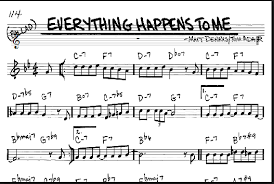
Everything Happens To Me

The verse – which Chet Baker’s performance excludes, and which is absent from the chart above – begins with superstitious high drama: “Black cats creep across my path until I’m almost mad / I must have roused the devil’s wrath, ’cause all my luck is bad”. (Ella Fitzgerald retains it; following a misleadingly jaunty introduction, so does Billie Holiday.) Dennis’s composition then modulates from minor to major, and Adair’s resigned tale of woe unfolds. Magic is replaced by a thoroughly modern kind of predestination: golf dates made will guarantee rain, card games played will engender inevitable defeat. The wordplay of the phrases “I guess I’ll go through life just catching colds and missing trains” and “I never miss a thing, I’ve had the measles and the mumps” suggest interminable negativity. And it’s always the protagonist’s own fault: “I guess I’m just a fool who never looks before he jumps / Everything happens to me”.

A love affair with the person to whom the song is addressed seemed briefly to present a solution to the “jinx”, but alas: “I’ve mortgaged all my castles in the air”. (I find this artful line really hard to get my head around. Dreams have crashed down to earth as crippling debts? To whom?) For the lost object of desire has cut ties with the hapless character altogether. Dealing with this unhappy turn, the penultimate couplet is legitimately funny: “I’ve telegraphed and phoned, sent an Air Mail Special, too / Your answer was ‘Goodbye’, and there was even postage due”.

The song concludes on a note of fatalism. “I fell in love just once and then it had to be with you / Everything happens to me”.

To be described as someone’s one and only true love, never to be replaced, is classic ‘romance’. But as the narrative plays itself out in Chet Baker’s delicate performance, the protagonist’s misery and self-reproach are all-encompassing and of long duration. The brilliance of the song is in its presentation of the failed love affair as the icing on the cake of this person’s beleaguered life: the mantra ‘everything happens to me’ hints at another, untold story of loss and disappointment.

**Update: actually there are four, a similar miscellany: romantic comedy Playing By Heart (1998) (“if romance is a mystery, there’s only one way to figure it out”), The Guard (2011) (“the FBI are about to discover that things work a little differently around here”), Dolphin Tale (2011) (“inspired by the amazing true story of Winter”), and Woody Allen’s A Rainy Day in New York (2019) (no tagline, but much controversy).