Watching Laura Mvula headline Love Supreme at the Roundhouse last night, I remembered this text sitting lonely on my computer, which I wrote the day after attending the 5 March 2015 cinema broadcast of her performance with Metropole Orkest, recorded at Paradiso Amsterdam on 28 November 2014.
At Screen 5 of the Ritzy in Brixton, the usher confirmed in a whisper that the screening of Laura Mvula’s gig hadn’t started yet (‘they are still doing the interviews’) and held open the door. The cinema was two-thirds empty and unusually chilly. Laura Mvula was on-screen in conversation with a male interviewer, responding to tweets coming in about the broadcast of the gig, displayed at the bottom of the screen. The interviewer advised the audience – the audience to their interview, wherever it was, and us, witnessing their exchange live – that we may have to pretend at various points that we have something in our eye, such was the emotive impact of what we were about to see.
Eating popcorn, I was curious. The camera filming the interview from the back of the venue suggested that the auditorium to which the artist was speaking was disappointingly half-empty – an image counterbalanced by a later view from the front, which showed row upon row filled with people. This, in combination with our own sparsely populated and cold auditorium, felt like something of an opening anticlimax.
The recorded gig itself begins with the conductor Jules Buckley entering the stage of the Paradiso in Amsterdam. The venue is a former church, and intricate blue stained-glass windows adorn the wall behind the orchestra. A gallery level rests on top of corniced pillars – an architectural arrangement smaller but not dissimilar in shape to the Palau Música de Catalana in Barcelona where I’d seen a slightly odd performance by Aloe Blacc the previous summer, which had concluded with the audience being encouraged to rush the stage while the artist slipped away. The cameras filming the gig reveal that the auditorium is heaving. The ensemble of more than fifty musicians is packed onto the stage, a choir standing beneath the gallery stage left, and three backing singers positioned downstage right. Jules Buckley makes a cheesy Jaws reference in relation to the sell-out gig (‘we’re going to need a bigger boat!’) and warmly introduces the Metropole Orkest, before welcoming Laura Mvula herself onto the stage.
She walks into the auditorium through a door to the left of the front of the audience, passing amongst people standing to ascend the shallow stage. In March 2015, Laura Mvula has a shaven head, and wears a long white jacket and black top. In November 2014, her afro and peach nylon dress, long sleeves draping down, speak of the 1970s. When she stretches her right arm towards the audience as if in supplication – a gesture she will make frequently during her performance – her sleeve punctuates the movement. At first, she doesn’t speak except to say ‘thank you’.

The performance is revelatory. The rich orchestration lends a new dimension to the songs, which now tell stories that are different to those of the intimate arrangements on Sing to the Moon (2013), on which the gig is based. The first number, ‘Like the Morning Dew’, describes the insubstantiality of a relationship: ‘Our love is / Like the morning clouds / Like the morning dew / That goes away / Early.’ The expansiveness of the arrangement envelops the voice of the soloist, speaking of the disappearance of the world that the song’s protagonist thought was there. Its resonant universe conjures imaginative flight, fantasy, and a strange kind of optimistic sadness about the flimsiness of that imagined world. ‘She’ describes a woman’s quest for intimacy, the lyric ‘she don’t stop / she don’t stop / she don’t stop’ underscored by percussion, giving the impression of a relentless progression forward. As she sings, her movement alludes to walking a path, although of course, standing on the spot, she goes nowhere. Whether the intended meaning or not, as she performs ‘Is There Anybody Out There?’ I think of how precious life must feel to someone facing death: ‘Is this the end / Before it’s even started / I can’t survive this way / I’m broken-hearted.’ The improvisation of the lead vocalist over the chorus constructs both a sense of internal dialogue and a conversation between people. As in the original arrangement, the tumbling strings give way to a dissonant passage, and the sensation of floating in space.
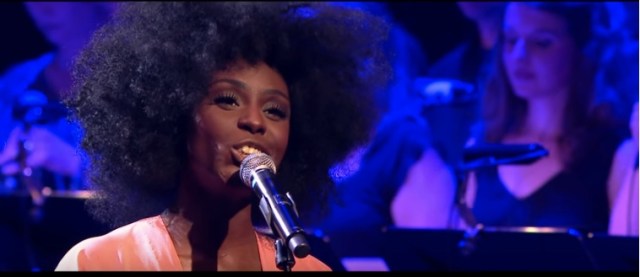
With ‘Father Father’, I recognize what the interviewer meant. Seated at the piano, she introduces the song by acknowledging Jules Buckley’s new arrangement for the orchestra (‘it’s better’). The purity of the brass at the start of the song seems to refer perfectly and incongruously to Vaughan Williams and Elgar. As she sings ‘I lost my heart / In the dark with you’, its attack is brutal. The texture of the song builds with the introduction of strings, piano, and timpani, creating an almost meteorological landscape of sound. Then, the song continues for as long again, with her beautiful improvisation around the lyrics ‘Father father / Please don’t let me go / Father father / Why’d you let me go’ as the music swells around her. Her gaze directed at no-one in particular, she speaks to herself, to the audience, to God. I now hear the song as the tragedy of the loss of faith, and wonder whether all of the songs in the concert are in some way circling that idea.
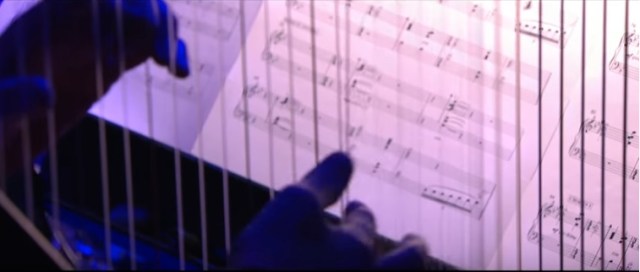
Huddled beneath my coat in the cold cinema, I moved in and out of absorption in the gig, fascinated by the technical execution of the music producing such intense emotional effects in the audience, occasionally feeling tears spring in my own eyes and roll down the side of my face. A large gathering of musicians had met an audience of 1,500, met in turn later by a much more disparately spread audience, watching silently in cinemas as the first audience clapped and cheered. At the end of each number, her face would wrinkle into a huge smile, puncturing the emotional world of the songs and reasserting the humour of the everyday.
The gig finished with an encore performance of ‘Make Me Lovely’.
Towards its end she said: ‘I just want to thank you all for being the most wonderful audience, ever’. At this, I smiled, feeling warmth toward this past audience but not feeling myself a part of it. Having concluded, the recorded concert was then unexpectedly followed up by a live performance from Laura Mvula in the venue of the interview, performing solo on a keyboard. It was unexpected, it seemed, to everyone – the screen showed a couple of audience members caught short attempting to get up. The much more minimal rendition of three of the numbers she had performed exposed again the texture of the orchestral arrangements, and the controlled power of her voice. Strangely, this live performance felt intimate, just for us, despite the ‘us’ being scattered in cinemas across the country. When she finished this reprise, she smiled, and said ‘thank you for coming’ again. In the Ritzy, the credits rolled silently, and no-one moved.
 People Think This Is Romantic