23: A Certain Smile (1958)

This song puts up a front.

Composer Sammy Fain and lyricist Paul Francis Webster wrote this winsome, Academy Award-nominated song for Jean Negulesco’s A Certain Smile (1958) – a sweeping cinematic adaptation of Françoise Sagan’s uncompromising novella about love, sex and infidelity. Critics at the time found the film’s treatment of Sagan’s story to be average at best: a “glossy, emotional yarn” (Variety), a “tepid romantic interlude” (New York Times). The song has been infrequently recorded since the 1970s.

No-one:

Me: ‘A Certain Smile’ is integral – INTEGRAL – to A Certain Smile‘s re-articulation of Sagan’s book as a melodramatic touristic visual feast – yes, and in case you imagine this is a situation of FILM = BAD, BOOK = GOOD, the last of those is an aspect that weirdly resonates with Sagan’s own literary style, which makes much of staging things to look at!* Plus, existentialist cynic Sagan wrote romantic song lyrics for Juliette Greco?!**

NB. “no-one” meme format for me still fresh as daisy because not on Twitter and this too probably. Anyway, let’s get into it.

‘A Certain Smile’ has been a rabbit hole to fall down. Back in the spring, Spotify gave me Ted Greene’s 1977 night sky of a solo recording. Confusion descended: did I know the song already, or was this sparkling arrangement enchanting me into thinking I did? (Martin Taylor’s intensely beautiful 1993 solo guitar rendition did similar magic.) I listened to the inaugural 1958 recording by Johnny Mathiswho performs the song with verse in a nightclub set piece in the film – and was still none the wiser. I couldn’t decide if it was the sing-song pattern of the melody that felt familiar, or the song itself. When I asked my mum about ‘A Certain Smile’, she knew it immediately, lyrics and all. From the generational point of view, this makes sense: more than half of the vocal recordings to be released professionally were out by the late 1960s, with ten of those released in 1958. This smash hit – Mathis’ recording reached #4 in the UK – has been in the atmosphere for decades, with diminishing density over time.

The song’s apparent sweetness contrasts with Sagan’s A Certain Smile (1956) – a text that begins archly with an epigraph from Roger Vailland: Love is what happens between two people who love each other.

Dominique, in a relationship with fellow Sorbonne student Bertrand, tells the winding story of her short but unexpectedly emotionally shattering affair with Bertrand’s married uncle, Luc. For one critic reviewing the book in 1957, Sagan communicates the experience of “serene despair” with immaculate precision, featuring “none of the obsession with the details of external reality so common in her contemporaries: ‘and now I shall show you what Life is really like in Paris, Moscow or New York’, in attempts which finally show what? nothing”.

Paul Francis Webster’s lyrics, prepared for the film, are of a different order of business.

What do you meet down a crooked little street in Paris
Vendors who sell pretty flowers that tell of spring
Once in a while you may meet a certain smile in Paris
So excitingly gay that it seems to say ‘cherie, fall in love with me’

A certain smile, a certain face
Can lead an unsuspecting heart on a merry chase
A fleeting glance can say so many lovely things
Suddenly you know why my heart sings

You’ll love awhile and when love goes
You try to hide the tears inside with a cheerful pose
But in the hush of night exactly like a bittersweet refrain
Comes that certain smile to haunt your heart again

Set against a dramatic minor key, the verse’s clever internal rhymes and their fantasy of Paris resolve into the optimistic choruses, their rhyming couplets, and their protagonist, sharing the wisdom of their experience while presenting a brave exterior. It’s strangely labyrinthine in its temporal journey, and much more complicated than it first appears to be.

This isn’t unlike the movie – although I will say I found A Certain Smile to be a rough watch, at least first time around. It rearranges the essential components of Sagan’s book to produce a morality tale that visually “abounds with mouth-watering vistas of the French Riviera”. Characters bear only marginal resemblance to their sources: the ingénue (Christine Carère), her parents (Eduard Franz, Katherine Locke) in extended grief for the loss of their son, said ingénue’s feckless boyfriend (Bradford Dillman), his rich and selfish mother (Kathryn Givney), the playboy uncle (Rossano Brazzi), his long-suffering wife Françoise (Joan Fontaine), and a rogues’ gallery of assorted friends and associates. Dominique’s red beret amid the grey stone of the Sorbonne marks her out as a scarlet woman in the making. Her fate is confirmed when, soon after Luc hits on Dominique in a café-bar she has attended with Bertrand, Françoise airily offers Dominique a red coat during her visit to their home, declaring it “far too young for me” – misogynising, if you will, a more or less throwaway moment in the book, in which the couple extravagantly buy a coat “in a reddish woollen material” for their nephew’s new girlfriend in a shop.

‘A Certain Smile’ instrumentally underscores the beats of Dominique’s entire emotional arc, from her misguided entanglement with Luc to her rapprochement with Bertrand. So closely is the song woven into the fabric of the film that it’s almost imperceptible, smoothing the way for the romance’s compliance with the sanitising “shibboleths of the Production Code”.

As recounted in Michaelangelo Capua’s Jean Negulesco: The Life and Films (2017), here is how Sagan – whose text features extra-marital sex, pregnancy scares and so on – reacted to A Certain Smile‘s screenplay in a meeting with Negulesco in Paris:

I gave her an appointment in a café not too far from where we were shooting. She was sitting on the terrace eating a ham and cheese sandwich in the company of young man. I approached her a bit confused.

‘Miss Sagan?’
‘Yes.’
‘Excuse me, I’m Jean Negulesco. Have you read the script?’
‘Yes.’
‘Did you like it?’
‘No.’
‘Could you tell me why?’
‘No.’
‘Do you want to join me on the set?’
‘No.’
‘Would you allow me to pay for your sandwich?’
‘Yes.’

She then said to the young man: ‘It’s not him that pays, it’s 20th Century Fox.’

Despite Sagan’s understandable aversion to the film’s adaptation of her book, they end up at similar destinations. Rachel Cusk praises her “fearless and astute portrayal of love as a psychical event that has its roots in family life and the early formation of personality”. As I watched the film a second time, I realised that Dominique’s bizarre actions were imagined to hinge on the death of her brother and the consequences for her family, and that every character in their own way was struggling with loss. All three of these interconnected works – novella, film and song – are grappling with the depths of pain and its origins, though Sagan’s writing looks at them most directly and dispassionately.

*In both visual and psychological modes. A particularly economical example of narrative reflexivity from A Certain Smile‘s fourth chapter: “I couldn’t help feeling quite warm towards myself.” (p. 186)

**From a fascinating short biographical post entitled ‘That Charming Monster, Francoise Sagan’: “It is not widely known that Françoise Sagan dabbled in song writing, composing lyrics for romantic songs and even librettos for ballets. This aspect of her career came about when, at the age of twenty, haunting the bars and nightclubs of Saint Germain des Prés, she met the musician Michel Magne. Having already tried out over fifty lyricists for his songs, Magne thought Sagan’s style would be perfect. Her lyrics reflect a maturity beyond her years and lack the cynicism of her books. They are often about people wrestling with private pain and angst, deep into alcohol-fuelled nights. Vous mon Coeur (You my Heart) is a plea to a lover not leave: ‘You, my heart/You my life/You who smile/You who embrace me/You, one day…..will leave me, my heart.’”
21: Willow Weep for Me (1932)

This song isn’t having it.

Ann Ronell – a female trailblazer in the sphere of Hollywood musical direction and Broadway composition – originated this wonderful chronicle of heartbreak in 1932. A publishing colleague of Irving Berlin rejected it for being too technically complicated, but support from Berlin himself brought the song to radio broadcast and wider critical and commercial success.

Willow weep for me
Willow weep for me
Bend your branches green along the stream that runs to sea
Listen to my plea
Hear me willow and weep for me
Gone my lovers’ dream
Lovely summer dream
Gone and left me here to weep my tears into the stream
Sad as I can be
Hear me willow and weep for me
Whisper to the wind and say that love has sinned
Left my heart a-breaking, and making a moan
Murmur to the night to hide its starry light
So none will see me sighing and crying all alone
Weeping willow tree
Weep in sympathy
Bend your branches down along the ground and cover me
When the shadows fall, hear me willow and weep for me

While hearing out their lonely protagonist’s pain, these lyrics wink theatrically: love in its entirety has “sinned” because the “lovely summer dream” of a seasonal romance hasn’t worked out for you? All the stars in the night sky should be obliterated to conceal your unique misery? Come on. There’s no shame in sadness.

Ronell’s celebrated, much recorded composition warmly presses that argument forward – in particular the major key in the A sections, its sing-song octave leap (Ted Gioia: “a vertiginous plunge followed by a reassuring triplet bounce unlike anything else in the jazz repertoire of the era”), and the way in which, as Alec Wilder notes, “the accompaniment moves into double time and out again the next measure”. Edward Jablonski interprets this choice as signifying “agitated stress”, but I’m not sure that’s it. Consider, for example, Ella Fitzgerald’s 1959 recording. “Listen to my plea”, entreats the song’s protagonist. Amid the dreaminess of Frank DeVol’s orchestral arrangement, this rhythmic shift counterargues: no, you need to shake things up.

The song’s appearance in the Marx Brothers’ Love Happy (1949) – a crime caper which brings together a diamond heist and a Broadway revue – sets off its refusal of the role of romantic victim in an utterly surprising way.

Ann Ronell scored Love Happy, and oversaw Frank Perkins’ instrumental arrangement of ‘Willow Weep for Me’ for one of the Broadway revue’s numbers. Choregraphed by Billy Daniel, it presents an extraordinary burlesque staging of the figure of Miss Sadie Thompson.

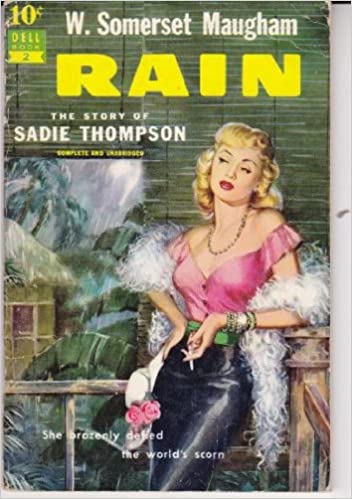
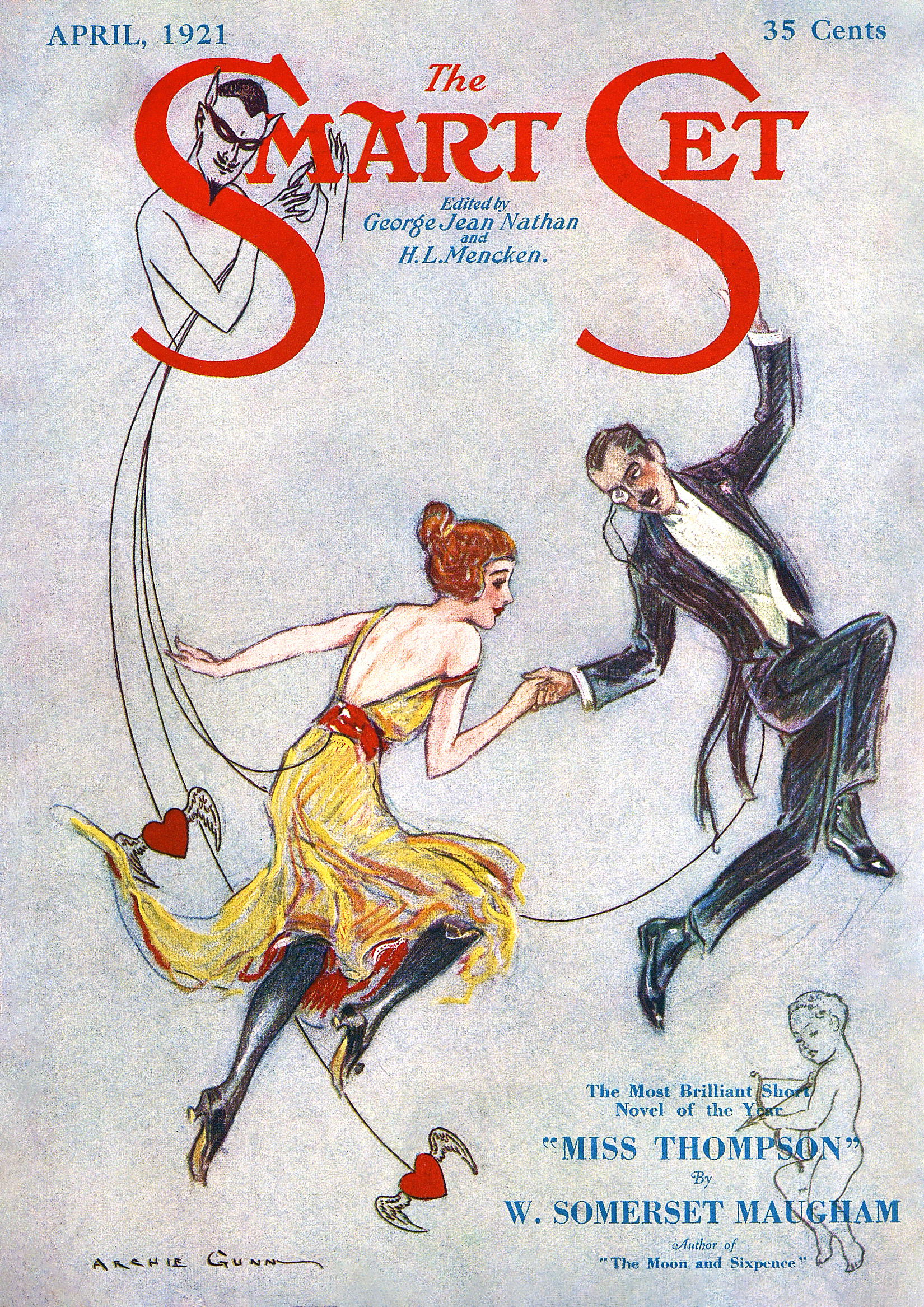
Sadie Thompson is a character in ‘Rain’ (1921), a short story by W. Somerset Maugham set in American Samoa. A ship’s crew member contracts measles, and its passengers are required to remain in port at Pago Pago for a period of quarantine: Dr and Mrs Macphail, missionary couple the Davidsons (ordinarily stationed elsewhere), and Sadie Thompson herself. All are offered accommodation in rooms above a shop. Sadie Thompson entertains sailors in her quarters, playing her gramophone loudly, to the the Davidsons’ infinite disapproval. They quickly infer that, having boarded at Iwelei (“plague spot of Honolulu. The Red Light district”), she is a prostitute, and Davidson himself undertakes to convert her. The missionary programme is vicious: the Davidsons expunge local practices of dancing and dress, impose fines on those who refuse to comply, and delight in destroying associates whose morality they deem insufficient. Davidson’s patriarchal fanaticism – of Sadie, he declares: “‘I want to put in her heart the passionate desire to be punished so that at the end, even if I offered to let her go, she would refuse'” – culminates in what the story very strongly implies is his rape of Sadie and his grisly death by cutting his own throat.

For Victoria Kuttainen, ‘Rain’ dramatises how missionary, medical and cultural regimes collide in the the “colonial, modernising Pacific”. She proposes that Somerset Maugham – both a literary figure and prolific writer for stage and screen – was acutely aware of the imagistic power of “fantasies of seductive starlets and beguiling tropical scenes”, and that his narrative choices comment on the performative power of speculation: other characters are given to report on Sadie’s conduct. In the diverse theatrical and cinematic adaptations of ‘Rain’,* meanwhile, “spectacle replaces speculation”. Stagings of Sadie melodramatically exoticise and evacuate the story of critical force.

The number in Love Happy quotes and exaggerates elements of these adaptations. It sweeps almost every hint of violence away, and reimagines the scenario as a comedy.

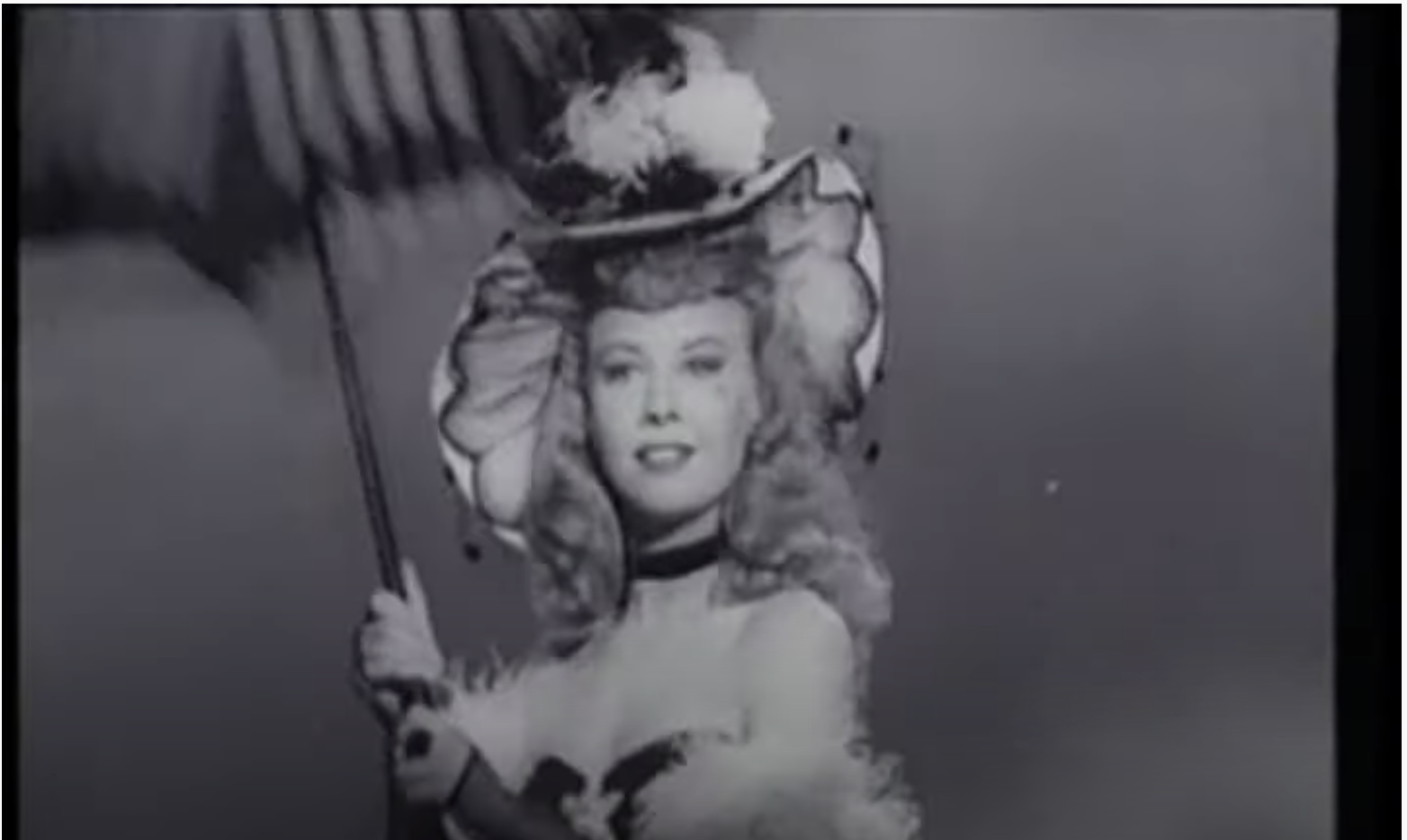
In this cartoon tropics, Sadie’s beau, Sergeant O’Hara (played by ‘Paul Valentine’, played by Mike Johnson) – a character introduced in these adaptations – places the needle on the gramophone, and the siren rasp of ‘Willow Weep For Me’ summons Sadie (played by ‘Maggie Phillips’, played by Vera-Ellen) to the stage. Marines gawp as she struts in, her hand magically conjuring her own spotlight. She roams about the stage with comic suggestiveness, occasionally knocking these uniformed men down like dominoes, while O’Hara gazes at her with deep desire. When, as in the story, Davidson (House Peters Jr.) stops the gramophone’s music, a drumbeat commences and a group representing Samoan dancers wearing what resemble lavalava enter the stage, supporting Sadie to continue – a section which trades in racialised stereotyping, places Sadie at its centre, but suggests collective solidarity between she and the islanders against the forces of missionary control. Davidson has failed, and exuberant music and dancing prevail. The gramophone resumes, and a whistle sends the Marines back, who have rushed Sadie like a pack of dogs. The number concludes softly: Sadie and O’Hara stand intimately together before the auditorium of the Broadway theatre to scattered applause.**

This larger-than-life musical rendition both sends up and luxuriates in the cultural habit of looking at Sadie. The lyrics and their sadness ghost the scene, a reminder of the tragedy of ‘Rain’, but here underscoring how Sadie just gets to go about her business.

Before watching the film, I had heard ‘Willow Weep for Me’ only in versions accentuating its bluesiness, as in the powerful recordings by Billie Holiday, Dinah Washington and Etta James, and Sarah Vaughan’s magical and hilarious live performance. With the exception of Stan Kenton’s 1946 arrangement featuring June Christy, the handful of recordings that precede Love Happy are a lively mix of foxtrot and cabaret, and a far cry from the sorrowful sentimentality of other later versions: Frank Sinatra, Julie London, Tony Bennett.

It begs so many questions: about the mood Ann Ronell originally intended for the song, how this scene in Love Happy was conceived and by whom,*** the direction of subsequent recordings. Regardless, it strikes me that its author’s well-documented determination, ambition, kindness and vivacity are of a piece with ‘Willow Weep for Me’. It is a song that “does exactly what it pleases”, recognising social and emotional limits, but isn’t about to accept them.

*John Colton & Clemence Randolph’s play Rain: a Play in Three Acts (1923); Sadie Thompson (1928), starring Gloria Swanson; Rain (1932), starring Joan Crawford; and Miss Sadie Thompson (1953), starring Rita Hayworth.

**Paul’s subsequent instruction to Maggie – “now go change into your ballet costume” – is arguably a misogynistic gag playing on the historical intersection of ballet and sex work.

***An edition of Film Music Notes speaks favourably of “the producer who allowed the composer select co-workers of her own choice wherever possible, thus assuring maximum of compatible tastes and efforts to musical production with minimum personnel”.

20: My Ship (1941)

This song is about how we got here.

NB. Major spoilers ahead for Lady in the Dark (1944) and Phantom Thread (2017).

I first heard ‘My Ship’ several years ago – probably Nancy Wilson’s very beautiful big band recording from 1963, whose choppy instrumental introduction soon settles into golden plain sailing. Ira Gershwin’s lyrics fantasise luxuries arriving from far away, which are as nothing without the delivery of a soul-mate:

My ship has sails that are made of silk
The decks are trimmed with gold
And of jam and spice
There’s a paradise
In the hold
My ship’s aglow with a million pearls
And rubies fill each bin,
The sun sits high
In a sapphire sky
When my ship comes in
I can wait the years
Till it appears
One fine day one spring
But the pearls and such
They won’t mean much
If there’s missing just one thing
I do not care if that day arrives
That dream need never be
If the ship I sing doesn’t also bring
My own true love to me

Despite its sun, the song’s story reminded me of Christmas, most likely because of the carol ‘I Saw Three Ships (Come Sailing In)’. The nursery rhyme ‘I saw a ship a-sailing’, about a merchant vessel packed with treats and crewed by mice-sailors with “chains about their necks” was probably somewhere in my mind too: it appeared in ‘Ship in a Bottle’ (1974), the very first episode of Bagpuss.

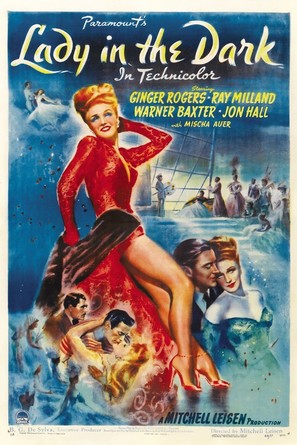
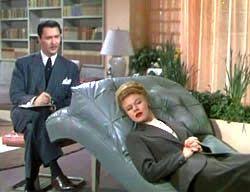
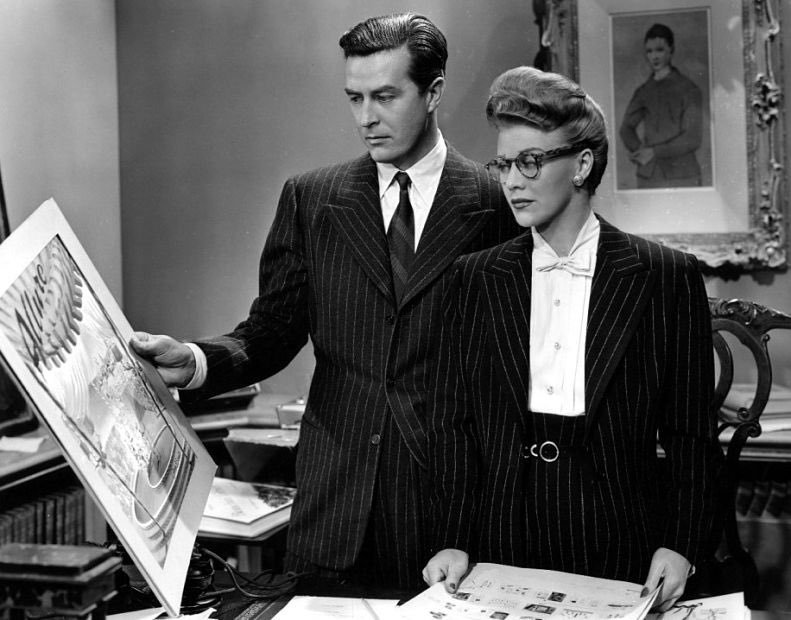
With Ira Gershwin, Kurt Weill composed the song for Moss Hart’s stage musical Lady in the Dark (1941). Liza Elliott, ambitious and successful editor of fashion magazine Allure, is in crisis. Her doctor recommends psychoanalysis. In the 1944 film dramatization – one of the highest grossing movies of the year – Liza (Ginger Rogers) finds herself humming a phrase from ‘My Ship’ repeatedly: an elusive echo of a repressed trauma. Psychoanalysis allows her to recall that as a young child she tried to perform the song at a family party. Her self-absorbed mother, preoccupied by male attention, is indifferent; the guests are thoughtlessly unkind, saying she is plain. As a child, Liza begins to hate her appearance. When her mother dies soon after, she is unable to grieve. She tries on her mother’s special blue dress, and her father chastises her angrily: a terrible rejection.

As Bruce McClung writes, ‘I saw a ship a-sailing’ is “the song’s predecessor”; further, “the gradual decoding of what ‘My Ship’ signifies sustains the drama, a process like the ‘Rosebud’ cipher in Citizen Kane. In relation to the song’s image of a ship bearing bounties, Lady in the Dark is also, mindblowingly, ghosted by Shakespeare’s The Merchant of Venice (1596) – a play that dramatizes, amongst other things, “the new set of economic interactions that accompanied the birth of capitalism”. McClung notes that Moss Hart’s own experience of psychoanalysis was formative of the story, but that Freud’s ‘The Theme of the Three Caskets’ (1913) is what gives Lady in the Dark its structure. In the essay, Freud theorises the lottery for Portia’s hand in The Merchant of Venice: a choice between gold, silver and lead caskets, one of which contains her portrait. Like Bassanio, Hart has Liza select between three ‘caskets’ – publisher Kendall Nesbitt (Warner Baxter), actor Randy Curtis (Jon Hall), and her magazine’s advertising executive Charley Johnson (Ray Milland), who represent simplistically “the roles of father, lover, and husband”.

This film is a gorgeous waking nightmare, and watching it I was furious from beginning to end.

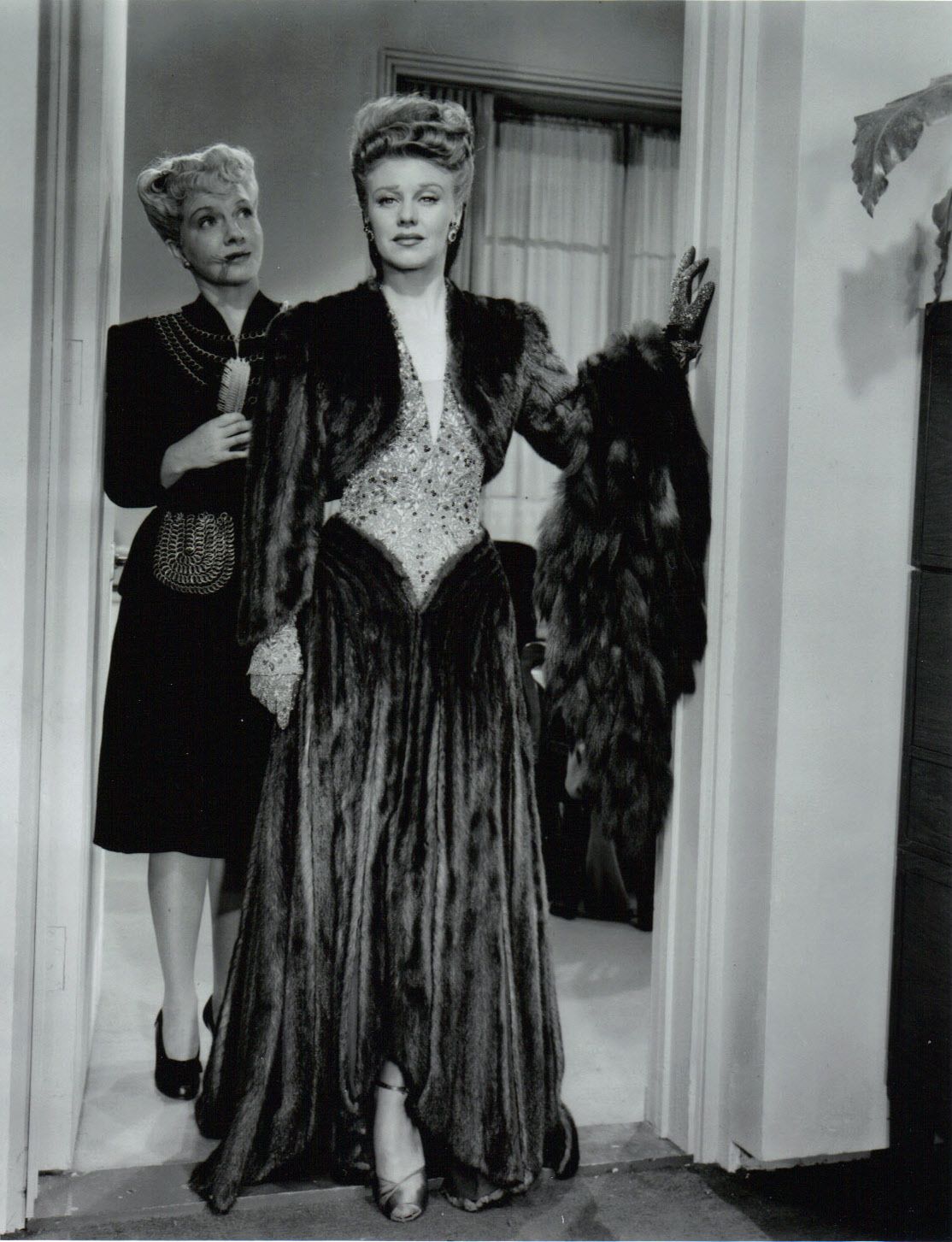
Amid the opulence of Allure‘s offices – the film’s lavish design and dream sequences subvert its maniacal heteronormativity – Charley attacks Liza continually, questioning her gender, sex life, and style, and brazenly declaring his desire for her job. When unusually she wears an evening gown on a date with Randy – a garment of sequin and mink that cost Paramount an eyewatering $35,000 dollars to produce – he jibes “you look wonderful – you actually look like a woman!” Her psychoanalyst Dr Brooks (Barry Sullivan) meanwhile proposes that, stemming from her childhood experiences, her distress lies with her reluctance to embrace femininity and “compete with other women”. Ignoring the injustices it so clearly lays out, the film egregiously weaponises psychoanalysis to confirm the “sex/gender system” and everything it supports. It ends with Liza agreeing to co-run the magazine with Charley, her literal tumble to the ground as he grabs her editorial chair for himself, and a kiss of unlikely passion between the two. This great review including on point picture captions (“Ray Milland is a shithead with a whip and Ginger Rogers is the lady in a cage in the circus dream”) fully has the measure of the film, as do these others on Letterboxd.

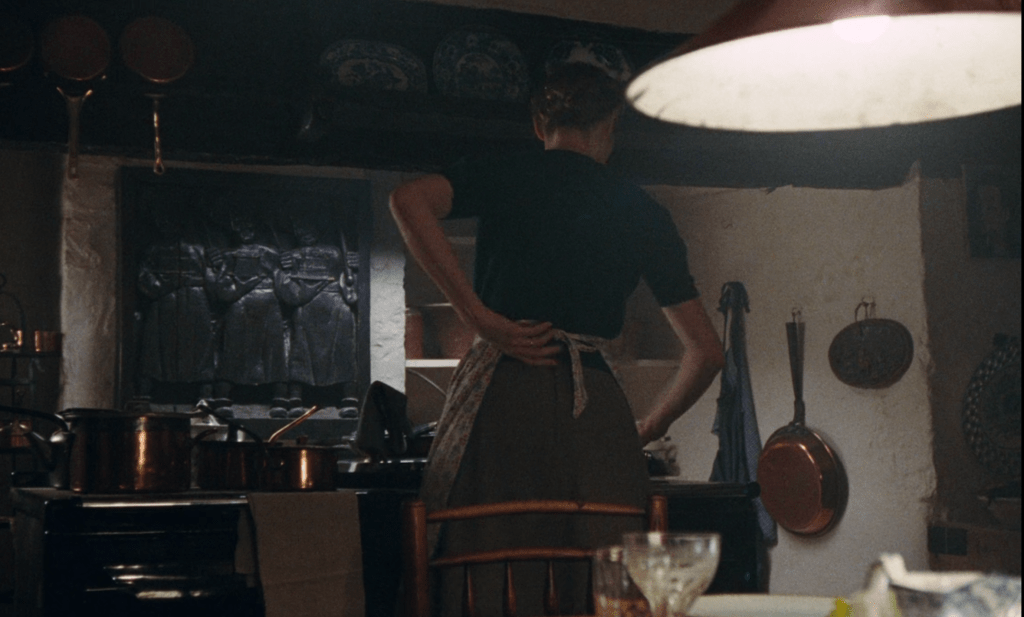
Paul Thomas Anderson’s extraordinary Phantom Thread (2017) includes ‘My Ship’. And Lady in the Dark seems to me to haunt the film in other ways, not least Freud’s essay.

At its conclusion Freud correlates the caskets to the mythological Fates (Moirai), the “three weaving goddesses who assign individual destinies to mortals at birth”, and thus to

the three inevitable relations that a man has with a woman – the woman who bears him, the woman who is his mate and the woman who destroys him; or that they are the three forms taken by the figure of the mother in the course of a man’s life – the mother herself, the beloved one who is chosen after her pattern, and lastly the Mother Earth who receives him once more. But it is in vain that an old man yearns for the love of a woman as he had it first from his mother; the third of the Fates alone, the silent Goddess of Death, will take him into her arms.

The relationship that Paul Thomas Anderson concocts between celebrated and exacting dressmaker Reynolds Woodcock (Daniel Day-Lewis) and his lover and model Alma (Vicky Krieps) attempts to have this cake and eat it. So consumed is Reynolds with his mother, and control over himself and his surroundings, that he cannot tolerate interruption or vulnerability, keeping his shrewd sister Cyril (Lesley Manville) close by as his safe companion. In these constrained, even hostile emotional circumstances, Alma (‘soul’) undertakes to derail his “games” by bringing him close to death: she feeds him poisonous mushrooms, then nurses him back to health, thereby impossibly occupying all three relations. This sadomasochistic gambit allows Reynolds to let go, to fall in love, to commit to her totally, and they have their own child. And so another cycle begins.

Oscar Peterson’s performance of ‘My Ship’ plays in the tearoom in which Woodcock first encounters Alma as a waitress, where he orders a ridiculous breakfast. Learning of Paul Thomas Anderson’s passion for big band jazz, I’m convinced that the narrative structure of Reynolds and Alma’s relationship is based on Nelson Riddle’s wonderful orchestral arrangement: brass and woodwind signal ‘watch out!’ before the song moves to surging strings, the solitary multiplicity of Peterson’s piano, and so on, periodically undercut by ambiguous, if not outrightly sinister harmonic choices. Key changes mark new phases, ascension to new heights. It’s almost unbearably poignant but also weirdly unserious somehow. It finishes with a steadying rallentando and fluttering flutes: a happy ending.

Aleksandar Hemon in the New Yorker concludes that Phantom Thread is “nothing if not propaganda for patriarchy”, and for sure I agree that it is in one sense a deep stitch-up, leaving little room for its women’s own desires beyond surviving these conditions, and doling out punishment for their perceived infractions. But like the stunning arrangement of ‘My Ship’ that it features, it is laced with compassionate unease, skewering power and fantasy with a delicate comic touch.

16: So Rare (1937)

This song is quite something.


The transportative harmonies of Ahmad Jamal’s beautiful recording on Ballades (2019) suggest ‘So Rare’ to be a standard as beloved as Sammy Cahn, Axel Stordahl and Paul Weston’s ‘I Should Care’ (1944), also covered on that album. Not so: although it has topped the charts more than once, it’s actually sort of overlooked. Finding out more about it has been akin to an archaeological dig. Put together, its various pieces produce a totally unexpected picture, but one that (surprise surprise) nonetheless traces out contours of gender, ancient and modern. It is a trip.

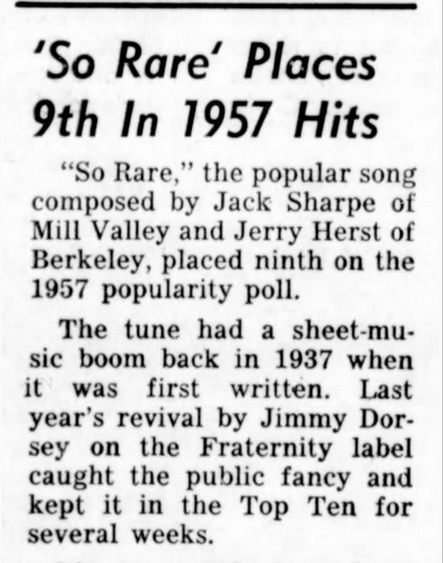
Written by Jerry Herst and Jack Sharpe, ‘So Rare’ is a rhapsody of love. It is jam-packed with images of heavenly hosts, exotic flowers, ethereal classical compositions and, most weirdly, the American flag. It was first recorded in 1937, no fewer than seven times that year, in various big band interpretations for dancing the foxtrot. Guy Lombardo and his Royal Canadians made it number one on popular radio show Your Hit Parade in the week of 11 September 1937. Then it was barely touched until 1957 – another bonanza year for the song, which saw the release of Jimmy Dorsey’s brash big band recording.

So Rare--clipping

Daily Independent Journal, San Rafael, California, 1 February 1958. https://www.newspapers.com/clip/3844368/jack-sharpe-1958/

Dorsey’s smash hit trailed several similar to near-identical arrangements in its wake – from Jimmy Carroll (1957), Billy Vaughn (1958), Les Brown’s Band of Renown (1960), Bill Black’s Combo (1964), and Willie Mitchell (1967).

Dorsey deletes most of the song’s lyrics. A raunchy saxophone solo takes the melodic lead in the A sections, while a chorus performs its first B section – the only words to appear.

You are perfection
You’re my ideal
You’re angels singing the Ave Maria
For you’re an angel
I breathe and live you
With every beat of the heart that I give you

Horns en masse deliver the second B section, while the chorus ‘do-do-doos’ along. The evil genius of this arrangement is in its juxtaposition of lyrics about putting virgins on pedestals, seductive sax, rasping horns, and a savage drum beat and tempo identical to that used in David Rose and his Orchestra’s ‘The Stripper’ (1962) (written in 1958) – both enactment and refusal of the nightmare Madonna-whore dichotomy that continues to be the bane of women’s lives.

In vocal recordings including more of the song’s lyrics, things take a series of different turns.

In full, ‘So Rare’ has a verse, and AABA twice over, with different lyrics each time around – one set normatively for a male voice (“You’re like the fragrance of blossoms fair / Sweet as a breath of air”), and the other for a female voice (“You have the warmth of a Schubert air / Charming and debonaire”), as if for a duet. The small number of vocalists who have tackled it (no duets) have picked and chosen between them. Ella Fitzgerald and Betty Johnson‘s gentle versions subversively go for the ‘male’ set, while Mavis Rivers rocks the ‘female’ set. So too does Vera Lynn‘s sentimental rendition, but – presumably on the basis of nationality – she rewrites the triumphalist second B section lines “You have that something, that certain manner / You thrill me more than the Star Spangled Banner”. Bing Crosby and Don Cherry weave those in, to all-American patriotic effect, while Andy Williams does not.

The two films that have used ‘So Rare’ in their soundtracks bring twenty year time lags, masculinity, femininity, and visions of America together in the most unlikely way.

Return to Macon County (1975) sees teenagers Bo (Nick Nolte, at least 33) and Harley (Don Johnson, 25) attempt to drive from Georgia to California in a ’57 Chevy to participate in a drag race. It is 1958. En route, they pick up manic pixie dream girl Junell (Robin Mattson), who, having been subject to harassment flirted with by the two in the roadside diner where she works, abandons her job to join them on the road. The film is like a less edgy Two-Lane Blacktop (1971), with couply scenes between Bo and Junell set in derelict and abandoned buildings that echo Rebel Without a Cause (1955).


Dorsey’s ‘So Rare’ is background to a motel room encounter between Harley and a random girl – full frontal, so we know she’s expendable – which only works for Harley when they head out to have sex in the car.

For Roger Ebert, this film was textbook nostalgia for the 1950s.

Ike and the rest of the adults were riled up about dragracing and juvenile delinquents, but 1958 was really a fairly innocent time, youth wise, and the characters in this movie would be chewed up in the first 10 minutes of a late 1960’s motorcycle picture, not to mention a contemporary ghetto violence exploiter.

Hustle (1975) is also preoccupied with the 1950s, but as the rotten foundation of the corruptions of the 1970s.


Lieutenant Phil Gaines (Burt Reynolds) is a Los Angeles cop, whose live-in lover Nicole Britton (Catherine Deneuve) is a high-end sex worker. He becomes embroiled in a case involving the death of young stripper Gloria Hollinger (Colleen Brennan), which her father Marty (Ben Johnson) refuses to accept as suicide. The film reveals the past as the seedbed of the present’s problems, all incubated in LA’s amorality. War trauma induced sexual apathy in Marty, thus infidelity in his wife Paula (Eileen Brennan), and thus a daughter who turned to sex work to cater to her insatiable desire for consumer goods – dysfunction as enmeshed as LA’s freeways, where ‘So Rare’ is introduced.

Hustle 3

Dorsey’s recording blasts from Gaines’ car, inaccurately trailed by an announcer: “For those of us who were alive in 1955, ‘So Rare’.”


Gaines repeats: “‘For those of us who were alive in 1955’. Christ.” His partner Sergeant Louis Belgrave (Paul Winfield) replies: “1955! That’s the year this little girl was born.” Gaines: “Yeah. Twenty years later, tissue specimens in a jar.” This dialogue about a twenty year old woman is the thin end of the wedge of the film’s misogyny, which is not inconsiderable. Idealised purity pitched against degradation: a vicious and enduring contrast.

14: Baby, It’s Cold Outside (1949)

This song mixes things up.

Frank Loesser wrote the duet ‘Baby, It’s Cold Outside’ in 1944 as a novelty party piece that he and his wife Lynn performed for friends at their housewarming. The song’s incongruous appearance in the romantic comedy Neptune’s Daughter (1949) garnered it an Academy Award and a clutch of other recordings in the same year by popular music and jazz greatsElla Fitzgerald & Louis Jordan, Margaret Whiting & Johnny Mercer, and Dinah Shore & Buddy Clark among them. Sixty years on, the song’s account of seduction fuels hot takes on sexual politics like no other. ‘Baby, It’s Cold Outside’: cute celebration of wintry flirtation, or vile dramatisation of sexual coercion?

The lyrics give us a couple who, in the score, are each assigned the nicknames ‘Wolf’ and ‘Mouse’. Gesturing to the bitter weather and his cosy living room’s roaring fire, the guy keenly insists that his gal should stay. Hyper-alert to the reputational consequences of such a choice, she invokes nosy neighbours and all her family members eagerly awaiting her chaste return – the most judgemental being her “maiden aunt”, whose “mind is vicious”. The story ends merrily with the Mouse’s seeming capitulation, the two singers delivering the song’s title lyric harmoniously together.

The contemporary debate about the song’s power dynamic has become frenzied. In 2018, an array of North American radio stations went so far as to ban it, one DJ making the assessment that “in a world where #MeToo has finally given women the voice they deserve, the song has no place”. In a similar vein, John Legend not uncontroversially adapted its lyrics with Natasha Rothwell for a 2019 #MeToo-responsive recording with Kelly Clarkson – who herself had previously recorded the song with Ronnie Dunn in 2013.

This fraught scene has given rise to some really amazing writing. I concur with Chris Willman’s hilarious view, which opens his 2018 survey piece for Variety:

There is one group, and one group only, that should be crusading against the performance of ‘Baby, It’s Cold Outside’ in public: vicious maiden aunts.

For Willman, Zoey Deschanel and Will Ferrell’s shower-scene performance in Elf (2003) is the fountainhead of the song’s becoming “ubiquitous almost to the point of torture” – a suggestion in interesting historical accordance with Amelia McDonell-Parry’s 2018 article for Rolling Stone. There, she writes that current critique of the song’s sexual politics first got underway in 2004. She refers to a truly brilliant 2016 Tumblr post by a “former English teacher/nerd”, who argues that the now-incendiary lyric “Say what’s in this drink?”, penned in 1944, was “a stock joke at the time, and the punchline was invariably that there’s actually pretty much nothing in the drink, not even a significant amount of alcohol”. This writer concludes:

it’s a song about a woman finding a way to exercise sexual agency in a patriarchal society designed to stop her from doing so. But it’s also, at the same time, one of the best illustrations of rape culture that pop culture has ever produced. It’s a song about a society where women aren’t allowed to say yes…which happens to mean it’s also a society where women don’t have a clear and unambiguous way to say no.

Unlike clickbait determined that ‘Baby, It’s Cold Outside’ should be either one thing or the other, the best recordings of the song find similar both-and depth.

Admittedly, Frank Sinatra’s performance with Dorothy Kirsten fully embraces predation: it features a cartoonish spoken word section in which, in Pepe Le Pew-style, he locks her in his house and swallows the key. But Carmen McRae and Sammy Davis Jr’s increasingly funny version gives us a boss female protagonist. Louis Armstrong and Velma Middleton’s is also packed with jokes. Like its fairytale fantasy video, Tom Jones and Cerys Matthews’s is almost psychedically hyperbolic, topped off with Matthews commenting “Bloody freezin’, innit?” in a broad Welsh accent.

Plus there are plenty that flip the heteronormative script, assigning the Wolf to the female vocalist, or presenting two male or female singers – Caroline Pennell, She&Him (Zooey Deschanel and M. Ward), Kelley Jakle & Shelley Regner, Nathaniel Rateliff & Julie Davis, John Travolta & Olivia Newton-John, the version from Glee. Scott Bradlee’s Postmodern Jukebox delightfully substitutes a tap dancer for the Wolf. In this context, rewritings of the song seem quite baffling. As I receive it, John Legend’s adaptation presents a controlling guy and an anxious girlfriend – similarly, Lydia Liza and Josiah Lemanski’s. (The comments on the Legend YouTube video are golden.) It’s notable that in both of these versions the Mouse’s lyrics remain largely unaltered.

In Neptune’s Daughter, the song’s first public outing was in fact performed with and without role reversal.

A comedy of mistaken identity, the film hinges on hot ‘South American’ masculinity and sexuality being compared to ‘North American’ schlubby haplessness, and ‘right’ and ‘wrong’ kinds of feminine conduct. Swimming champion turned swimsuit designer Eve Barrett (Esther Williams) is anxious to protect her man-obsessed sister Betty (Betty Garrett) from herself – in particular her yearning for José O’Rourke (Ricardo Montalban), the captain of the South American polo team (yes, all of South America). Betty confuses masseur Jack Spratt (Red Skelton) with José, and commences an aggressive programme of seduction, much to Jack’s initial terror. Meanwhile, Eve tackles José, and he cultivates her misapprehension that Betty is dating him.

The song takes place mid-way through the film, improbably on a “warm summer’s evening”, and contrasts the two couples: Eve sidestepping José’s wolfish overtures, and Betty ardently pinning Jack to a couch. The scene quickly segues to ‘Jungle Rhumba’, an extended dance number orchestrated by Xavier Cugat, an exoticising proxy for what Betty and Jack may or may not be getting up to.

It’s a strange, not unproblematic film. But with its pantomimic cross-dressing, presentation of desire, and a decidedly homoerotic massage scene between José and Jack, Neptune’s Daughter both establishes and messes with Eve’s opening gambit: “men are men, and women are women, and, well, that’s just the way it is” – as do the richest interpretations of Loesser’s ingenious song.

13: Violets For Your Furs (1941)

This song is the epitome of shifting sands.

Matt Dennis and Thomas Adair wrote ‘Violets For Your Furs’ together in 1941. Appearing on The Rosemary Clooney Show in 1957, Dennis reminisced about the process:

Well this is probably the corniest songwriting story of all time, but my partner and I were sitting in the pub one snowy night back in New York and he was having a beef with the girl he was dating at the time. Sitting there just listening to a combo play the blues, and well, feeling kind of moody anyway, he came up with this song title. It sounded pretty good to me, so I just started working on the melody right there. Believe it or not he wrote the lyrics right on the tablecloth too, and before the evening was over we’d written ourselves this song.

The wintry context of its creation makes its way into Adair’s lyrics. A kind of theatre of memory, the song sketches out a scene between two lovers, nostalgically recalled by the song’s protagonist. As snow drifts down in the Manhattan streets, a man buys a posy of violets for his beloved’s fur coat, which has the enchanting effect of making the chilly situation seem like spring. The song concludes adorably: “You smiled at me so sweetly, since then one thought occurs / That we fell in love completely, the day that I bought you violets for your furs”.

On one level, it’s a simple story of a simpler time: men were chivalrous, women were graceful, furs were the height of sartorial elegance, and love was new. But even on its own terms, setting aside any questions that may or may not arise concerning ‘men’, ‘women’, courtship, and who can procure fresh flowers and furs in Manhattan at the tail end of the Great Depression, the song contains multitudes.

Tommy Dorsey and Frank Sinatra recorded it first in 1941, in an interpretation that conjures divine dinner dances, and the giddy euphoria of falling in love. The moment on the Manhattan street feels like it happened just last week, but also that it’s yet to come. Meanwhile, Sinatra’s sleigh bell-sprinkled 1956 rendition – whose seasonal phrasing is taken by Barry Manilow’s recording – seems to look back to a happy event many Christmasses ago. Johnny Hartman’s extraordinary performance – a tribute to John Coltrane’s – is heavy with deep disappointment. Shirley Horn’s sublime version aches with remembered longing. Beverly Kenney serves up bright and naive entitlement, with a tiny hint of rage: maybe this character didn’t get what they wanted in the end. Stacey Kent delivers a poignant reverie.

Alec Wilder and James T. Maher delight in the way ‘Violets For Your Furs’ “moves and does lovely inventive things”, comparing singer and composer Matt Dennis’s writings to Johnny Mercer’s, which each “suggest the presence of the performer in their composition”. It’s so rich. Its embrace of then and now, whenever these times are in the universe of a given interpretation and whatever has taken place in-between, is magic. Even still, it’s comparatively neglected as a standard, with recordings only in the double digits. No films seem to have taken it up, although it is fleetingly mentioned in a scene in the ninth episode of cancelled ABC drama Six Degrees (2006-2007).

Is that neglect to do with anti-fur politics, as this piano studio proprietor suggests?

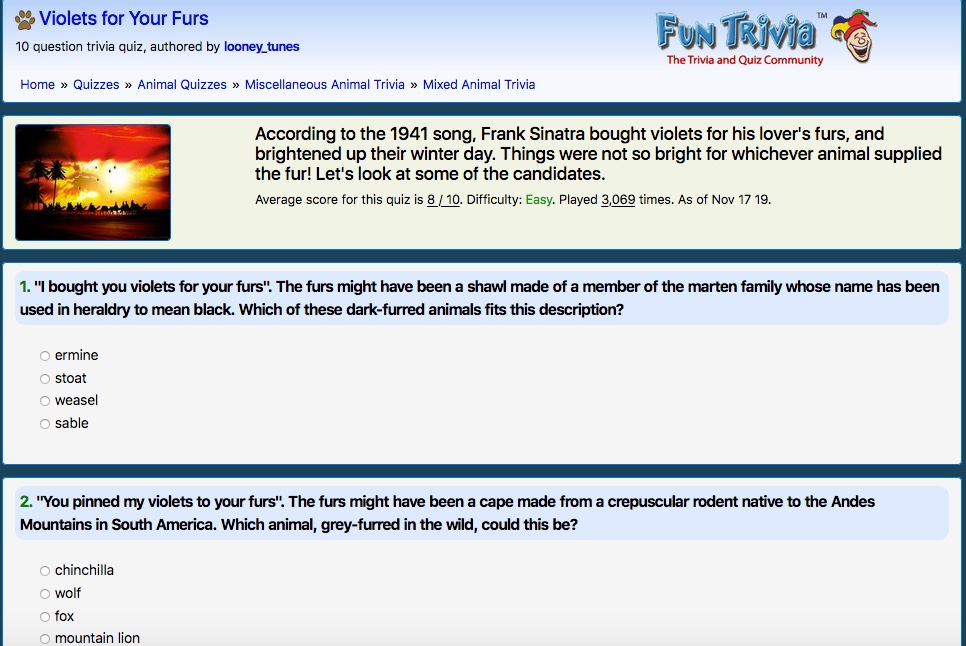
(On that issue, this highly specialised quiz about animals = in the running for my most favourite weird internet thing.)

Violets For Your Furs

Or is it to do with the somewhat antiquated ritual it describes?

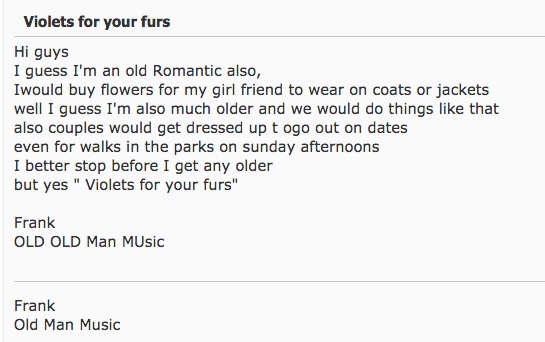
This 2003 sinatrafamily.com thread is started by a forum member who can’t ‘get’ the song, and thinks it’s ‘asinine’. Her contribution prompts a flurry of rebuttals from fellow posters fantasising trips down all kinds of real and imagined memory lanes, some lamenting the decline of civilisation as manifest in casual dress. A lengthy discourse on hats unfolds. Its kind and friendly online banter is a world away from the cultivated vitriol of the contemporary social industry.

Violets Sinatra forum

These thoughts of animal rights, old school gallantry and polite conversation were front of mind as I wandered around the internet seeking out links to various versions of ‘Violets For Your Furs’. Seeing the cover art for Marty Paich’s I Get A Boot Out Of You (1959) took me aback.

Paich’s magnificently louche arrangement of ‘Violets For Your Furs’ on this album suggests lovers in smoky late night bars. The racy cover art is like a cutesified sexy and highly unsettling anticipation of the shower scene from Hitchcock’s Psycho (1960).

Similarly, Dave Brubeck’s Angel Eyes (1965) features a tremendous hard-swinging version of the song, and a glassy-eyed Terry Reno on its cover. Twenty or so years after ‘Violets For Your Furs’ was composed, second wave feminism was burgeoning, and at the same time beautiful girls stared out from a lot of cover art, in varying states of undress. (I’d call it Playboy-ification, but these album covers are ahead of the Playboy game.) Plus ça change, etc. Romantic love may be protean, and the gentle attentions of ‘Violets For Your Furs’ out of joint with the softcore objectifications of the 1960s. But the patriarchal structures that prop up ‘romance’ are doggedly persistent, for sure.

9: More Than You Know (1929)

This song disturbs.

In The Fabulous Baker Boys (1989), as novice vocalist Susie Diamond, Michelle Pfeiffer delivers a captivating performance of a section from ‘More Than You Know’. Former escort Susie has rocked up extremely late for an audition to join the struggling piano duo of Jack (Jeff Bridges) and Frank (Beau Bridges). Following a moment of antagonism with controlling jobsworth Frank, she casts a magic spell over the dilipidated piano showroom with an unexpectedly mesmerising rendition. The selection of lyrics anticipates their unfolding relationships, and the boom and catastrophic bust of the brothers’ business. Frank’s wedding ring gleams in shot as he fights back unexpected emotion.

‘More Than You Know’ first appeared in the short-lived Broadway musical Great Day! addressed by its plantation-owning protagonist to her love interest. For Thomas S. Hischak, the song is ‘a languid yet stately ballad that seems to tumble forth effortlessly as it explains how one’s love is greater than the object of affection can ever realize’. Definitely, but in terms of its overall structure and effect I tend to agree with Alec Wilder and James T. Maher:

The verse is very florid and ‘inspirational’. It isn’t a verse as much as an exclamatory introduction to the chorus. The latter for those who have never heard it, comes as a complete surprise in that it is much less dramatic than the verse.

Wilder and Maher are talking about Vincent Youman’s composition, but the same dynamic applies to Billy Rose and Edward Eliscu’s lyrics.

The sharp distinction between ‘florid’ verse and ‘stately’ chorus accentuates the song’s unfolding of insecurity in love. In the verse, nonchalance (‘Whether you remain or wander / I’m growing fonder of you’) quickly escalates to grandiosity (‘Wouldn’t I be glad to take you? / Give you the break you need’) before the chorus lays out a more consistent scenario: I’ll be around, how you must need me, I know this is just sex for you, please don’t get bored. It’s an extraordinary portrait of self-deception and brutal frankness all at once.

The ups and downs of the song’s story are discomfiting to read on the page – maybe why many versions redact the verse – but so much else is possible in performance.

One of the earliest of the song’s hundreds of recordings, by The Scamps, claws back agency on the part of the protagonist with gentle harmonies and unexpected humour. In a dramatic arrangement, Della Reese openly treads a line between anger and desperate tenderness. Beverly Kenney’s restrained and wistful delivery hints at volcanic passion. Jackie Paris offers unsteady yearning. Dee Dee Bridgewater’s rich performance admits to no vulnerability whatsover.

The song’s uses on-screen are similarly divergent – to take two examples of the five films in which it has featured, Hit the Deck (1955) and The Fabulous Baker Boys (1989). As films, despite massive differences in genre and tone, there are spooky affinities between them: both are about the entertainment business, and social and sexual legitimacy.

Hit The Deck tells the convoluted story of three couples getting it together. It hinges on a dodgy hotel suite audition undertaken by ingenue Susan (Jane Powell) with the vile actor-manager of a production, also entitled ‘Hit The Deck’, which features musical theatre actress Carol (Debbie Reynolds). Accompanied by fellow naval officers Bill (Tony Martin) and Rico (Vic Damone), all of whom are on shore leave, Danny (Walter Pidgeon) runs to the hotel suite to protect his sister’s chastity. Cue hijinks as the sailors attempt to escape disciplinary action for trashing the suite. Before this pivotal event, Bill sings in ‘Keepin’ Myself For You’ a club cabaret number danced by Ginger (Ann Miller), his fiancee of six years, and Danny horns in on Carol’s dress rehearsal of the suggestive song ‘A Kiss Or Two’.

While all this is going on, Ginger has had enough of waiting around to get married, and unconvincingly dumps Bill for ‘someone else’. ‘More Than You Know’ is his effort to win her back.

It’s a strange choice. The song far better suits Ginger’s own vulnerable position in their long-distance relationship. But then, as a cabaret performer, the film has presented her as from the wrong side of the theatrical and sexual abstinence tracks. Sung by Bill, ‘Whether you’re right / whether you’re wrong’ and ‘Loving may be all you can give’ take on an unpleasant moralising dimension. (Also dodgy: as in The Fabulous Baker Boys’ highly questionable representation of jazz club Henry’s, Ginger’s earlier number ‘The Lady from the Bayou’ racialises desire.) Bill croons, and Ginger distracts herself by tapping on her parakeet’s cage. With the kiss that seals the marital deal, the cage remains prominently in shot – an unusual, pro-Ginger moment of critique in a film that just can’t make up its mind about women and sex.

Hit the Deck--cage

8: You Go To My Head (1938)

This song is a struggle.

‘You Go To My Head’ was written by John Frederick Coots and Haven Gillespie in 1936, and first recorded in 1938. Its tone and story could not be further away from their earlier hit, the enduring Christmas earworm ‘Santa Claus Is Coming To Town’ (1934).

Gillespie’s lyrics give us a protagonist engulfed in the fog of infatuation. Addressing the object of their desire, the person speaks of incessant thoughts, flights of fancy, involuntary physical reaction to the ‘very mention’ of the other person, and straight up libidinal heat brought on by their eyes and smile. Rational self-talk (‘get a hold of yourself’) competes ineffectually with full-bodied feeling.

Philip Furia jokes that though the song’s many booze analogies are explicit only in the first A section, Gillespie returns to the theme later ‘by reminding us that alcohol, like mercury, rises in thermometers’. The abstraction of the cover sketch on the sheet music published by the Remick Music Corporation offers another sense of the body as machine. Meanwhile, in terms of its harmonic progressions, Ted Gioia proposes that ‘this song comes closer than any tune I know to capturing in musical form the feeling of losing control’. In form and content, it’s all about being under the influence.

More than twice the versions by vocalists have been recorded by women than men.

Wandering around Spotify in search of some of the nearly four hundred recordings of the song is an object lesson in interpretative variety. My current favourite is Reginald Chapman’s addictive funk arrangement featuring vocalist Sam Reed – which, like Dinah Washington’s live Latin take with Clifford Brown, is packed with energetic dilemma.


Meanwhile, Billie Holiday’s two recordings, made in 1938 and 1952, each overflow with tender sadness. Lush, expansive orchestral arrangements accompany Ella Fitzgerald and Frank Sinatra‘s gentle performances. Johnny Hartman’s intimate rendition speaks of solitary contemplation – and even more so, Stacey Kent’s, a stunning performance with pianist David Newton that summons up a moonlit landscape of ice.

And various interpretations imbue the song’s angst and sexuality with a drama adjacent to film noir – a move that reflects the song’s earliest uses in film, in Otto Preminger’s Laura (1944) and Howard Hawks’ The Big Sleep (1946).

Sarah Vaughan’s 1961 version with Count Basie has a vaguely sinister sensibility: a clamorous city is filled with threat, both from the self and from others. The texture of its horns echoes the anxiety-inducing arrangement on Stan Kenton’s New Concepts of Artistry in Rhythm (1953) – a more intensely swirling vortex of urban noise. Also unsettling is Lio‘s 1980 electropop interpretation, whose metallic vocals, synths and strings anticipate the narrative concerns of Ridley Scott’s Blade Runner (1982). Differently strange is Bryan Ferry’s 1975 performance. Its video sees a listless, tuxedo-clad Ferry visited by a self-objectifying femme fatale: her spidery hand pulls open the door to his weirdly daylit room, where she is revealed to be a figment of his imagination.

This video treads a fine line between critique and indulgence of misogynistic fetishism – a psychological concern at the heart of Preminger’s Laura.

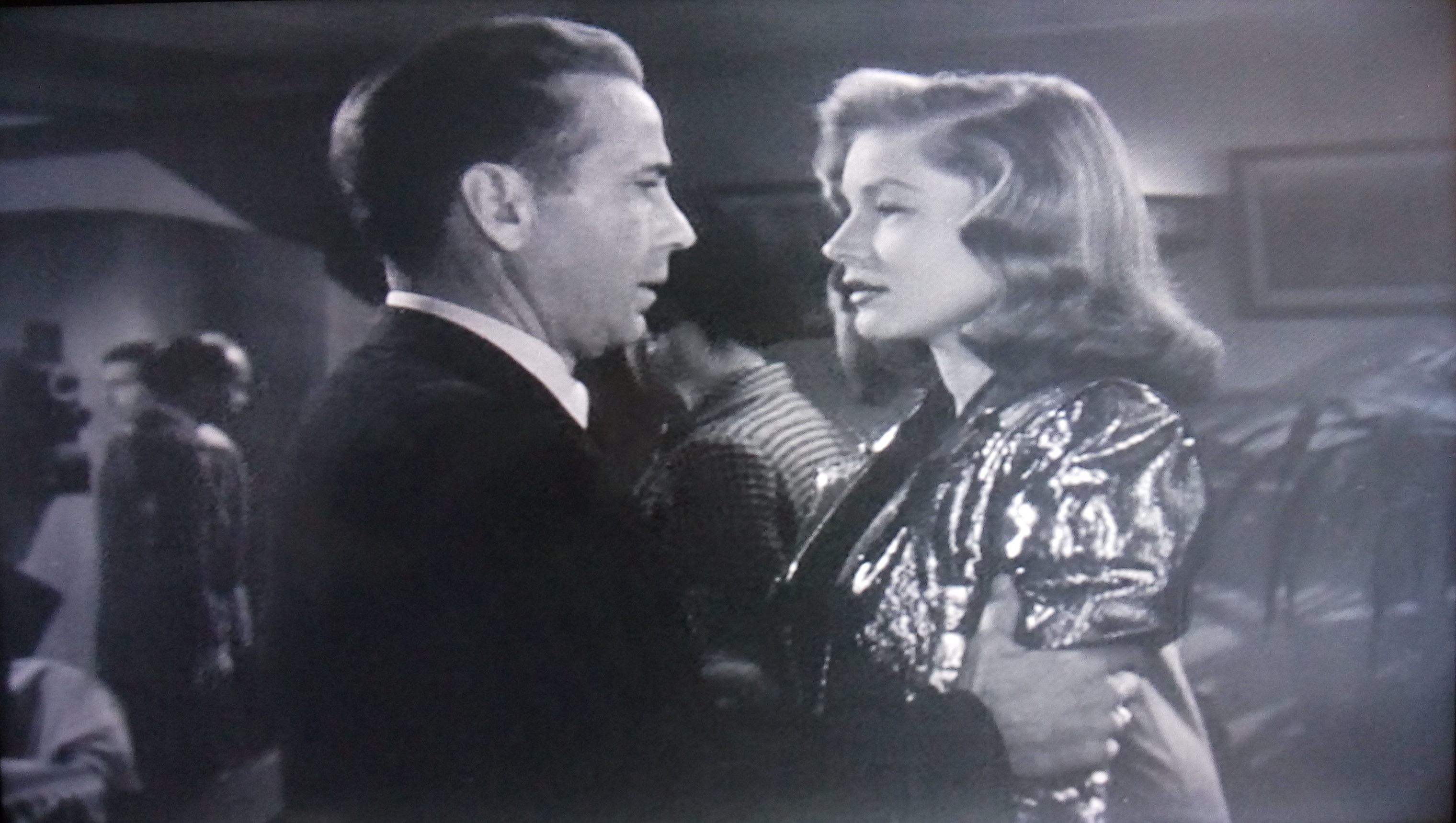
Both Laura and The Big Sleep feature restaurant scenes where instrumental performances of ‘You Go To My Head’ act as the backdrop to key events. In The Big Sleep, the song marks the acceleration of the attraction between detective Philip Marlowe (Humphrey Bogart) and client Vivian Rutledge (Lauren Bacall) – a narrative use of the song that extends no further than that electric moment.

IMG_20190424_113648

A different instrumental theme entitled ‘Laura’a standard subsequently recorded almost as many times as ‘You Go To My Head’ – conspicuously dominates Laura‘s action. But the film’s very brief, particular placement of ‘You Go To My Head’, and the lyrics which ghost its performance, signpost with mordant accuracy the identity of the murderer, and their motivation for killing its eponymous heroine.

The killer could be any of the three characters in the frame: Laura’s patron Waldo Lydecker (Clifton Webb), her fiance Shelby Carpenter (Vincent Price), and her aunt Ann Treadwell (Judith Anderson). Investigating officer Detective Mark McPherson (Dana Andrews) soon begins to succumb to an obsession with Laura (Gene Tierney) himself.

At one point in the film, Laura is seen to utter the crucial line: ‘I never have been and I never will be bound by anything I don’t do of my own free will’. As elsewhere in Preminger’s oeuvre, Laura dramatizes ‘the battle between a woman’s self-definition and a definition imposed by men’. It takes as its subtle text a beautiful song amenable to numerous interpretations – among them, obsessive fixation and self-undoing. In Laura, its ‘singer’, as it were, is not the film’s female heroine but someone entirely different.