23: A Certain Smile (1958)

This song puts up a front.

Composer Sammy Fain and lyricist Paul Francis Webster wrote this winsome, Academy Award-nominated song for Jean Negulesco’s A Certain Smile (1958) – a sweeping cinematic adaptation of Françoise Sagan’s uncompromising novella about love, sex and infidelity. Critics at the time found the film’s treatment of Sagan’s story to be average at best: a “glossy, emotional yarn” (Variety), a “tepid romantic interlude” (New York Times). The song has been infrequently recorded since the 1970s.

No-one:

Me: ‘A Certain Smile’ is integral – INTEGRAL – to A Certain Smile‘s re-articulation of Sagan’s book as a melodramatic touristic visual feast – yes, and in case you imagine this is a situation of FILM = BAD, BOOK = GOOD, the last of those is an aspect that weirdly resonates with Sagan’s own literary style, which makes much of staging things to look at!* Plus, existentialist cynic Sagan wrote romantic song lyrics for Juliette Greco?!**

NB. “no-one” meme format for me still fresh as daisy because not on Twitter and this too probably. Anyway, let’s get into it.

‘A Certain Smile’ has been a rabbit hole to fall down. Back in the spring, Spotify gave me Ted Greene’s 1977 night sky of a solo recording. Confusion descended: did I know the song already, or was this sparkling arrangement enchanting me into thinking I did? (Martin Taylor’s intensely beautiful 1993 solo guitar rendition did similar magic.) I listened to the inaugural 1958 recording by Johnny Mathiswho performs the song with verse in a nightclub set piece in the film – and was still none the wiser. I couldn’t decide if it was the sing-song pattern of the melody that felt familiar, or the song itself. When I asked my mum about ‘A Certain Smile’, she knew it immediately, lyrics and all. From the generational point of view, this makes sense: more than half of the vocal recordings to be released professionally were out by the late 1960s, with ten of those released in 1958. This smash hit – Mathis’ recording reached #4 in the UK – has been in the atmosphere for decades, with diminishing density over time.

The song’s apparent sweetness contrasts with Sagan’s A Certain Smile (1956) – a text that begins archly with an epigraph from Roger Vailland: Love is what happens between two people who love each other.

Dominique, in a relationship with fellow Sorbonne student Bertrand, tells the winding story of her short but unexpectedly emotionally shattering affair with Bertrand’s married uncle, Luc. For one critic reviewing the book in 1957, Sagan communicates the experience of “serene despair” with immaculate precision, featuring “none of the obsession with the details of external reality so common in her contemporaries: ‘and now I shall show you what Life is really like in Paris, Moscow or New York’, in attempts which finally show what? nothing”.

Paul Francis Webster’s lyrics, prepared for the film, are of a different order of business.

What do you meet down a crooked little street in Paris
Vendors who sell pretty flowers that tell of spring
Once in a while you may meet a certain smile in Paris
So excitingly gay that it seems to say ‘cherie, fall in love with me’

A certain smile, a certain face
Can lead an unsuspecting heart on a merry chase
A fleeting glance can say so many lovely things
Suddenly you know why my heart sings

You’ll love awhile and when love goes
You try to hide the tears inside with a cheerful pose
But in the hush of night exactly like a bittersweet refrain
Comes that certain smile to haunt your heart again

Set against a dramatic minor key, the verse’s clever internal rhymes and their fantasy of Paris resolve into the optimistic choruses, their rhyming couplets, and their protagonist, sharing the wisdom of their experience while presenting a brave exterior. It’s strangely labyrinthine in its temporal journey, and much more complicated than it first appears to be.

This isn’t unlike the movie – although I will say I found A Certain Smile to be a rough watch, at least first time around. It rearranges the essential components of Sagan’s book to produce a morality tale that visually “abounds with mouth-watering vistas of the French Riviera”. Characters bear only marginal resemblance to their sources: the ingénue (Christine Carère), her parents (Eduard Franz, Katherine Locke) in extended grief for the loss of their son, said ingénue’s feckless boyfriend (Bradford Dillman), his rich and selfish mother (Kathryn Givney), the playboy uncle (Rossano Brazzi), his long-suffering wife Françoise (Joan Fontaine), and a rogues’ gallery of assorted friends and associates. Dominique’s red beret amid the grey stone of the Sorbonne marks her out as a scarlet woman in the making. Her fate is confirmed when, soon after Luc hits on Dominique in a café-bar she has attended with Bertrand, Françoise airily offers Dominique a red coat during her visit to their home, declaring it “far too young for me” – misogynising, if you will, a more or less throwaway moment in the book, in which the couple extravagantly buy a coat “in a reddish woollen material” for their nephew’s new girlfriend in a shop.

‘A Certain Smile’ instrumentally underscores the beats of Dominique’s entire emotional arc, from her misguided entanglement with Luc to her rapprochement with Bertrand. So closely is the song woven into the fabric of the film that it’s almost imperceptible, smoothing the way for the romance’s compliance with the sanitising “shibboleths of the Production Code”.

As recounted in Michaelangelo Capua’s Jean Negulesco: The Life and Films (2017), here is how Sagan – whose text features extra-marital sex, pregnancy scares and so on – reacted to A Certain Smile‘s screenplay in a meeting with Negulesco in Paris:

I gave her an appointment in a café not too far from where we were shooting. She was sitting on the terrace eating a ham and cheese sandwich in the company of young man. I approached her a bit confused.

‘Miss Sagan?’
‘Yes.’
‘Excuse me, I’m Jean Negulesco. Have you read the script?’
‘Yes.’
‘Did you like it?’
‘No.’
‘Could you tell me why?’
‘No.’
‘Do you want to join me on the set?’
‘No.’
‘Would you allow me to pay for your sandwich?’
‘Yes.’

She then said to the young man: ‘It’s not him that pays, it’s 20th Century Fox.’

Despite Sagan’s understandable aversion to the film’s adaptation of her book, they end up at similar destinations. Rachel Cusk praises her “fearless and astute portrayal of love as a psychical event that has its roots in family life and the early formation of personality”. As I watched the film a second time, I realised that Dominique’s bizarre actions were imagined to hinge on the death of her brother and the consequences for her family, and that every character in their own way was struggling with loss. All three of these interconnected works – novella, film and song – are grappling with the depths of pain and its origins, though Sagan’s writing looks at them most directly and dispassionately.

*In both visual and psychological modes. A particularly economical example of narrative reflexivity from A Certain Smile‘s fourth chapter: “I couldn’t help feeling quite warm towards myself.” (p. 186)

**From a fascinating short biographical post entitled ‘That Charming Monster, Francoise Sagan’: “It is not widely known that Françoise Sagan dabbled in song writing, composing lyrics for romantic songs and even librettos for ballets. This aspect of her career came about when, at the age of twenty, haunting the bars and nightclubs of Saint Germain des Prés, she met the musician Michel Magne. Having already tried out over fifty lyricists for his songs, Magne thought Sagan’s style would be perfect. Her lyrics reflect a maturity beyond her years and lack the cynicism of her books. They are often about people wrestling with private pain and angst, deep into alcohol-fuelled nights. Vous mon Coeur (You my Heart) is a plea to a lover not leave: ‘You, my heart/You my life/You who smile/You who embrace me/You, one day…..will leave me, my heart.’”
21: Willow Weep for Me (1932)

This song isn’t having it.

Ann Ronell – a female trailblazer in the sphere of Hollywood musical direction and Broadway composition – originated this wonderful chronicle of heartbreak in 1932. A publishing colleague of Irving Berlin rejected it for being too technically complicated, but support from Berlin himself brought the song to radio broadcast and wider critical and commercial success.

Willow weep for me
Willow weep for me
Bend your branches green along the stream that runs to sea
Listen to my plea
Hear me willow and weep for me
Gone my lovers’ dream
Lovely summer dream
Gone and left me here to weep my tears into the stream
Sad as I can be
Hear me willow and weep for me
Whisper to the wind and say that love has sinned
Left my heart a-breaking, and making a moan
Murmur to the night to hide its starry light
So none will see me sighing and crying all alone
Weeping willow tree
Weep in sympathy
Bend your branches down along the ground and cover me
When the shadows fall, hear me willow and weep for me

While hearing out their lonely protagonist’s pain, these lyrics wink theatrically: love in its entirety has “sinned” because the “lovely summer dream” of a seasonal romance hasn’t worked out for you? All the stars in the night sky should be obliterated to conceal your unique misery? Come on. There’s no shame in sadness.

Ronell’s celebrated, much recorded composition warmly presses that argument forward – in particular the major key in the A sections, its sing-song octave leap (Ted Gioia: “a vertiginous plunge followed by a reassuring triplet bounce unlike anything else in the jazz repertoire of the era”), and the way in which, as Alec Wilder notes, “the accompaniment moves into double time and out again the next measure”. Edward Jablonski interprets this choice as signifying “agitated stress”, but I’m not sure that’s it. Consider, for example, Ella Fitzgerald’s 1959 recording. “Listen to my plea”, entreats the song’s protagonist. Amid the dreaminess of Frank DeVol’s orchestral arrangement, this rhythmic shift counterargues: no, you need to shake things up.

The song’s appearance in the Marx Brothers’ Love Happy (1949) – a crime caper which brings together a diamond heist and a Broadway revue – sets off its refusal of the role of romantic victim in an utterly surprising way.

Ann Ronell scored Love Happy, and oversaw Frank Perkins’ instrumental arrangement of ‘Willow Weep for Me’ for one of the Broadway revue’s numbers. Choregraphed by Billy Daniel, it presents an extraordinary burlesque staging of the figure of Miss Sadie Thompson.

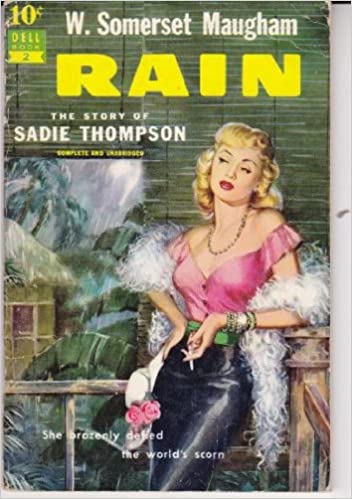
Sadie Thompson is a character in ‘Rain’ (1921), a short story by W. Somerset Maugham set in American Samoa. A ship’s crew member contracts measles, and its passengers are required to remain in port at Pago Pago for a period of quarantine: Dr and Mrs Macphail, missionary couple the Davidsons (ordinarily stationed elsewhere), and Sadie Thompson herself. All are offered accommodation in rooms above a shop. Sadie Thompson entertains sailors in her quarters, playing her gramophone loudly, to the the Davidsons’ infinite disapproval. They quickly infer that, having boarded at Iwelei (“plague spot of Honolulu. The Red Light district”), she is a prostitute, and Davidson himself undertakes to convert her. The missionary programme is vicious: the Davidsons expunge local practices of dancing and dress, impose fines on those who refuse to comply, and delight in destroying associates whose morality they deem insufficient. Davidson’s patriarchal fanaticism – of Sadie, he declares: “‘I want to put in her heart the passionate desire to be punished so that at the end, even if I offered to let her go, she would refuse'” – culminates in what the story very strongly implies is his rape of Sadie and his grisly death by cutting his own throat.

For Victoria Kuttainen, ‘Rain’ dramatises how missionary, medical and cultural regimes collide in the the “colonial, modernising Pacific”. She proposes that Somerset Maugham – both a literary figure and prolific writer for stage and screen – was acutely aware of the imagistic power of “fantasies of seductive starlets and beguiling tropical scenes”, and that his narrative choices comment on the performative power of speculation: other characters are given to report on Sadie’s conduct. In the diverse theatrical and cinematic adaptations of ‘Rain’,* meanwhile, “spectacle replaces speculation”. Stagings of Sadie melodramatically exoticise and evacuate the story of critical force.

The number in Love Happy quotes and exaggerates elements of these adaptations. It sweeps almost every hint of violence away, and reimagines the scenario as a comedy.

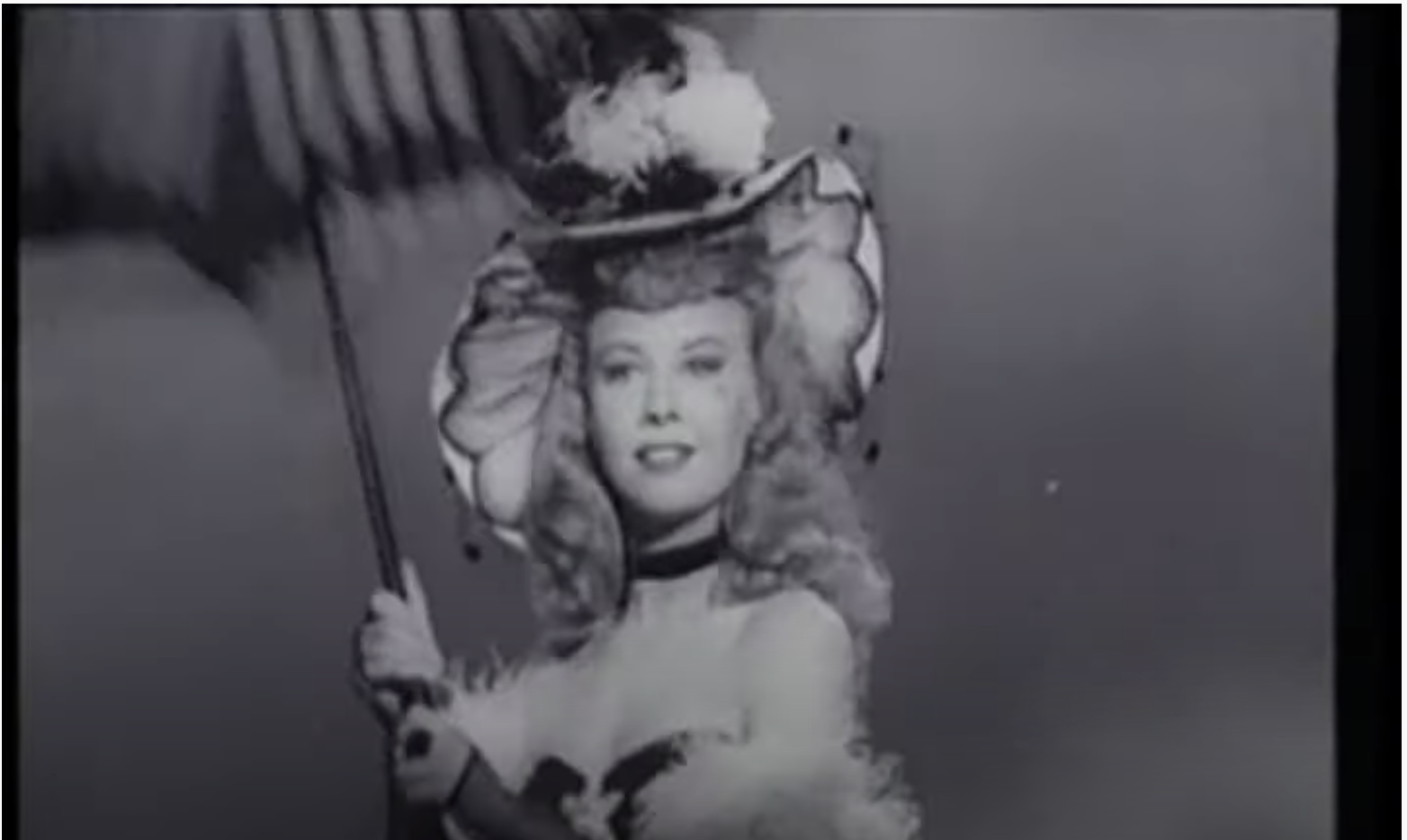
In this cartoon tropics, Sadie’s beau, Sergeant O’Hara (played by ‘Paul Valentine’, played by Mike Johnson) – a character introduced in these adaptations – places the needle on the gramophone, and the siren rasp of ‘Willow Weep For Me’ summons Sadie (played by ‘Maggie Phillips’, played by Vera-Ellen) to the stage. Marines gawp as she struts in, her hand magically conjuring her own spotlight. She roams about the stage with comic suggestiveness, occasionally knocking these uniformed men down like dominoes, while O’Hara gazes at her with deep desire. When, as in the story, Davidson (House Peters Jr.) stops the gramophone’s music, a drumbeat commences and a group representing Samoan dancers wearing what resemble lavalava enter the stage, supporting Sadie to continue – a section which trades in racialised stereotyping, places Sadie at its centre, but suggests collective solidarity between she and the islanders against the forces of missionary control. Davidson has failed, and exuberant music and dancing prevail. The gramophone resumes, and a whistle sends the Marines back, who have rushed Sadie like a pack of dogs. The number concludes softly: Sadie and O’Hara stand intimately together before the auditorium of the Broadway theatre to scattered applause.**

This larger-than-life musical rendition both sends up and luxuriates in the cultural habit of looking at Sadie. The lyrics and their sadness ghost the scene, a reminder of the tragedy of ‘Rain’, but here underscoring how Sadie just gets to go about her business.

Before watching the film, I had heard ‘Willow Weep for Me’ only in versions accentuating its bluesiness, as in the powerful recordings by Billie Holiday, Dinah Washington and Etta James, and Sarah Vaughan’s magical and hilarious live performance. With the exception of Stan Kenton’s 1946 arrangement featuring June Christy, the handful of recordings that precede Love Happy are a lively mix of foxtrot and cabaret, and a far cry from the sorrowful sentimentality of other later versions: Frank Sinatra, Julie London, Tony Bennett.

It begs so many questions: about the mood Ann Ronell originally intended for the song, how this scene in Love Happy was conceived and by whom,*** the direction of subsequent recordings. Regardless, it strikes me that its author’s well-documented determination, ambition, kindness and vivacity are of a piece with ‘Willow Weep for Me’. It is a song that “does exactly what it pleases”, recognising social and emotional limits, but isn’t about to accept them.

*John Colton & Clemence Randolph’s play Rain: a Play in Three Acts (1923); Sadie Thompson (1928), starring Gloria Swanson; Rain (1932), starring Joan Crawford; and Miss Sadie Thompson (1953), starring Rita Hayworth.

**Paul’s subsequent instruction to Maggie – “now go change into your ballet costume” – is arguably a misogynistic gag playing on the historical intersection of ballet and sex work.

***An edition of Film Music Notes speaks favourably of “the producer who allowed the composer select co-workers of her own choice wherever possible, thus assuring maximum of compatible tastes and efforts to musical production with minimum personnel”.

20: My Ship (1941)

This song is about how we got here.

NB. Major spoilers ahead for Lady in the Dark (1944) and Phantom Thread (2017).

I first heard ‘My Ship’ several years ago – probably Nancy Wilson’s very beautiful big band recording from 1963, whose choppy instrumental introduction soon settles into golden plain sailing. Ira Gershwin’s lyrics fantasise luxuries arriving from far away, which are as nothing without the delivery of a soul-mate:

My ship has sails that are made of silk
The decks are trimmed with gold
And of jam and spice
There’s a paradise
In the hold
My ship’s aglow with a million pearls
And rubies fill each bin,
The sun sits high
In a sapphire sky
When my ship comes in
I can wait the years
Till it appears
One fine day one spring
But the pearls and such
They won’t mean much
If there’s missing just one thing
I do not care if that day arrives
That dream need never be
If the ship I sing doesn’t also bring
My own true love to me

Despite its sun, the song’s story reminded me of Christmas, most likely because of the carol ‘I Saw Three Ships (Come Sailing In)’. The nursery rhyme ‘I saw a ship a-sailing’, about a merchant vessel packed with treats and crewed by mice-sailors with “chains about their necks” was probably somewhere in my mind too: it appeared in ‘Ship in a Bottle’ (1974), the very first episode of Bagpuss.

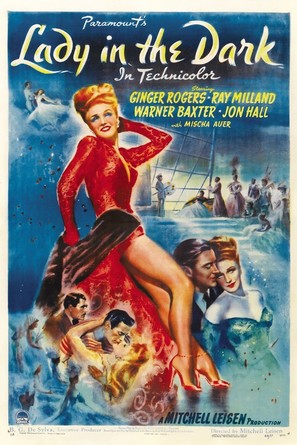
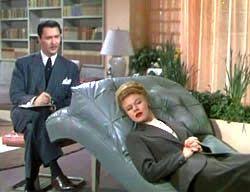
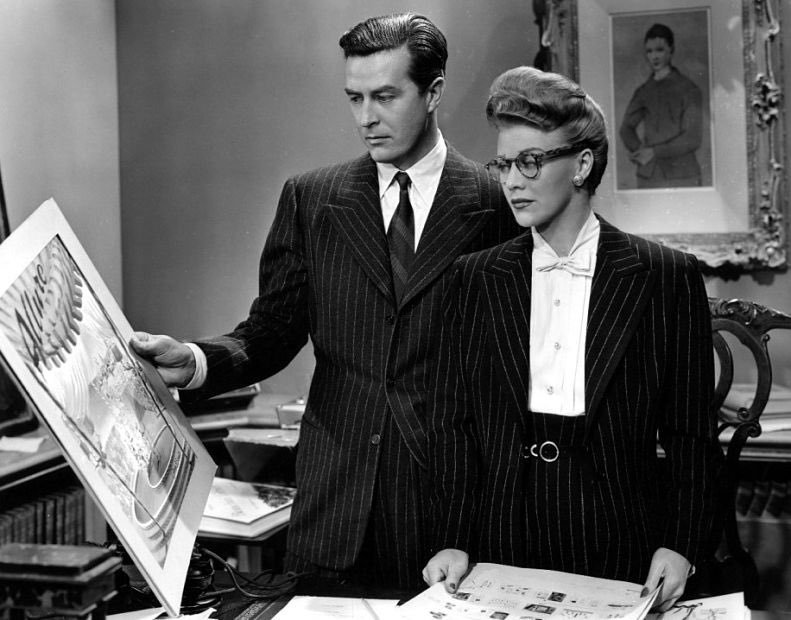
With Ira Gershwin, Kurt Weill composed the song for Moss Hart’s stage musical Lady in the Dark (1941). Liza Elliott, ambitious and successful editor of fashion magazine Allure, is in crisis. Her doctor recommends psychoanalysis. In the 1944 film dramatization – one of the highest grossing movies of the year – Liza (Ginger Rogers) finds herself humming a phrase from ‘My Ship’ repeatedly: an elusive echo of a repressed trauma. Psychoanalysis allows her to recall that as a young child she tried to perform the song at a family party. Her self-absorbed mother, preoccupied by male attention, is indifferent; the guests are thoughtlessly unkind, saying she is plain. As a child, Liza begins to hate her appearance. When her mother dies soon after, she is unable to grieve. She tries on her mother’s special blue dress, and her father chastises her angrily: a terrible rejection.

As Bruce McClung writes, ‘I saw a ship a-sailing’ is “the song’s predecessor”; further, “the gradual decoding of what ‘My Ship’ signifies sustains the drama, a process like the ‘Rosebud’ cipher in Citizen Kane. In relation to the song’s image of a ship bearing bounties, Lady in the Dark is also, mindblowingly, ghosted by Shakespeare’s The Merchant of Venice (1596) – a play that dramatizes, amongst other things, “the new set of economic interactions that accompanied the birth of capitalism”. McClung notes that Moss Hart’s own experience of psychoanalysis was formative of the story, but that Freud’s ‘The Theme of the Three Caskets’ (1913) is what gives Lady in the Dark its structure. In the essay, Freud theorises the lottery for Portia’s hand in The Merchant of Venice: a choice between gold, silver and lead caskets, one of which contains her portrait. Like Bassanio, Hart has Liza select between three ‘caskets’ – publisher Kendall Nesbitt (Warner Baxter), actor Randy Curtis (Jon Hall), and her magazine’s advertising executive Charley Johnson (Ray Milland), who represent simplistically “the roles of father, lover, and husband”.

This film is a gorgeous waking nightmare, and watching it I was furious from beginning to end.

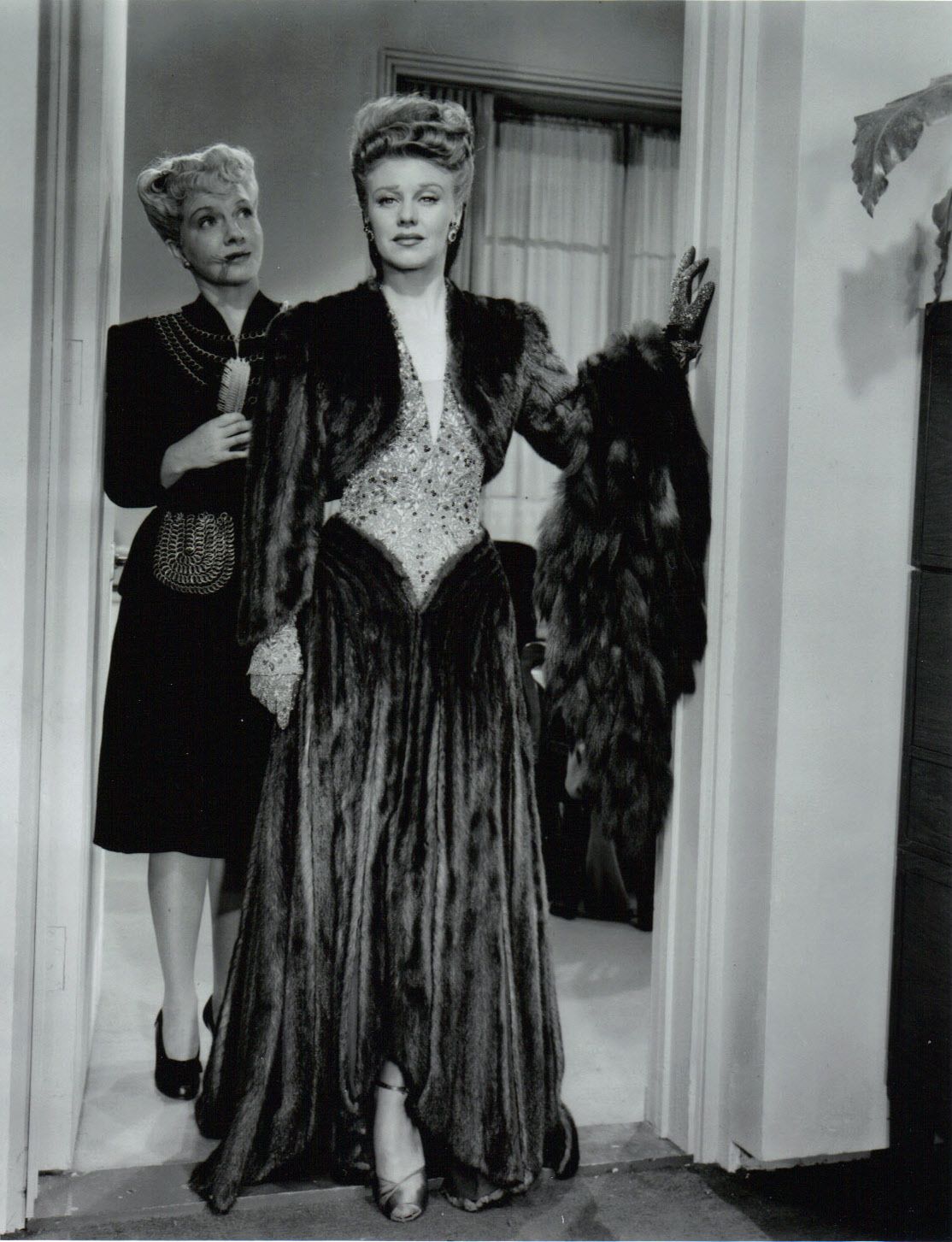
Amid the opulence of Allure‘s offices – the film’s lavish design and dream sequences subvert its maniacal heteronormativity – Charley attacks Liza continually, questioning her gender, sex life, and style, and brazenly declaring his desire for her job. When unusually she wears an evening gown on a date with Randy – a garment of sequin and mink that cost Paramount an eyewatering $35,000 dollars to produce – he jibes “you look wonderful – you actually look like a woman!” Her psychoanalyst Dr Brooks (Barry Sullivan) meanwhile proposes that, stemming from her childhood experiences, her distress lies with her reluctance to embrace femininity and “compete with other women”. Ignoring the injustices it so clearly lays out, the film egregiously weaponises psychoanalysis to confirm the “sex/gender system” and everything it supports. It ends with Liza agreeing to co-run the magazine with Charley, her literal tumble to the ground as he grabs her editorial chair for himself, and a kiss of unlikely passion between the two. This great review including on point picture captions (“Ray Milland is a shithead with a whip and Ginger Rogers is the lady in a cage in the circus dream”) fully has the measure of the film, as do these others on Letterboxd.

Paul Thomas Anderson’s extraordinary Phantom Thread (2017) includes ‘My Ship’. And Lady in the Dark seems to me to haunt the film in other ways, not least Freud’s essay.

At its conclusion Freud correlates the caskets to the mythological Fates (Moirai), the “three weaving goddesses who assign individual destinies to mortals at birth”, and thus to

the three inevitable relations that a man has with a woman – the woman who bears him, the woman who is his mate and the woman who destroys him; or that they are the three forms taken by the figure of the mother in the course of a man’s life – the mother herself, the beloved one who is chosen after her pattern, and lastly the Mother Earth who receives him once more. But it is in vain that an old man yearns for the love of a woman as he had it first from his mother; the third of the Fates alone, the silent Goddess of Death, will take him into her arms.

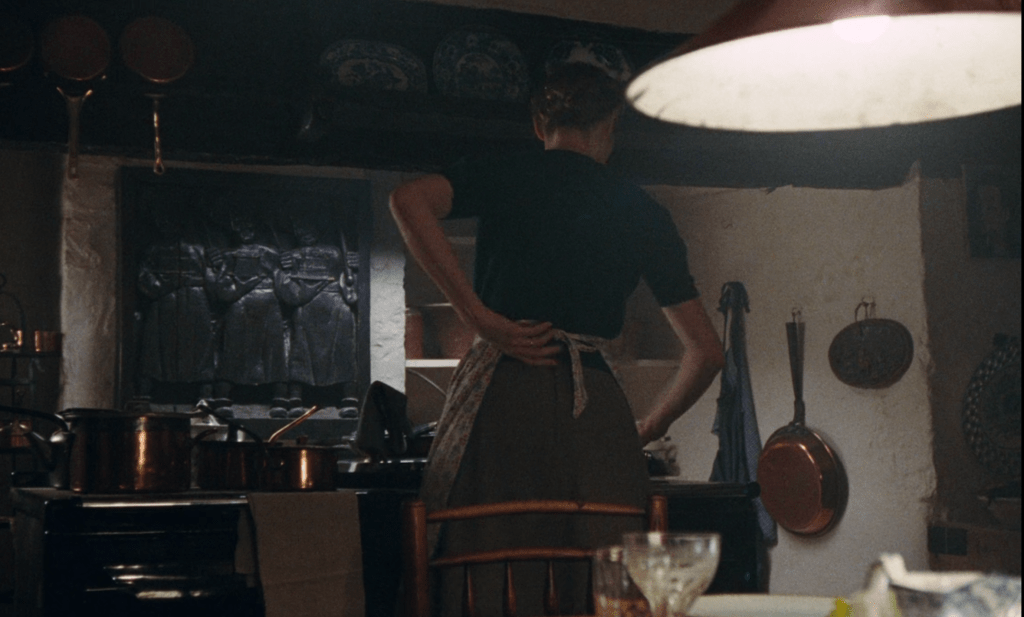
The relationship that Paul Thomas Anderson concocts between celebrated and exacting dressmaker Reynolds Woodcock (Daniel Day-Lewis) and his lover and model Alma (Vicky Krieps) attempts to have this cake and eat it. So consumed is Reynolds with his mother, and control over himself and his surroundings, that he cannot tolerate interruption or vulnerability, keeping his shrewd sister Cyril (Lesley Manville) close by as his safe companion. In these constrained, even hostile emotional circumstances, Alma (‘soul’) undertakes to derail his “games” by bringing him close to death: she feeds him poisonous mushrooms, then nurses him back to health, thereby impossibly occupying all three relations. This sadomasochistic gambit allows Reynolds to let go, to fall in love, to commit to her totally, and they have their own child. And so another cycle begins.

Oscar Peterson’s performance of ‘My Ship’ plays in the tearoom in which Woodcock first encounters Alma as a waitress, where he orders a ridiculous breakfast. Learning of Paul Thomas Anderson’s passion for big band jazz, I’m convinced that the narrative structure of Reynolds and Alma’s relationship is based on Nelson Riddle’s wonderful orchestral arrangement: brass and woodwind signal ‘watch out!’ before the song moves to surging strings, the solitary multiplicity of Peterson’s piano, and so on, periodically undercut by ambiguous, if not outrightly sinister harmonic choices. Key changes mark new phases, ascension to new heights. It’s almost unbearably poignant but also weirdly unserious somehow. It finishes with a steadying rallentando and fluttering flutes: a happy ending.

Aleksandar Hemon in the New Yorker concludes that Phantom Thread is “nothing if not propaganda for patriarchy”, and for sure I agree that it is in one sense a deep stitch-up, leaving little room for its women’s own desires beyond surviving these conditions, and doling out punishment for their perceived infractions. But like the stunning arrangement of ‘My Ship’ that it features, it is laced with compassionate unease, skewering power and fantasy with a delicate comic touch.

13: Violets For Your Furs (1941)

This song is the epitome of shifting sands.

Matt Dennis and Thomas Adair wrote ‘Violets For Your Furs’ together in 1941. Appearing on The Rosemary Clooney Show in 1957, Dennis reminisced about the process:

Well this is probably the corniest songwriting story of all time, but my partner and I were sitting in the pub one snowy night back in New York and he was having a beef with the girl he was dating at the time. Sitting there just listening to a combo play the blues, and well, feeling kind of moody anyway, he came up with this song title. It sounded pretty good to me, so I just started working on the melody right there. Believe it or not he wrote the lyrics right on the tablecloth too, and before the evening was over we’d written ourselves this song.

The wintry context of its creation makes its way into Adair’s lyrics. A kind of theatre of memory, the song sketches out a scene between two lovers, nostalgically recalled by the song’s protagonist. As snow drifts down in the Manhattan streets, a man buys a posy of violets for his beloved’s fur coat, which has the enchanting effect of making the chilly situation seem like spring. The song concludes adorably: “You smiled at me so sweetly, since then one thought occurs / That we fell in love completely, the day that I bought you violets for your furs”.

On one level, it’s a simple story of a simpler time: men were chivalrous, women were graceful, furs were the height of sartorial elegance, and love was new. But even on its own terms, setting aside any questions that may or may not arise concerning ‘men’, ‘women’, courtship, and who can procure fresh flowers and furs in Manhattan at the tail end of the Great Depression, the song contains multitudes.

Tommy Dorsey and Frank Sinatra recorded it first in 1941, in an interpretation that conjures divine dinner dances, and the giddy euphoria of falling in love. The moment on the Manhattan street feels like it happened just last week, but also that it’s yet to come. Meanwhile, Sinatra’s sleigh bell-sprinkled 1956 rendition – whose seasonal phrasing is taken by Barry Manilow’s recording – seems to look back to a happy event many Christmasses ago. Johnny Hartman’s extraordinary performance – a tribute to John Coltrane’s – is heavy with deep disappointment. Shirley Horn’s sublime version aches with remembered longing. Beverly Kenney serves up bright and naive entitlement, with a tiny hint of rage: maybe this character didn’t get what they wanted in the end. Stacey Kent delivers a poignant reverie.

Alec Wilder and James T. Maher delight in the way ‘Violets For Your Furs’ “moves and does lovely inventive things”, comparing singer and composer Matt Dennis’s writings to Johnny Mercer’s, which each “suggest the presence of the performer in their composition”. It’s so rich. Its embrace of then and now, whenever these times are in the universe of a given interpretation and whatever has taken place in-between, is magic. Even still, it’s comparatively neglected as a standard, with recordings only in the double digits. No films seem to have taken it up, although it is fleetingly mentioned in a scene in the ninth episode of cancelled ABC drama Six Degrees (2006-2007).

Is that neglect to do with anti-fur politics, as this piano studio proprietor suggests?

(On that issue, this highly specialised quiz about animals = in the running for my most favourite weird internet thing.)

Violets For Your Furs

Or is it to do with the somewhat antiquated ritual it describes?

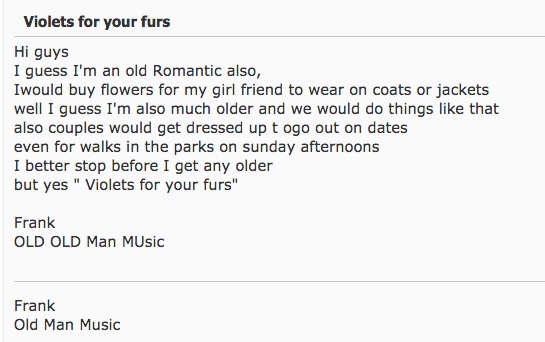
This 2003 sinatrafamily.com thread is started by a forum member who can’t ‘get’ the song, and thinks it’s ‘asinine’. Her contribution prompts a flurry of rebuttals from fellow posters fantasising trips down all kinds of real and imagined memory lanes, some lamenting the decline of civilisation as manifest in casual dress. A lengthy discourse on hats unfolds. Its kind and friendly online banter is a world away from the cultivated vitriol of the contemporary social industry.

Violets Sinatra forum

These thoughts of animal rights, old school gallantry and polite conversation were front of mind as I wandered around the internet seeking out links to various versions of ‘Violets For Your Furs’. Seeing the cover art for Marty Paich’s I Get A Boot Out Of You (1959) took me aback.

Paich’s magnificently louche arrangement of ‘Violets For Your Furs’ on this album suggests lovers in smoky late night bars. The racy cover art is like a cutesified sexy and highly unsettling anticipation of the shower scene from Hitchcock’s Psycho (1960).

Similarly, Dave Brubeck’s Angel Eyes (1965) features a tremendous hard-swinging version of the song, and a glassy-eyed Terry Reno on its cover. Twenty or so years after ‘Violets For Your Furs’ was composed, second wave feminism was burgeoning, and at the same time beautiful girls stared out from a lot of cover art, in varying states of undress. (I’d call it Playboy-ification, but these album covers are ahead of the Playboy game.) Plus ça change, etc. Romantic love may be protean, and the gentle attentions of ‘Violets For Your Furs’ out of joint with the softcore objectifications of the 1960s. But the patriarchal structures that prop up ‘romance’ are doggedly persistent, for sure.

9: More Than You Know (1929)

This song disturbs.

In The Fabulous Baker Boys (1989), as novice vocalist Susie Diamond, Michelle Pfeiffer delivers a captivating performance of a section from ‘More Than You Know’. Former escort Susie has rocked up extremely late for an audition to join the struggling piano duo of Jack (Jeff Bridges) and Frank (Beau Bridges). Following a moment of antagonism with controlling jobsworth Frank, she casts a magic spell over the dilipidated piano showroom with an unexpectedly mesmerising rendition. The selection of lyrics anticipates their unfolding relationships, and the boom and catastrophic bust of the brothers’ business. Frank’s wedding ring gleams in shot as he fights back unexpected emotion.

‘More Than You Know’ first appeared in the short-lived Broadway musical Great Day! addressed by its plantation-owning protagonist to her love interest. For Thomas S. Hischak, the song is ‘a languid yet stately ballad that seems to tumble forth effortlessly as it explains how one’s love is greater than the object of affection can ever realize’. Definitely, but in terms of its overall structure and effect I tend to agree with Alec Wilder and James T. Maher:

The verse is very florid and ‘inspirational’. It isn’t a verse as much as an exclamatory introduction to the chorus. The latter for those who have never heard it, comes as a complete surprise in that it is much less dramatic than the verse.

Wilder and Maher are talking about Vincent Youman’s composition, but the same dynamic applies to Billy Rose and Edward Eliscu’s lyrics.

The sharp distinction between ‘florid’ verse and ‘stately’ chorus accentuates the song’s unfolding of insecurity in love. In the verse, nonchalance (‘Whether you remain or wander / I’m growing fonder of you’) quickly escalates to grandiosity (‘Wouldn’t I be glad to take you? / Give you the break you need’) before the chorus lays out a more consistent scenario: I’ll be around, how you must need me, I know this is just sex for you, please don’t get bored. It’s an extraordinary portrait of self-deception and brutal frankness all at once.

The ups and downs of the song’s story are discomfiting to read on the page – maybe why many versions redact the verse – but so much else is possible in performance.

One of the earliest of the song’s hundreds of recordings, by The Scamps, claws back agency on the part of the protagonist with gentle harmonies and unexpected humour. In a dramatic arrangement, Della Reese openly treads a line between anger and desperate tenderness. Beverly Kenney’s restrained and wistful delivery hints at volcanic passion. Jackie Paris offers unsteady yearning. Dee Dee Bridgewater’s rich performance admits to no vulnerability whatsover.

The song’s uses on-screen are similarly divergent – to take two examples of the five films in which it has featured, Hit the Deck (1955) and The Fabulous Baker Boys (1989). As films, despite massive differences in genre and tone, there are spooky affinities between them: both are about the entertainment business, and social and sexual legitimacy.

Hit The Deck tells the convoluted story of three couples getting it together. It hinges on a dodgy hotel suite audition undertaken by ingenue Susan (Jane Powell) with the vile actor-manager of a production, also entitled ‘Hit The Deck’, which features musical theatre actress Carol (Debbie Reynolds). Accompanied by fellow naval officers Bill (Tony Martin) and Rico (Vic Damone), all of whom are on shore leave, Danny (Walter Pidgeon) runs to the hotel suite to protect his sister’s chastity. Cue hijinks as the sailors attempt to escape disciplinary action for trashing the suite. Before this pivotal event, Bill sings in ‘Keepin’ Myself For You’ a club cabaret number danced by Ginger (Ann Miller), his fiancee of six years, and Danny horns in on Carol’s dress rehearsal of the suggestive song ‘A Kiss Or Two’.

While all this is going on, Ginger has had enough of waiting around to get married, and unconvincingly dumps Bill for ‘someone else’. ‘More Than You Know’ is his effort to win her back.

It’s a strange choice. The song far better suits Ginger’s own vulnerable position in their long-distance relationship. But then, as a cabaret performer, the film has presented her as from the wrong side of the theatrical and sexual abstinence tracks. Sung by Bill, ‘Whether you’re right / whether you’re wrong’ and ‘Loving may be all you can give’ take on an unpleasant moralising dimension. (Also dodgy: as in The Fabulous Baker Boys’ highly questionable representation of jazz club Henry’s, Ginger’s earlier number ‘The Lady from the Bayou’ racialises desire.) Bill croons, and Ginger distracts herself by tapping on her parakeet’s cage. With the kiss that seals the marital deal, the cage remains prominently in shot – an unusual, pro-Ginger moment of critique in a film that just can’t make up its mind about women and sex.

Hit the Deck--cage

6: Dream Dancing/So Near And Yet So Far (1941)

These songs epitomise ‘romance’.

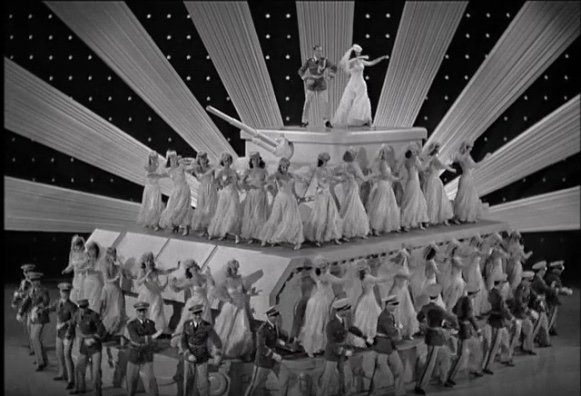
Cole Porter wrote ‘Dream Dancing’ and ‘So Near And Yet So Far’ for musical comedy You’ll Never Get Rich (1941), the Fred Astaire/Rita Hayworth vehicle that made Hayworth stratospherically famous. In its film context, ‘Dream Dancing’ is a blink-and-you’d-miss-it instrumental backdrop to a dinner dance attended by the protagonists. ‘So Near And Yet So Far’ is a killer showpiece rhumba danced by the two, with vocals from Astaire, presented as if in dress rehearsal towards the film’s finale extravaganza.

Within both songs, the object of desire is a fantasy: thrilling, distant, unreachable.

‘Dream Dancing’ narrates a person meeting their lover again in the reverie of sleep. Its interpretive possibilities are numerous. In Marlene VerPlanck’s lively and increasingly agitated version, sleep promises agonising separation. By contrast, this witty live performance by Mel Torme and George Shearing serves up unrequited passion, its melancholy becoming transmuted into frolicsome imaginary fun. Tony Bennett and Bill Evans’s stunning interpretation suggests the sadness of loss assuaged by dreams. Its aching optimism sets off the words of the verse: ‘When shades enfold / The sunset’s gold / And stars are bright above again / I smile, sweetheart / For then I know I can start / To live again, to love again.’

‘So Near And Yet So Far’ is more straightforwardly about someone playing hard to get.

Only a handful of artists have recorded it since 1941, largely sticking with the song’s original Latin feel. My favourite is Fred Astaire’s 1952 recording with Oscar Peterson, a more intimate, conversational rendition than his 1941 performance, relocating the verse and its dubious rhyme of ‘going native’ with ‘co-operative’ to mid-way through the song.

‘So Near And Yet So Far’ is an example of a latune, ‘a tune with a Latin beat and an English-language lyric’, a hybrid form keenly pursued by Cole Porter and many other popular songwriters during the twentieth century. In his fascinating history of the genre, Gustavo Perez Firmat contemplates its ambivalence:

Like Fred and Rita’s rhumba in You’ll Never Get Rich, this type of song is “so near” to and yet “so far” from indigenous Cuban music, for while the rhythm may transport us to Havana, the lyric strands us in the United States. […] Whether applied only to Cuba or to Latin America as a whole, atmospheric Latin Americanism is a mode of intimacy, a mechanism for cultural appropriation that, paradoxically, has the effect of keeping the appropriated object at a distance.

Rita Hayworth was herself a ‘Hollywood Latina’ of Spanish and Irish descent whose career was marked by an ‘evolution from dark-haired señorita to all-American strawberry blonde’. Priscilla Peña Ovalle interprets the self-possessed sexuality of Hayworth’s character in You’ll Never Get Rich in terms of this public transformation: ghosted by Hayworth’s perceived origins, the character is pitched to land ‘somewhere between virgin and siren’.

The plot of You’ll Never Get Rich is curious. The mutual admiration felt between choreographer Robert Curtis (Astaire) and dancer Sheila Winthrop (Hayworth) becomes a convoluted love story when Robert’s boss Martin Cortland (Robert Benchley) tries to hit on Sheila with a diamond bracelet – much to the chagrin of his wife Julia (Frieda Inescort), the theatre’s legal owner.

To ward off divorce, Robert agrees to pretend the gift was actually from him. Cue a sequence of misunderstandings consequent upon Martin’s catting around, compounded when Robert is conscripted and assigned to an army base overseen by Sheila’s boyfriend Captain Tom Barton (John Hubbard). Seeking to win her heart, Robert casts Sheila in a big show he is asked to stage for the troops, and egregiously commissions a real justice to marry them amidst a big theatrical wedding. Astonishingly, Robert’s deception ceases to be a problem for Sheila when another misunderstanding is cleared up. In the end he and Sheila are happily united.

Though these beautiful songs describe fantasy, the film in which they appear is an odd combination of escapism and pragmatism. Sheila has money, dances for fun rather than a wage, speaks her mind, expresses her desire, exploits her femininity when the occasion demands it. The war is not immediately threatening. Various characters take wearied jabs at the institution of marriage, yet a marital union is the film’s inevitable end, on the back of this extraordinary spectacle.

You'll Never Get Rich 2

And for the most part, the key female characters – a shrewd and capable dancer, a wronged wife, a many-times-married aunt – are strong, economically independent and well able to see through the men’s idiotic ruses towards romantic seduction. With its layers of exoticism, the story is so near and yet so far from idealism and mystery.

4: Gee, Baby, Ain’t I Good To You (1929)

This song assumes many guises.

‘Gee, Baby, Ain’t I Good To You’ was written in 1929 as a collaboration between bandleader Don Redman and songwriter Andy Razaf. Its lyrics present a person contemplating love and fidelity, and the furs, cars and jewels they give to their significant other as token and guarantee. Recorded first in New York under the name of Redman’s band, McKinney’s Cotton Pickers, in a session featuring a host of Harlem jazz luminaries, Redman performed the lyrics himself.

It’s since been recorded hundreds of times, most recently in a live set by Jeff Goldblum and the Mildred Snitzer Orchestra, with a virtuosic vocal performance by Haley Reinhart which builds from quiet seduction to full-throated euphoria.

In his beautiful biography of Andy Razaf, Barry Singer discusses the ‘pristine craftsmanship’ of the song and its multidimensionality.

‘Ain’t I Good To You?”s lyric question – “Gee baby, ain’t I good to you?” – was in many ways a perfect blues phrase: bittersweet, wry, and plaintive all at once, a question that readily absorbed whatever emotional experience a singer might bring to it – insistence, recalcitrance, determination, despair – the range of possible inflection was endless.

Jose James’ powerful version of the song uneasily suggests control masquerading as love. Redman’s original spoken word performance seems a milder, more hesitant variation on that theme. Meanwhile, Nat King Cole’s 1944 interpretation is kindly and vulnerable: his character sounds like a soft touch being taken for a ride in a situation that will not end well, as the song’s discordant finish hints. In Peggy Lee’s version, her wistful vocal performance is in dialogue with spiky piano improvisation, as if it’s her guy arguing with her, wriggling to get free. Ella Fitzgerald and Louis Armstrong’s duet, which tweaks the lyrics, presents a fiery conjugality in which a couple showers one another with gifts. Two additional lines conclude the song: ‘Get me paying taxes of what I gave to you / Gee baby, ain’t I good to you’.

This handful of versions toys with constraints of gender, money and power, exposing the torturous difficulty of human connection. A universe of possibility lives in the song.

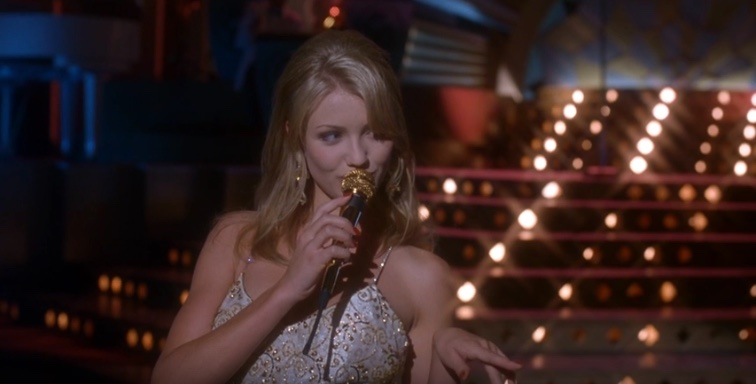
At YouTube links to these recordings, references to the problematic Jim Carrey movie The Mask (1994) pop up repeatedly in the comments – ‘SSSSSSSSSSOMEBODY STOP ME! SSSSSSMOKIN”, ‘Just watched The Mask and it brought me here :-)’. Having never seen the film in full before, I didn’t know that mid-way through The Mask is a performance of ‘Gee, Baby, Ain’t I Good To You’ by Cameron Diaz, dubbed by vocalist Susan Boyd.

Mask 9

Carrey stars as Jekyll and Hyde character Stanley Ipkiss, a downtrodden bank clerk living in the Chicago-like Edge City. His accidental acquisition of the magical mask of Loki transforms him into the libidinal Mask by night, unleashing his subdued inner self, which to this point has been given expression only through his fandom of Tex Avery cartoons. (This recent Den of Geek post interprets the film as a parable of alcohol consumption.)

Ipkiss has developed a crush on singer Tina Carlyle (Diaz) thanks to her rain-drenched visit to his bank on a reconnaisance mission for her gangster boyfriend Dorian, who intends to rob the bank as part of a larger city takeover. Hearing that she will give a performance, Ipkiss transforms into the Mask to gain entry to the exclusive Coco Bongo, the club where Carlyle works and Dorian is based, having robbed the bank himself first to pay for his night out.

https://www.youtube.com/watch?v=GlarHBBQ5tA

From the stretch limo that carries the Mask to the club, to Diaz’s appearance onstage and his racy response, the scene draws heavily on the Tex Avery animation ‘Red Hot Riding Hood’ (1943) which appeared earlier in the film, a short which jazzes up Little Red Riding Hood.

https://vimeo.com/218354742

Where ‘Red Hot Riding Hood’ satirises the male gaze, The Mask fully signs up to it, and nowhere more explicitly than in this scene. Red Riding Hood’s performance of Bobby Troup’s ‘Daddy’ (1941), a song about getting and being given fancy stuff, begins sweetly and becomes increasingly physically exaggerated, even grotesque. In The Mask, the opposite is the case: here, ‘Gee, Baby, Ain’t I Good To You’ manifests as a story of male satisfaction, and the vehicle for the consistent presentation of Cameron Diaz’s body as alluring temptation. With a lyrical adjustment – ‘I know how to make a good man happy, I treat you right / With lots of love just about every night’ – the overwhelming visuality of the scene veils the delicate ambivalence of Redman and Razaf’s composition about love and gifts.

3: Peel Me A Grape (1962)

This song has many layers.

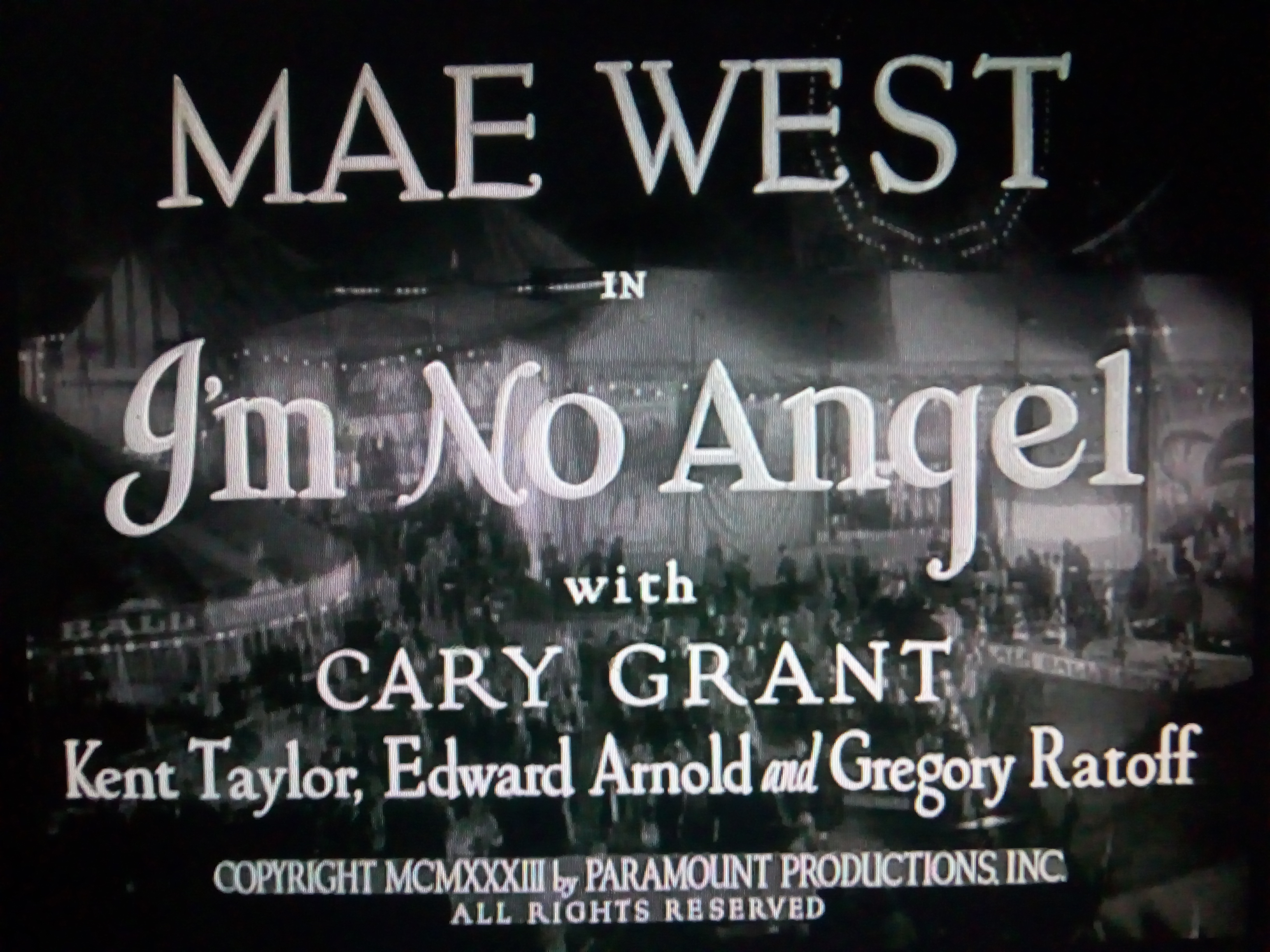
The phrase ‘peel me a grape’ was Mae West’s invention, an ad-libbed wisecrack rattled off by her character Tira, the brassy protagonist of I’m No Angel (1933).

First recorded by Anita O’Day and Cal Tjader nearly thirty years later, Dave Frishberg’s ‘Peel Me A Grape’ consists of a list of splendid demands made by a woman to a lover. She wants Scotch on delivery, polar bear rugs, peach fuzz for a pillow. “Here’s how to be an agreeable chap”, she explains. “Love me and leave me in luxury’s lap.” In case of any doubt as to who is calling the shots: “When I say do it / Jump to it.” Peel me a grape: gratify my fancies. Immediately.

Frishberg wrote the song in response to a request for “a cute, sexy piece” for singer Fran Jeffries (magnificent in The Pink Panther (1963)). The New Yorker‘s Whitney Balliett celebrated how Frishberg’s post-war composition “laughs at social ennui”. Listening to it with my female ears, a comic jab at baby boomer boredom doesn’t immediately strike me as its main thing. I hear power play and not only the obvious one.

To that extent, the story of Mae West’s I’m No Angel is fully written into the song’s DNA.

IMG_20190202_144934

Tira is a hustling circus dancer. Her ascent to the big time through a daring lion-taming act delivers her personal wealth, access to the well-to-do, and ultimately Jack Clayton (Cary Grant), with whom she falls passionately in love.

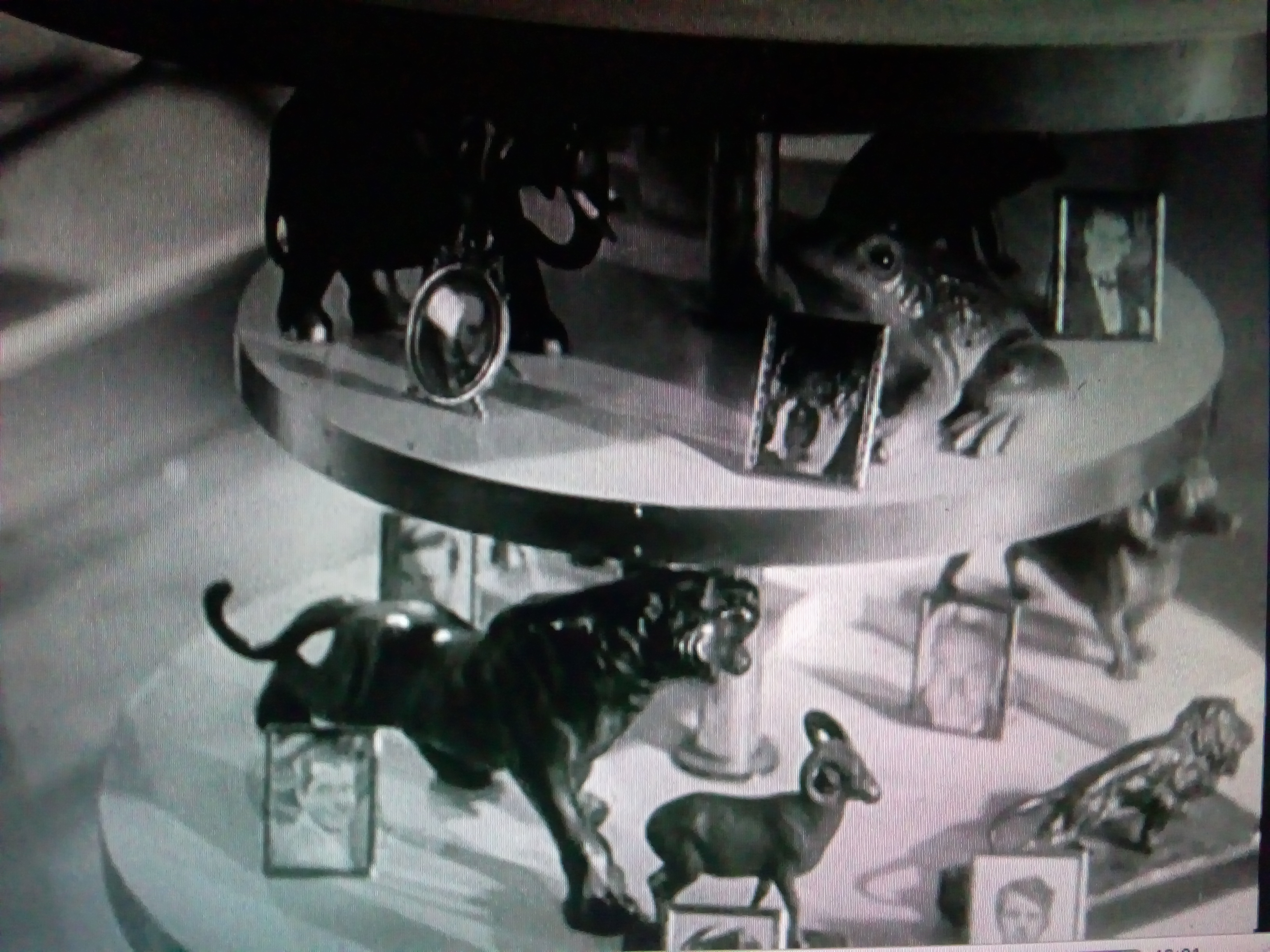
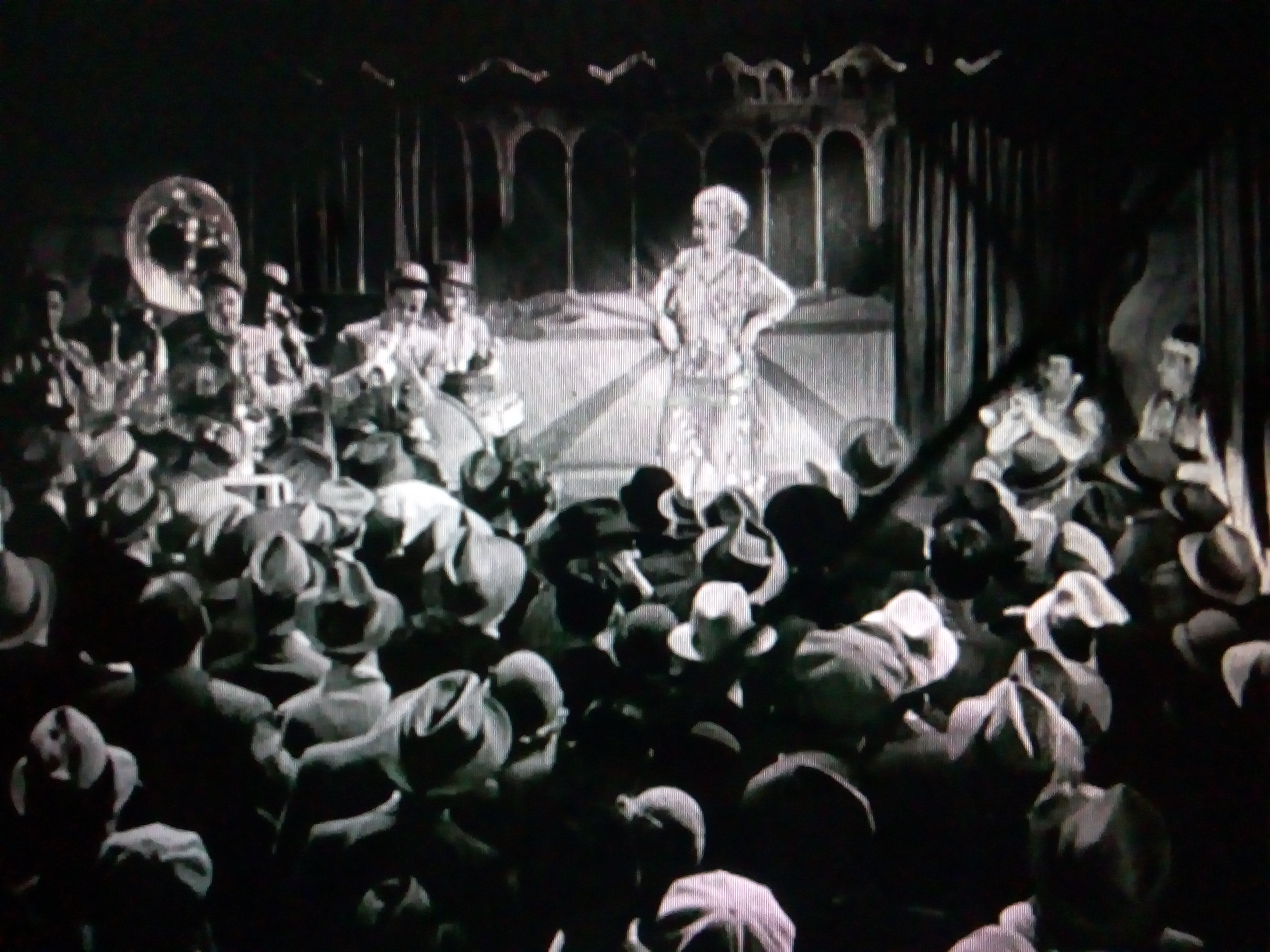
Encountering baying hordes of men who crowd in tents to watch her dance, and later, in her dealings with high society, Tira is feisty and funny. She navigates the many bear traps of a society hostile to sexually and economically independent women, and works her advantages. In respect of men, she is both huntress and hunted. Her astrological sign is Leo the Lion. Her meetings with lovers and her interactions with the circus lions share the frisson of physical danger. Meanwhile, she labels the gifts of clothing, jewellery and trinkets she receives from her conquests with their images, a kind of sexual taxonomy. This shot of animal ornaments couldn’t really be clearer on the issue.

IMG_20190202_161624

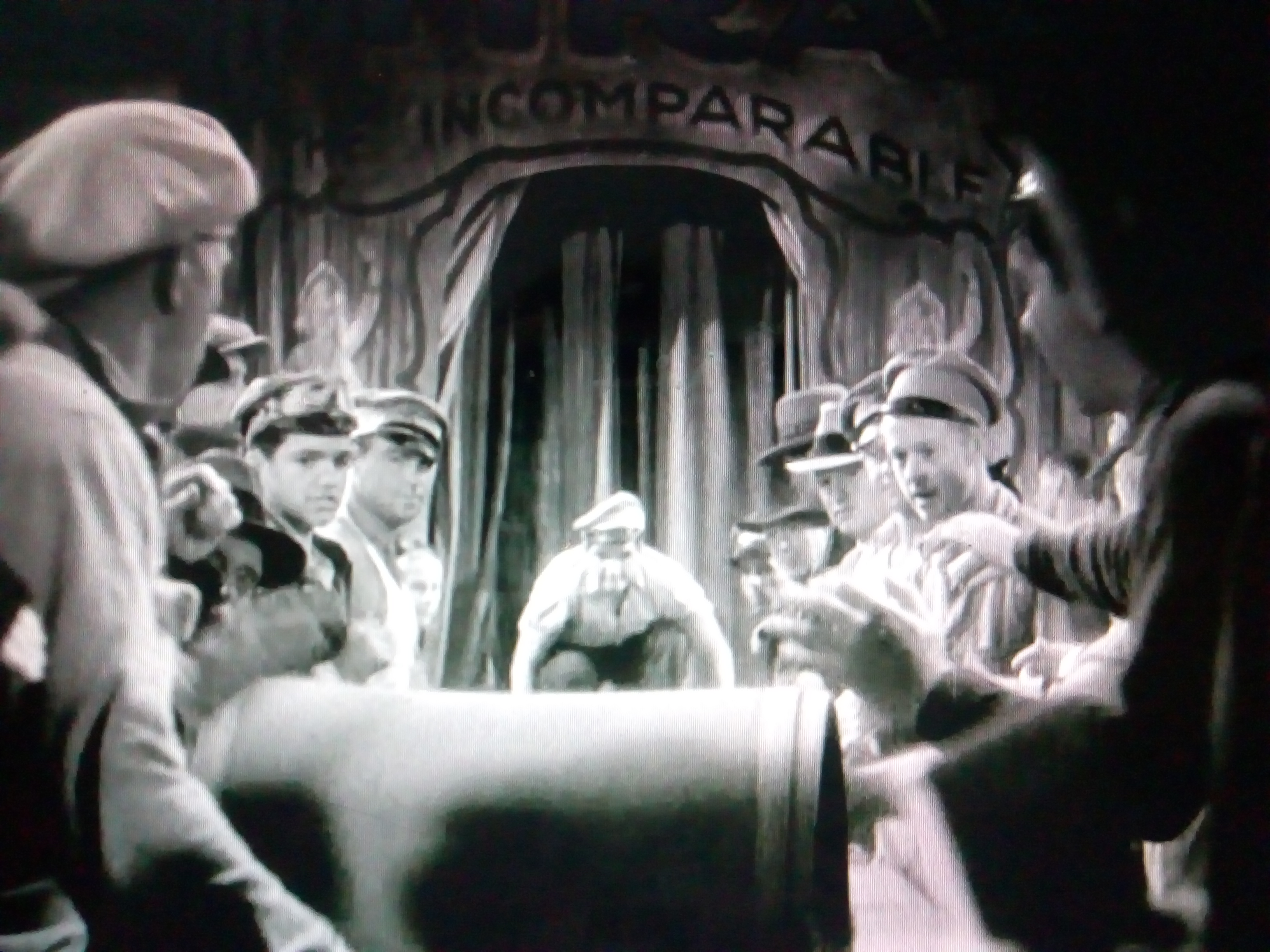
The hunt, and the evasion of capture, each involve theatre. Tira is spectacular. She’s introduced with stagehands rolling out a catwalk carpet –

IMG_20190202_145358

– and in performance, her costume gestures towards nudity.

IMG_20190202_145645

Exiting the stage following her dance, she purrs “Am I makin’ myself clear, boys?” – and approaching the wings, mutters smilingly to herself: “Suckers.” As she advises an unhappy fellow showgirl, to whom she donates one of her many necklaces: “Take all you can get, and give as little as possible.” Asked by rich showgoer The Chump whether she believes in marriage – this from a five-times, still married man who grasps at her body greedily – she quips: “Only as a last resort.”

The song’s catchy title appears mid-way through the film, in a scene in which society girl Alicia attempts to bribe Tira to leave her fiance alone with cold, hard cash. In disbelief at her idiotic complicity and snobbish rudeness, Tira shoves Alicia out of the door. Turning back to her apartment, Tira marks her victory by issuing this instruction to one of her African American maids:

“Oh Beulah.”

“Yes ma’am?”

“Peel me a grape.”

https://www.youtube.com/watch?v=FeRm1T9V5wc

Patricia Spears Jones unfolds the objectionable racial politics of this moment of class domination, against the desperate backdrop of the 1930s, and in complex tribute to ‘Miss Lil’, in an extraordinary poem dedicated to Gertrude Howard, the actress who played Beulah.

‘Peel Me A Grape’ isn’t talking about this episode of course, but it is about subordination. Though a demanding woman is its protagonist, I can’t help but hear as strongly the structural power of the man who is buying the mink furs and champagne.

Interpretations of the song slip and slide into a theatricality that spins the given role, plays with domination and submission, just as Mae West’s Tira negotiates her way through life. Anita O’Day sings with a sly smile in her voice. Patti LaBelle delivers a huge cabaret performance that entirely withholds access to an inner life (and, like O’Day’s, finishes up with some talk of grape varieties). Blossom Dearie performs shallow entitlement. Nancy Wilson offers the seasoned, non-serious voice of experience. In Ariana Savalas‘ hot interpretation, she whispers burlesque-ly. But the one that really gets me is Diana Krall‘s. Her delivery is tough, her piano solos alive with wit. Yet when she sings the line “Just hang around” quite quietly, the situation suddenly seems very lonely.


1: My Future Just Passed (1930)

This beautiful song has a dark heart.

Shirley Horn’s dreamy version, recorded in 1963, leads the listener gently into the woods: an idle fantasy about a man encountered by chance escalates to stalkerish obsession. Her phenomenal interpretation of this song made me want to start this blog.

Yikes, I thought, when I first listened to it in 2014. The character is decisive, even powerful, which makes it all the more unsettling. At the time I was reading Muriel Spark’s The Driver’s Seat (1970), which may or may not have had something to do with how I received it.

It wasn’t initially written to be sung by a woman.

‘My Future Just Passed’ was written by Richard A. Whiting and George Marion Jr. for musical comedy film Safety in Numbers (1930). The musical linchpin of the film, the song features as an instrumental overture accompanying the opening credits, and as a duet between its romantic protagonists.

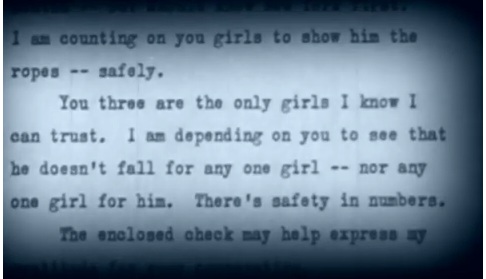
Naive young heir William Butler Reynolds (Charles ‘Buddy’ Rogers) arrives to New York City from the west, packed off by his uncle (Richard Tucker) to gain some practical knowledge of life. As he explains to his nephew in not so many words, the aim is to ensure that he doesn’t ultimately piss all of his gigantic fortune up the wall in nightclubs when he comes of age. In a letter, the uncle tasks Jacqueline (Kathryn Crawford), Maxine (Josephine Dunn) and Pauline (Carole Lombard), three Follies chorus girls, with introducing him to the city.

safety in numbers

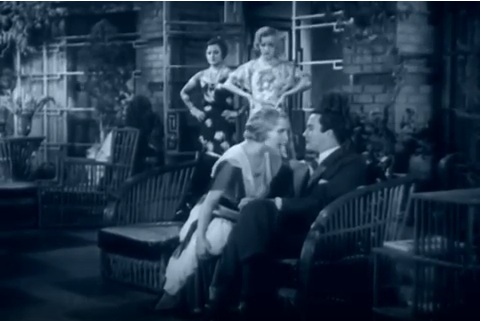
The girls cohabit stylishly in a palatial Art Deco apartment with two servants. (The IMDb bio of Louise Beavers, who plays housekeeper Messalina, is amazing reading.) Their guest immediately demonstrates his maximal unworldliness. He drops his entire allowance on gifts of jewellery for them all, is unable to recognise a bra when confronted with one resting on a chair, and so on. But suddenly he discovers untapped Casanova potential, charming each girl in turn through song. They duly fight over him, abandoning their urbane shrewdness, yet also band together to protect him from the advances of other predatory chorus girls.

safety in numbers 2

In a move that is only surprising if you forget that the film is basically about heteronormative training, these independent performers also allow the inexperienced youth to negotiate salary on their behalf with their show’s producer.

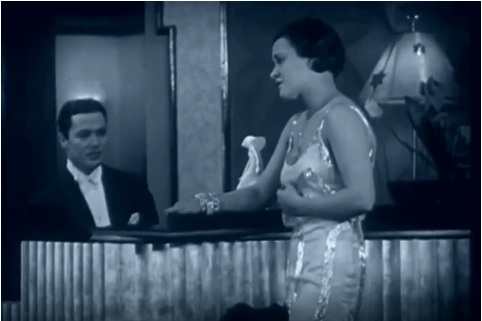
Safety in Numbers inevitably resolves with a match: though barely any conversation seems to have been exchanged, Reynolds and Jacqueline have fallen in love.

safety in numbers 3

‘My Future Just Passed’ is Reynolds’ declaration of love for Jacqueline, followed by her mournful solo reply (here, at 1:04:55). The first chorus’ stride piano is laden with sentimentality. The song overall is anodyne. The film has made Reynolds the centre of its universe, and the girls orbit around him, so this is standard love story stuff: boy pledges undying affection to vacillating girl, and he will sever her existing “ties”, win out for sure.

In the year in which the film came out, Annette Hanshaw released a single version of ‘My Future Just Passed’ that combines Reynolds’ lyrics with additional choruses. Shirley Horn’s much later version uses these additional lyrics, but removes the cheeky verse about playing the field as a young person, and the chorus with references to school.

In Hanshaw’s version, the inclusion of the verse sets the song up as a tongue-in-cheek story of teenage flirtation and preoccupation. Her wry performance refuses to take the song’s romantic narrative seriously. She concludes the whole thing archly with a catlike ‘that’s all!’ Compared to the film’s presentation of the song, this rendition is positively subversive.

Meanwhile, Shirley Horn’s interpretation puts blissful instrumentation next to fatalistic obsession. We get to listen in on her character’s dicey inner life in the midst of sweeping strings. This juxtaposition makes the song’s theatrical metaphors pop. “Ring down the curtain, I’m certain at present / My future just passed” and “Here are my arms, may he find illusion there / Kiss my two lips, remove all the rouge on there”, sung by Horn with languid smoothness, troublingly emphasise the constructed relation between femininity and artifice. Magical thinking, manipulation, and a hopeful wish for the physical contact that would wipe lipstick traces clean away: pretty bleak. A dark heart, but so beautiful.