This song is quite something.
The transportative harmonies of Ahmad Jamal’s beautiful recording on Ballades (2019) suggest ‘So Rare’ to be a standard as beloved as Sammy Cahn, Axel Stordahl and Paul Weston’s ‘I Should Care’ (1944), also covered on that album. Not so: although it has topped the charts more than once, it’s actually sort of overlooked. Finding out more about it has been akin to an archaeological dig. Put together, its various pieces produce a totally unexpected picture, but one that (surprise surprise) nonetheless traces out contours of gender, ancient and modern. It is a trip.
Written by Jerry Herst and Jack Sharpe, ‘So Rare’ is a rhapsody of love. It is jam-packed with images of heavenly hosts, exotic flowers, ethereal classical compositions and, most weirdly, the American flag. It was first recorded in 1937, no fewer than seven times that year, in various big band interpretations for dancing the foxtrot. Guy Lombardo and his Royal Canadians made it number one on popular radio show Your Hit Parade in the week of 11 September 1937. Then it was barely touched until 1957 – another bonanza year for the song, which saw the release of Jimmy Dorsey’s brash big band recording.
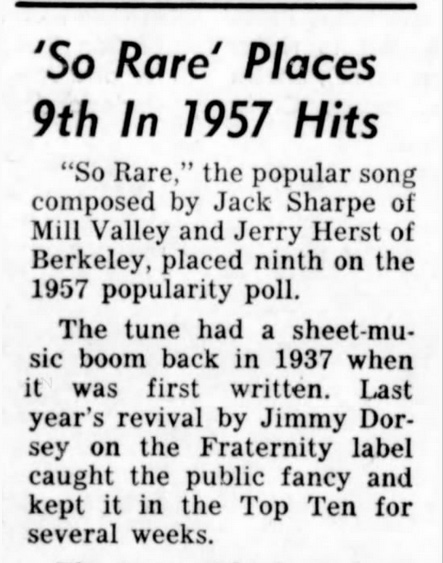
Daily Independent Journal, San Rafael, California, 1 February 1958. https://www.newspapers.com/clip/3844368/jack-sharpe-1958/
Dorsey’s smash hit trailed several similar to near-identical arrangements in its wake – from Jimmy Carroll (1957), Billy Vaughn (1958), Les Brown’s Band of Renown (1960), Bill Black’s Combo (1964), and Willie Mitchell (1967).
Dorsey deletes most of the song’s lyrics. A raunchy saxophone solo takes the melodic lead in the A sections, while a chorus performs its first B section – the only words to appear.
You are perfection
You’re my ideal
You’re angels singing the Ave Maria
For you’re an angel
I breathe and live you
With every beat of the heart that I give you
Horns en masse deliver the second B section, while the chorus ‘do-do-doos’ along. The evil genius of this arrangement is in its juxtaposition of lyrics about putting virgins on pedestals, seductive sax, rasping horns, and a savage drum beat and tempo identical to that used in David Rose and his Orchestra’s ‘The Stripper’ (1962) (written in 1958) – both enactment and refusal of the nightmare Madonna-whore dichotomy that continues to be the bane of women’s lives.
In vocal recordings including more of the song’s lyrics, things take a series of different turns.
In full, ‘So Rare’ has a verse, and AABA twice over, with different lyrics each time around – one set normatively for a male voice (“You’re like the fragrance of blossoms fair / Sweet as a breath of air”), and the other for a female voice (“You have the warmth of a Schubert air / Charming and debonaire”), as if for a duet. The small number of vocalists who have tackled it (no duets) have picked and chosen between them. Ella Fitzgerald and Betty Johnson‘s gentle versions subversively go for the ‘male’ set, while Mavis Rivers rocks the ‘female’ set. So too does Vera Lynn‘s sentimental rendition, but – presumably on the basis of nationality – she rewrites the triumphalist second B section lines “You have that something, that certain manner / You thrill me more than the Star Spangled Banner”. Bing Crosby and Don Cherry weave those in, to all-American patriotic effect, while Andy Williams does not.
The two films that have used ‘So Rare’ in their soundtracks bring twenty year time lags, masculinity, femininity, and visions of America together in the most unlikely way.
Return to Macon County (1975) sees teenagers Bo (Nick Nolte, at least 33) and Harley (Don Johnson, 25) attempt to drive from Georgia to California in a ’57 Chevy to participate in a drag race. It is 1958. En route, they pick up manic pixie dream girl Junell (Robin Mattson), who, having been subject to harassment flirted with by the two in the roadside diner where she works, abandons her job to join them on the road. The film is like a less edgy Two-Lane Blacktop (1971), with couply scenes between Bo and Junell set in derelict and abandoned buildings that echo Rebel Without a Cause (1955).


Dorsey’s ‘So Rare’ is background to a motel room encounter between Harley and a random girl – full frontal, so we know she’s expendable – which only works for Harley when they head out to have sex in the car.
For Roger Ebert, this film was textbook nostalgia for the 1950s.
Ike and the rest of the adults were riled up about dragracing and juvenile delinquents, but 1958 was really a fairly innocent time, youth wise, and the characters in this movie would be chewed up in the first 10 minutes of a late 1960’s motorcycle picture, not to mention a contemporary ghetto violence exploiter.
Hustle (1975) is also preoccupied with the 1950s, but as the rotten foundation of the corruptions of the 1970s.


Lieutenant Phil Gaines (Burt Reynolds) is a Los Angeles cop, whose live-in lover Nicole Britton (Catherine Deneuve) is a high-end sex worker. He becomes embroiled in a case involving the death of young stripper Gloria Hollinger (Colleen Brennan), which her father Marty (Ben Johnson) refuses to accept as suicide. The film reveals the past as the seedbed of the present’s problems, all incubated in LA’s amorality. War trauma induced sexual apathy in Marty, thus infidelity in his wife Paula (Eileen Brennan), and thus a daughter who turned to sex work to cater to her insatiable desire for consumer goods – dysfunction as enmeshed as LA’s freeways, where ‘So Rare’ is introduced.

Dorsey’s recording blasts from Gaines’ car, inaccurately trailed by an announcer: “For those of us who were alive in 1955, ‘So Rare’.”


Gaines repeats: “‘For those of us who were alive in 1955’. Christ.” His partner Sergeant Louis Belgrave (Paul Winfield) replies: “1955! That’s the year this little girl was born.” Gaines: “Yeah. Twenty years later, tissue specimens in a jar.” This dialogue about a twenty year old woman is the thin end of the wedge of the film’s misogyny, which is not inconsiderable. Idealised purity pitched against degradation: a vicious and enduring contrast.
 People Think This Is Romantic